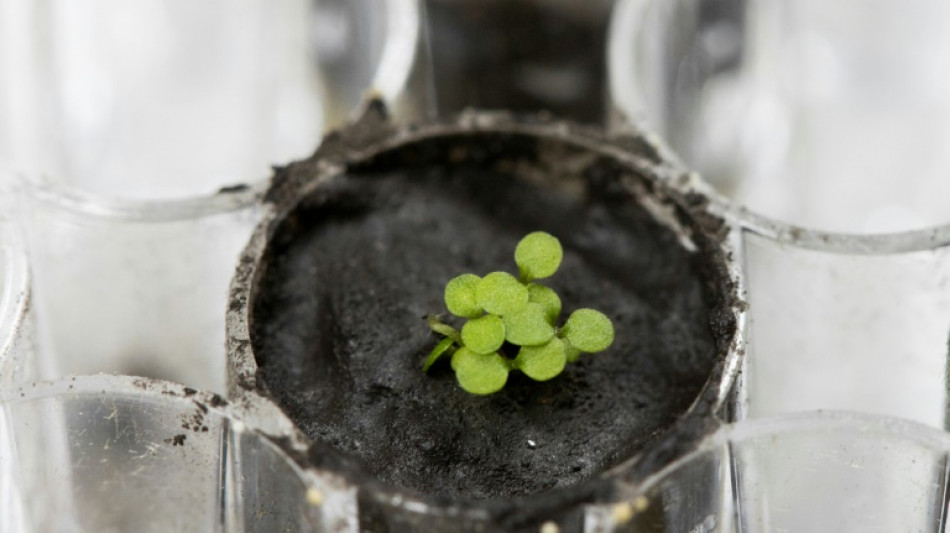
Scientists successfully grow plants in soil from the Moon / Photo: Tyler JONES - UF/IFAS Communications/AFP

 Lights out in Laos as electricity exports surge

 Steven Strogatz weighs AI mathematics advances and their consequences for researchers

 Anthropic boss calls for AI slowdown, Altman and Musk agree

 French IT giant Capgemini sells subsidiary after row over ICE links

 Quebec Brokerage Qubit Insurance Announces New Data on Coverage Shortfalls as Rebuilding Costs Rise

 Lady Gaga welcomes first child with fiance: US media

 Bhutan business bets on hazelnuts for farming future

 'Widow's Bay' and 'The Pitt' are favorites for Emmys night

 Coastal erosion forces cancellation of California music festival

 Argentina's Dirty War rears its head in Venice film

 UK lawmakers throw out bill to legalise assisted dying

 US inflation steady in August, fueling Fed rate hike expectations

 New York marks 25th anniversary of 9/11 attacks

 Nepal flood reconstruction bill to be $4.78 bn: foreign ministry

 JUMO and Standard Bank launch Social Finance Framework to scale inclusive finance in Africa

 Doomsday tech: could AI really kill us all?

 French comedy show 'Call my agent' makes film comeback

 It's all coming back: Celine Dion fans gear up for Paris return

 Researchers eye AI revolution in natural disaster forecasts

 US braces for inflation report that may push Fed to hike rates

 Musk threatens legal action over documentary

 Latin America fact-check group asks Meta not to replace verification practice

 AI Risks to Enter 60–80% of Liability and Cyber Insurance Underwriting by 2028, ScienceSoft Predicts

 Tribal Launches Campfire, Letting Business and Technical Teams Build on Salesforce Together

 Stocks fall as fresh oil surge fans inflation fears

That's one small pot of soil, one giant leap for man's knowledge of space agriculture: scientists have for the first time grown plants in lunar soil brought back by astronauts in the Apollo program.
The ground-breaking experiment, detailed in the journal Communications Biology on Thursday, has given researchers hope that it may be possible to one day grow plants directly on the Moon.
That would save future space missions much hassle and expense, facilitating longer and farther trips.
However, according to the study's University of Florida authors, much remains to be studied on the topic, and they intend to leave no stone unturned.
"This research is critical to NASA's long-term human exploration goals," said Bill Nelson, the head of the US space agency. "We'll need to use resources found on the Moon and Mars to develop food sources for future astronauts living and operating in deep space."
For their experiment, the researchers used just 12 grams (a few teaspoons) of lunar soil collected from various spots on the Moon during the Apollo 11, 12, and 17 missions.
In tiny thimble-sized pots, they placed about a gram of soil (called "regolith") and added water, then the seeds. They also fed the plants a nutrient solution every day.
The researchers chose to plant arabidopsis thaliana, a relative of mustard greens, because it grows easily and, most importantly, has been studied extensively. Its genetic code and responses to hostile environments -- even in space -- are well known.
As a control group, seeds were also planted in soil from Earth as well as samples imitating lunar and Martian soil.
The result: after two days, everything sprouted, including the lunar samples.
"Every plant -- whether in a lunar sample or in a control -- looked the same up until about day six," Anna-Lisa Paul, lead author of the paper, said in a statement.
But after that, differences started to appear: the plants in the lunar samples grew more slowly and had stunted roots.
After 20 days, the scientists harvested all the plants, and ran studies on their DNA.
Their analysis showed that the lunar plants had reacted similarly to those grown in hostile environments, such as soil with too much salt, or heavy metals.
In the future, scientists want to understand how this environment could be made more hospitable.
NASA is preparing to return to the Moon as part of the Artemis program, with a long-term goal of establishing a lasting human presence on its surface.
A.Leibowitz--CPN