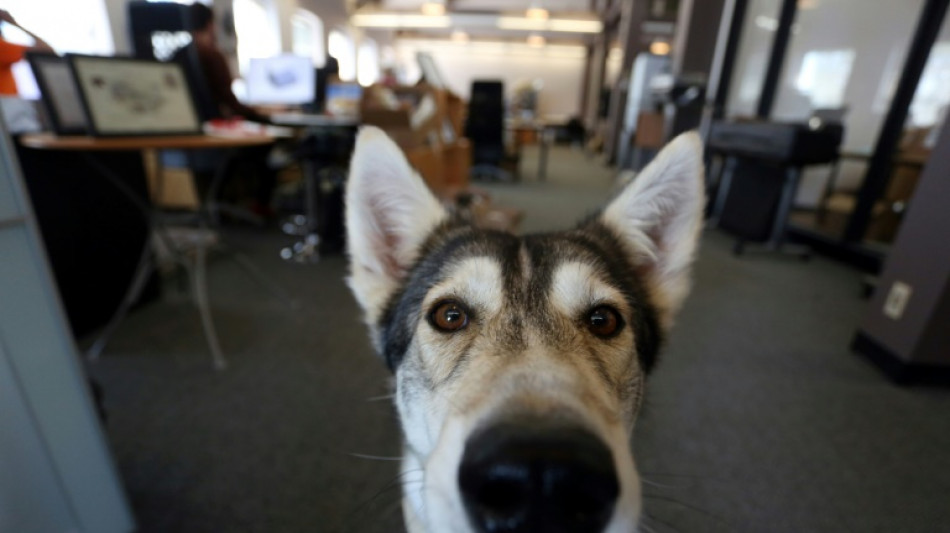
Canadian offices going to the dogs as work-from-home ending / Photo: Dave Chan - AFP

 Lights out in Laos as electricity exports surge

 Steven Strogatz weighs AI mathematics advances and their consequences for researchers

 Anthropic boss calls for AI slowdown, Altman and Musk agree

 French IT giant Capgemini sells subsidiary after row over ICE links

 Quebec Brokerage Qubit Insurance Announces New Data on Coverage Shortfalls as Rebuilding Costs Rise

 Lady Gaga welcomes first child with fiance: US media

 Bhutan business bets on hazelnuts for farming future

 'Widow's Bay' and 'The Pitt' are favorites for Emmys night

 Coastal erosion forces cancellation of California music festival

 Argentina's Dirty War rears its head in Venice film

 UK lawmakers throw out bill to legalise assisted dying

 US inflation steady in August, fueling Fed rate hike expectations

 New York marks 25th anniversary of 9/11 attacks

 Nepal flood reconstruction bill to be $4.78 bn: foreign ministry

 JUMO and Standard Bank launch Social Finance Framework to scale inclusive finance in Africa

 Doomsday tech: could AI really kill us all?

 French comedy show 'Call my agent' makes film comeback

 It's all coming back: Celine Dion fans gear up for Paris return

 Researchers eye AI revolution in natural disaster forecasts

 US braces for inflation report that may push Fed to hike rates

 Musk threatens legal action over documentary

 Latin America fact-check group asks Meta not to replace verification practice

 AI Risks to Enter 60–80% of Liability and Cyber Insurance Underwriting by 2028, ScienceSoft Predicts

 Tribal Launches Campfire, Letting Business and Technical Teams Build on Salesforce Together

 Stocks fall as fresh oil surge fans inflation fears

Daisy moseys over to greet visitors, her tail wagging. She's listed as chief morale officer on Tungsten Collaborative's website, and is among the many pets joining their owners returning to Canadian offices after working from home through the pandemic.
The 12-year-old Lab sniffs for treats. Before long, a Basset Hound named Delilah waddles over, offering up her belly for a rub, along with other four-legged colleagues Eevee the Greyhound and German Shepherd puppy Hudson, who lets out a bark.
Daisy's proficiencies include "stress management" and "client engagement," according to her biography, which notes that many of the industrial design studio's "greatest innovations can be traced back to a long walk" with her.
"We encourage people if they have pets to bring them (to work)," Tungsten president Bill Dicke, 47, said in an interview with AFP.
"You develop this relationship being at home with your pet on a day-to-day basis and all of a sudden you go back to work, so now they have to be crated for the day or roam the house alone, it's not fair to them," he opined.
"The tolerance for pets (at work) during the pandemic has increased," he added.
These dogs sleep under desks or in the boardroom throughout the day, chase balls down a hallway or chew squeaky toys. There's a row of water bowls in the office kitchen, if they get thirsty.
The Ottawa company is listed by the Humane Society as dog-friendly, and it's actually helped drum up business, Dicke said, as well as increased staff productivity.
Workers are forced to take regular breaks for dog walks instead of "eating lunch at their desk," for example, and are not fretting about their pet being left alone at home, he explained.
According to a recent Leger survey for PetSafe, 51 percent of Canadians support bringing dogs to the office.
Younger workers were the most supportive, with 18 percent of those aged 18 to 24 years saying they would change jobs if their employer refused to allow them to bring their pet to work.
With an estimated 200,000 Canadians adopting a dog or cat since the start of the pandemic in 2020, bringing the nationwide total to 3.25 million, it could force employers now pressing staff to return to the office to consider this option.
- 'Going to w-o-r-k' -
Johan Van Hulle, 29, joined Tungsten last year. Its dog policy, he said, "was a key part of the decision" to take the job, after working from home with Eevee.
"Allowing dogs is a good indicator" of a company's culture, he said, and the kind of "not too corporate" workplace that appeals to him.
Across town at construction joint venture Chandos Bird, people designing a nuclear research laboratory are visibly smitten by 10-year-old Samson.
His owner Trevor Watt didn't want to leave the Yorkshire Terrier alone after moving into a new house and starting work in a new office in January.
It was supposed to be a temporary arrangement until Samson got used to his new surroundings, but he endeared himself with colleagues and staff in neighboring offices, who take turns walking him.
"He loves going to work," Watt said. "When I say I'm going to w-o-r-k, he's ready to jump in the car."
Watt likes it, too. "I don't have to worry about him."
"Dogs in new environments get very anxious, when left alone," he explained. "I think a lot of new owners know that now that they've had their puppies through Covid."
If Samson needs to go out, he just puts a paw on Watt's leg. He has toys and a bed at the office, and wanders from desk to desk.
Petting him is a great way to "decompress after a tough meeting," commented Watt's boss Byron Williams.
Dogs in the workplace, however, can also create challenges, he said, such as "if somebody is scared of dogs" or allergic to dander.
One of Watt's coworkers is terrified of dogs. It was agreed with her that Samson would be leashed the days she comes to the office.
At other offices, workers surveyed by AFP lamented carpet stains, disruptive barking and pet hair or drool on clothes -- not a great look for impressing clients.
Downtown, many stores and cafes have water bowls for dogs, and several shopkeepers such as Emma Inns of the Adorit fashion boutique bring their dogs to work.
"If they're home alone, they get into trouble," she said of Rosie, Oscar and Camilla.
As store mascots, however, they're great for business.
"Everyone knows their names," Inns said. "Some people come just to see them, but then buy something."
J.Bondarev--CPN