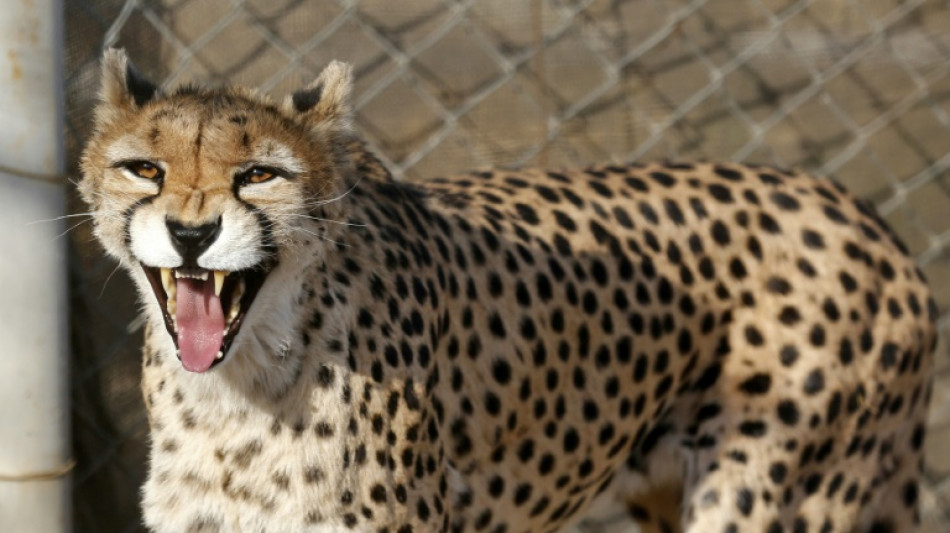
Rare birth of Asiatic cheetah cubs in Iran / Photo: ATTA KENARE - AFP

 Lights out in Laos as electricity exports surge

 Steven Strogatz weighs AI mathematics advances and their consequences for researchers

 Anthropic boss calls for AI slowdown, Altman and Musk agree

 French IT giant Capgemini sells subsidiary after row over ICE links

 Quebec Brokerage Qubit Insurance Announces New Data on Coverage Shortfalls as Rebuilding Costs Rise

 Lady Gaga welcomes first child with fiance: US media

 Bhutan business bets on hazelnuts for farming future

 'Widow's Bay' and 'The Pitt' are favorites for Emmys night

 Coastal erosion forces cancellation of California music festival

 Argentina's Dirty War rears its head in Venice film

 UK lawmakers throw out bill to legalise assisted dying

 US inflation steady in August, fueling Fed rate hike expectations

 New York marks 25th anniversary of 9/11 attacks

 Nepal flood reconstruction bill to be $4.78 bn: foreign ministry

 JUMO and Standard Bank launch Social Finance Framework to scale inclusive finance in Africa

 Doomsday tech: could AI really kill us all?

 French comedy show 'Call my agent' makes film comeback

 It's all coming back: Celine Dion fans gear up for Paris return

 Researchers eye AI revolution in natural disaster forecasts

 US braces for inflation report that may push Fed to hike rates

 Musk threatens legal action over documentary

 Latin America fact-check group asks Meta not to replace verification practice

 AI Risks to Enter 60–80% of Liability and Cyber Insurance Underwriting by 2028, ScienceSoft Predicts

 Tribal Launches Campfire, Letting Business and Technical Teams Build on Salesforce Together

 Stocks fall as fresh oil surge fans inflation fears

An Asiatic cheetah gave birth to three "healthy" cubs in Iran, the head of the environment department said Sunday, calling it a first in captivity for the endangered species.
"Iran", one of only a dozen cheetahs found in the Islamic republic, delivered three "healthy" cubs by C-section, Ali Salajegheh told IRNA news agency.
"This is the first birth of an Asiatic cheetah in captivity," he said.
"By preserving these cubs, we can increase the cheetah population in captivity and then in semi-captivity," Salajegheh added.
The world's fastest land animal, capable of reaching speeds of 120 kilometres (74 miles) per hour, cheetahs once stalked habitats from the eastern reaches of India to the Atlantic coast of Senegal and beyond
They are still found in parts of southern Africa, but have practically disappeared from North Africa and Asia.
Iran is one of the last countries in the world where the Asiatic cheetahs live in the wild and began a United Nations-supported protection programme in 2001.
The subspecies "Acinonyx jubatus venaticus", commonly known as the Asiatic cheetah, is critically endangered, according to the International Union for Conservation of Nature.
In January deputy environment minister Hassan Akbari said Iran is home to only a dozen Asiatic cheetahs -- down from an estimated 100 in 2010.
Their situation "is extremely critical", Akbari said at the time, adding that the animals have been victims of drought, hunters and car accidents.
S.F.Lacroix--CPN