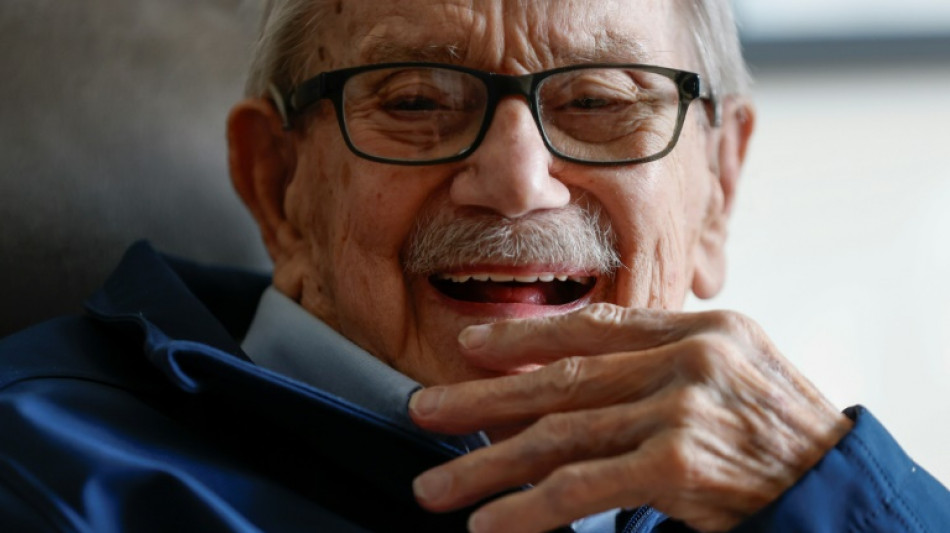
For US veteran, D-Day memories still vivid after 80 years / Photo: KAMIL KRZACZYNSKI - AFP

 Kenya's economy faces climate change risks: World Bank

 Chipmaker Kioxia reports AI-driven 45-fold surge in quarterly net profit

 Far right and far left battle for power in polarised Berlin

 The last trio: S.Africa's zoo elephants await their fate

 Oil industry sees war windfall but girds for political blowback

 Amazon beats expectations with cloud and AI growth

 Blowout Microsoft results lift US stocks as oil retreats

 'Beginning of the end': Relief but no party as French wildfire winds down

 Southern Europe 'becoming more flammable' in hotter climate, experts say

 Mammoth bones found on parched bed of Danube in Bulgaria

 MEXC Lists Grvt (GRVT) with $60,000 Worth of GRVT and 10,000 USDT in Airdrop+ Rewards

 George and Amal Clooney flee French home due to wildfire

 MEXC Ventures Supports Alpha Arena's APAC Debut at Coinfest Bali

 AI data centre supplier Zhongji InnoLight slips on Hong Kong debut

 May, June heatwaves caused 2,877 extra deaths in England: govt

 BMW profit down a third as carmaker plans job cuts

 Seoul extends losses as most Asian markets drop, oil rises again

 Gambling.com Group Is Now Grandstand

 Meet the astronomer digging into the Milky Way's 'fossils'

 AI data centre supplier Zhongji InnoLight falls on Hong Kong debut

 Samsung operating profit up 1,800% in second quarter on AI boom

 Japanese population below 120 million for first time in decades

 US actor Jared Leto denies latest accusations of sexual assault

 Danube drops to 'historic lows' as fresh heatwave hits

 BTS pulls out of Grammys after Asian pop category introduction
Richard Rung recalls it vividly: German artillery firing on his landing craft, the sound of machine gun bullets striking the vessel, blood mixed with seawater on the deck, troops crying on the beach.
It has been nearly eight decades since Rung landed in France on D-Day -- June 6, 1944 -- as a 19-year-old US Navy sailor, part of a massive amphibious invasion that broke through German coastal defenses in a key victory for Allied forces.
He now lives in a suburb of Chicago with Dorothy, his wife of 75 years, but his memories of the violence and death he witnessed half a world away are still clear, and that distant day can still feel close at hand.
"D-Day is not always, you know, a long way off," said Rung, a gray-haired, mustachioed 99-year-old wearing a blue jacket with the US Navy emblem.
"Sometimes, it's yesterday," he said. "When you have these experiences, they come back to you if you get a right situation."
- 'They opened up' -
Rung's path to Normandy began when he was drafted in 1943, choosing the Navy on the advice of his father, who urged him to "take the Navy. At least you'll be at sea, you have something to eat."
He dreamed of serving on a destroyer, but was assigned to maintain the engine on a landing craft because of his knowledge of motors gained in vocational school -- a turn of events that brought him to France.
Rung trained in the United States and then traveled by ship to Britain, where he witnessed German planes bombing London.
"Every night, they were raided," he said.
After crossing the English Channel, Rung's landing craft hit Omaha Beach as part of the second wave on D-Day, coming under heavy German artillery and machine gun fire.
"We dropped the ramp at 7:30... and they opened up on us," he said.
- 'Get down!' -
Despite the danger, he tried to see what was unfolding -- to his skipper's chagrin.
"He looked down and he said, 'Dick, get down!' I wanted to see," said Rung, who remembered hearing bullets hitting the side of the landing craft as he looked at the beach.
"The machine guns were terrible," he said. "I'll never forget the machine guns."
The ship's log -- copied in Rung's diary -- provides a clipped, military account of the landing.
"0730 Hit beach. It being well guarded received two shells from 88mm. One in starboard locker, one in skipper's quarters, one 47mm hole in starboard bulwark. Two soldiers killed two badly hurt. One 47mm through port ramp extension."
Four minutes later, the landing craft pulled back and went in search of a better site, but other spots were also heavily guarded.
Finding a location and unloading the vessel took hours, but that mission had to be completed before the wounded could be taken to a hospital ship.
- 'It was terrible' -
Rung said the landing craft's deck was "flowing in blood" from troops who were hit mixed with seawater that entered when the ramp was lowered, which crew members had to clean off later in the day.
He also recalled seeing the bodies of fallen troops and "guys... crying on the beach. It was terrible."
The landing craft carried a bulldozer for mine-clearing, but "he never made it," Rung said. "He got to the beach -- I found this out the next morning -- he hit a mine."
"If they didn't get hit with a rifle, (they) could easily step on a mine," he said.
Two days after D-Day, Rung made a gruesome discovery while ashore.
"That's when I found this big pile of arms and legs," he said, wondering how it would be possible to identify someone from those remains.
- 'Peace, not war' -
After more than two months in Normandy, Rung was sent to the Pacific, and was at Leyte Harbor in the Philippines when Japan formally surrendered on September 2, 1945.
"Nobody can imagine what a great feeling it gave us to see and know that the war was over and that the thing we have been fighting so long and hard for had finally come to pass," he wrote in his diary.
Rung was honorably discharged from the Navy in 1946, going to college with funding from the GI Bill and later teaching history and political science as a professor.
He initially "didn't say much" about his World War II experiences, thinking that might be better, but "that's a mistake," he said.
"A guy that says, 'I don't want to talk about it' -- he needs to talk about it."
Rung still sometimes speaks to high school students, urging them to "work for peace, not war."
"I want them to be conscious of the fact that being a peacemaker is the way to go," he said.
P.Petrenko--CPN