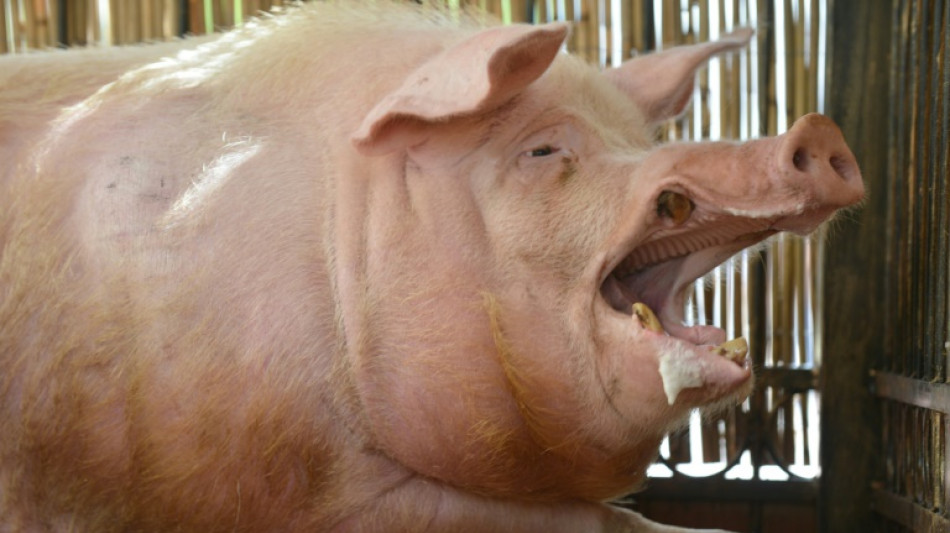
Researchers decode pigs' well-being through oinks and grunts / Photo: Sergei SUPINSKY - AFP/File

 Lights out in Laos as electricity exports surge

 Steven Strogatz weighs AI mathematics advances and their consequences for researchers

 Anthropic boss calls for AI slowdown, Altman and Musk agree

 French IT giant Capgemini sells subsidiary after row over ICE links

 Quebec Brokerage Qubit Insurance Announces New Data on Coverage Shortfalls as Rebuilding Costs Rise

 Lady Gaga welcomes first child with fiance: US media

 Bhutan business bets on hazelnuts for farming future

 'Widow's Bay' and 'The Pitt' are favorites for Emmys night

 Coastal erosion forces cancellation of California music festival

 Argentina's Dirty War rears its head in Venice film

 UK lawmakers throw out bill to legalise assisted dying

 US inflation steady in August, fueling Fed rate hike expectations

 New York marks 25th anniversary of 9/11 attacks

 Nepal flood reconstruction bill to be $4.78 bn: foreign ministry

 JUMO and Standard Bank launch Social Finance Framework to scale inclusive finance in Africa

 Doomsday tech: could AI really kill us all?

 French comedy show 'Call my agent' makes film comeback

 It's all coming back: Celine Dion fans gear up for Paris return

 Researchers eye AI revolution in natural disaster forecasts

 US braces for inflation report that may push Fed to hike rates

 Musk threatens legal action over documentary

 Latin America fact-check group asks Meta not to replace verification practice

 AI Risks to Enter 60–80% of Liability and Cyber Insurance Underwriting by 2028, ScienceSoft Predicts

 Tribal Launches Campfire, Letting Business and Technical Teams Build on Salesforce Together

 Stocks fall as fresh oil surge fans inflation fears

European researchers have developed a way of decoding the feelings of pigs through their grunts, oinks and squeals in a project aimed at improving animal welfare.
Biologists studied over 7,000 recordings from 411 pigs, from the brief squeaks of satisfaction at feeding time to the desperate cries at slaughter, before classifying them into 19 different categories.
"We show that it's possible basically to figure out the emotions of the pigs according to their vocalisations," project leader Elodie Briefer, a lecturer at the University of Copenhagen, told AFP.
The project, split between Switzerland, Denmark, Norway, France and the Czech Republic and published in the journal Nature, offers a new way of improving animal welfare by laying the groundwork for a tool that can categorise an emotion based on the noise produced, according to the researcher.
"We also run a machine learning algorithm... which produces a spectrogram, then it is trained to recognise negative and positive contexts."
Once developed, the new tool would allow farmers, who today can mostly only check the physical well-being of the animals, to monitor their mental health.
The researcher said if the negative squeals increase, the farmer would be alerted that something was wrong and could check.
The Scandinavian country is home to 13.2 million pigs -- making it the leader in Europe with over two per capita -- and for the Danish Agriculture and Food Council the implications of the study are promising.
"This concept... could potentially be a useful tool among others in the work to monitor the health and well-being of pigs," Trine Vig, a spokeswoman for the council, said.
- 'They're very vocal' -
According to Briefer they reached "92 percent accuracy of classifying the valence... (or) whether the call is negative or positive, and 82 percent accuracy in classifying the actual context in which the sounds were produced".
According to the findings, positive feelings are expressed in short grunts, while negative sentiments are most often expressed with longer sounds.
But why focus on the pig rather than a cow or a rabbit?
For the authors of the study, the pig, known for its wide range of squeaks and noises, was the perfect match.
"They're very vocal, which makes them easier to study," the researcher said.
"They produce vocalisations all the time, even in a low intensity situation, they would still vocalise."
A.Zimmermann--CPN