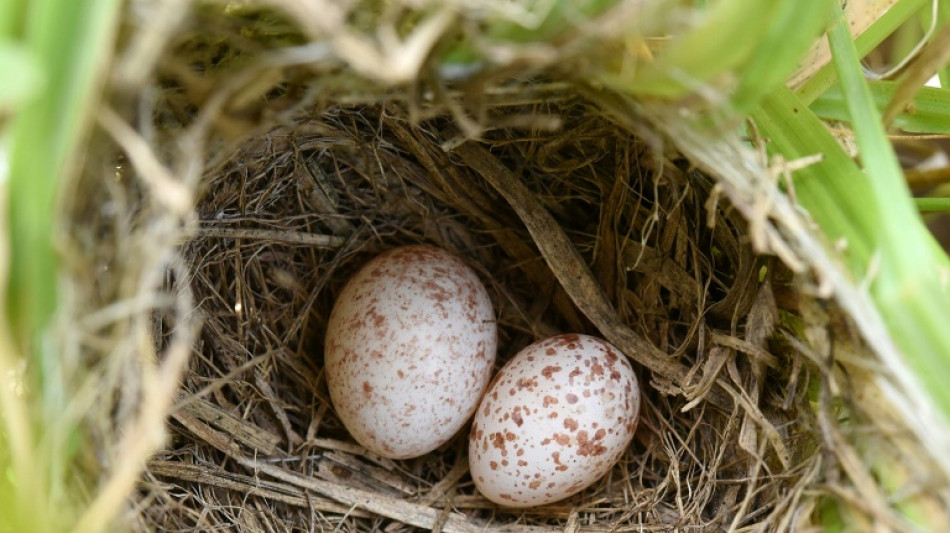
Green eggs and scam: Cuckoo finch's long con may be up / Photo: Claire N. Spottiswoode - University of Cambridge & University of Cape Town/AFP

 Lights out in Laos as electricity exports surge

 Steven Strogatz weighs AI mathematics advances and their consequences for researchers

 Anthropic boss calls for AI slowdown, Altman and Musk agree

 French IT giant Capgemini sells subsidiary after row over ICE links

 Quebec Brokerage Qubit Insurance Announces New Data on Coverage Shortfalls as Rebuilding Costs Rise

 Lady Gaga welcomes first child with fiance: US media

 Bhutan business bets on hazelnuts for farming future

 'Widow's Bay' and 'The Pitt' are favorites for Emmys night

 Coastal erosion forces cancellation of California music festival

 Argentina's Dirty War rears its head in Venice film

 UK lawmakers throw out bill to legalise assisted dying

 US inflation steady in August, fueling Fed rate hike expectations

 New York marks 25th anniversary of 9/11 attacks

 Nepal flood reconstruction bill to be $4.78 bn: foreign ministry

 JUMO and Standard Bank launch Social Finance Framework to scale inclusive finance in Africa

 Doomsday tech: could AI really kill us all?

 French comedy show 'Call my agent' makes film comeback

 It's all coming back: Celine Dion fans gear up for Paris return

 Researchers eye AI revolution in natural disaster forecasts

 US braces for inflation report that may push Fed to hike rates

 Musk threatens legal action over documentary

 Latin America fact-check group asks Meta not to replace verification practice

 AI Risks to Enter 60–80% of Liability and Cyber Insurance Underwriting by 2028, ScienceSoft Predicts

 Tribal Launches Campfire, Letting Business and Technical Teams Build on Salesforce Together

 Stocks fall as fresh oil surge fans inflation fears

For two million years African cuckoo finches have been tricking other birds into raising their young by mimicking the colour of their eggs, but new research suggests the tables may be turning in this evolutionary scam.
The cute yellow appearance of the cuckoo finch belies its nefarious nature: it smuggles its forged eggs into foreign nests, where unwitting foster parents treat them like their very own.
The cuckoo finch eggs then hatch a little earlier than the others in the nest, allowing them to grow quicker and beg more loudly for food than the host chicks -- which starve to death as their confused parents prioritise the imposter.
Aiming to save their young from this grisly fate, birds like the African tawny-flanked prinia, a common victim of the ruse, have evolved ever more colourful and elaborate patterns for their eggs to avoid falling for counterfeits.
But the wily cuckoo finch has responded in kind, evolving the ability to copy a variety of egg colours and signatures of several different bird species.
Way back in 1933, British geneticist Reginald Punnett hypothesised that cuckoo finches inherited this remarkable talent of mimicry from their mothers.
His theory has been proved for the first time by a study published in the PNAS science journal this week, which confirmed that the skill is inherited via the W chromosome which only female birds have -- similar to how only human males have the Y chromosome.
However the study said that "in this particular arms race, played out in grasslands of central Africa, natural selection has shaped a genetic architecture that appears to be a double-edged sword."
Studying the DNA samples of 196 cuckoo finches from 141 nests of four grass-warbler species in Zambia, the researchers found that the long-term dupes have evolved new ways to sniff out the cuckoo finch's deceptions.
- The uncrackable green egg -
Claire Spottiswoode, an evolutionary biologist of the University of Cambridge and University of Cape Town who led the research, gave the example of the olive-green egg, laid by the tawny-flanked prinia.
A single female cuckoo finch cannot produce an infinite variety of differently coloured eggs, she said.
It can only mimic the egg of the bird that raised it -- the cuckoo finch is "imprinted" with how to target its future victims from the shells of its foster siblings.
This means that different cuckoo finches can lay blue or white eggs, while others can produce them in red and white -- but because the skill is inherited via the female chromosome, they can never combine those pigments to make that olive green.
"Maternal inheritance is the reason why they're unable to mimic that particular deep olive green colour," Spottiswoode told AFP.
That puts the cuckoo finch at a evolutionary disadvantage -- their rivals the prinias can inherit the genetic talents of both parents to make increasingly complicated eggs.
"We may see the emergence of unforgeable egg signatures which could force cuckoo finches to switch to other naive host species," Spottiswoode said.
Even now cuckoo finches "make a lot of mistakes" she said, and once prinias spot a forgery they spear the egg and throw it out of the nest.
But if an egg avoids detection long enough to hatch, the parents lose all ability to detect the much larger fraud in their nest.
"It's really remarkable how you have this beautiful adaptation at the egg stage, then at the chick stage the hosts seem to be completely stupid and raise a chick that looks completely unlike their own," Spottiswoode said.
A.Agostinelli--CPN