Russian town buries soldier born under Putin, killed in Ukraine

 Lights out in Laos as electricity exports surge

 Steven Strogatz weighs AI mathematics advances and their consequences for researchers
 Anthropic boss calls for AI slowdown, Altman and Musk agree

 French IT giant Capgemini sells subsidiary after row over ICE links

 Quebec Brokerage Qubit Insurance Announces New Data on Coverage Shortfalls as Rebuilding Costs Rise

 Lady Gaga welcomes first child with fiance: US media

 Bhutan business bets on hazelnuts for farming future

 'Widow's Bay' and 'The Pitt' are favorites for Emmys night

 Coastal erosion forces cancellation of California music festival

 Argentina's Dirty War rears its head in Venice film

 UK lawmakers throw out bill to legalise assisted dying

 US inflation steady in August, fueling Fed rate hike expectations

 New York marks 25th anniversary of 9/11 attacks

 Nepal flood reconstruction bill to be $4.78 bn: foreign ministry

 JUMO and Standard Bank launch Social Finance Framework to scale inclusive finance in Africa

 Doomsday tech: could AI really kill us all?

 French comedy show 'Call my agent' makes film comeback

 It's all coming back: Celine Dion fans gear up for Paris return

 Researchers eye AI revolution in natural disaster forecasts

 US braces for inflation report that may push Fed to hike rates

 Musk threatens legal action over documentary

 Latin America fact-check group asks Meta not to replace verification practice

 AI Risks to Enter 60–80% of Liability and Cyber Insurance Underwriting by 2028, ScienceSoft Predicts

 Tribal Launches Campfire, Letting Business and Technical Teams Build on Salesforce Together

 Stocks fall as fresh oil surge fans inflation fears

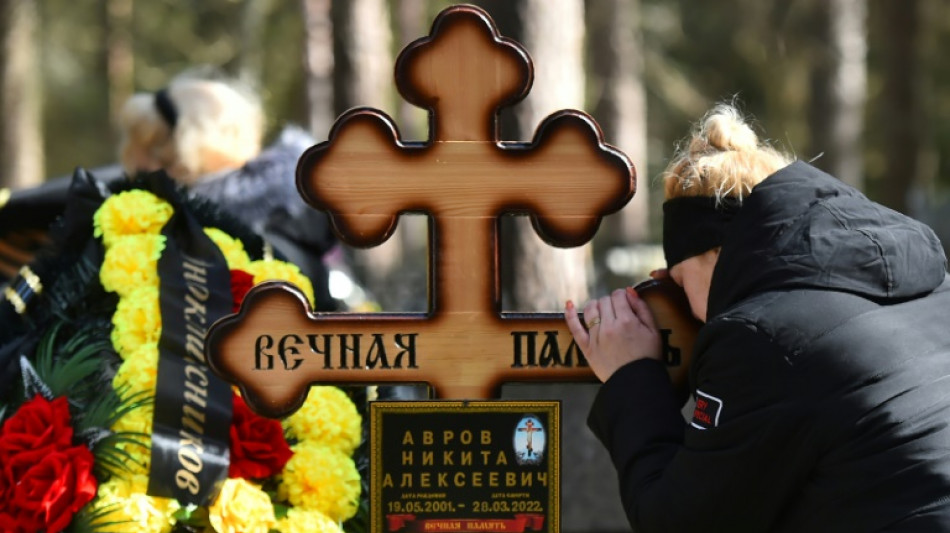
A baby-faced 20-year-old, Nikita Avrov was killed in Ukraine while serving as a gunner on a Russian tank.
At his funeral on Tuesday, those giving eulogies leave no room for doubt: the private died for a good cause, for his Russian fatherland.
In front of his family's house in the small town of Luga, 150 kilometres (93 miles) south of Saint Petersburg, Avrov's casket is briefly put on display, surrounded by funeral wreaths, while the flag of his motorised infantry division flies alongside.
Around 60 people file past to pay their final respects to a soldier who was born after Russian President Vladimir Putin took power in 2000.
Mourners also hold a ceremony at a war memorial where an Eternal Flame burns beside monuments to Soviet soldiers killed in World War II and Afghanistan.
Five fur-hatted soldiers and their commanding officer carry the coffin to the cemetery to the mournful sound of a brass band and fire their guns into the air.
In this town of 30,000 people, there is little sense of the bloody military operation in neighbouring Ukraine, launched by Russian troops on February 24, to fierce resistance from Ukrainian forces depicted by Moscow as hordes of neo-Nazis.
Some cars bear stickers with the letter Z, which has come to symbolise patriotic backing for the Russian operation.
According to the local authorities, Avrov was a gunner: loading the weapons of an assault tank.
He died in late March in Izyum, a small town in eastern Ukraine that was taken by Russian troops, strategically located between the cities of Kharkiv and Slavyansk.
- 'Forces of evil' -
Whether officials, military or clergy, those who speak at the memorial ceremony frame his death as a patriotic sacrifice.
"Fighting neo-Nazis and nationalists in Ukraine, he died for our motherland, for peace for each of us," says Alexei Golubev, a municipal official, as the dead man posthumously receives a bravery medal.
"When Russia shows weakness, some impure people try to bring it to its knees... But they won't manage it!", says Sergei Nikitin, a colonel.
His speech echoes Moscow's official rhetoric: that the West took advantage of Russia's weakness after the breakup of the USSR and brought Ukraine under its sway.
In a nearby Russian Orthodox church, a priest makes similar patriotic points.
"Nikita wasn't afraid of the forces of evil. He defended us so that we could have peaceful skies," says Father Nikolai, as some 200 people gather to listen to the eulogy.
Standing outside are two former classmates of Avrov, who give their names as Sergei and Anton.
"Nikita was a soldier and died in combat. That's a heroic deed," says Sergei.
"We have to defend our country. It's true that it's the best ones who die," adds Anton.
- 'No justification' -
A mournful mood about such deaths prevails among women present.
The exact numbers of Russian troops killed in Ukraine are not known, while a Kremlin spokesman last week acknowledged they are "significant". Russia last gave a figure of 1,351 deaths, on March 25.
"It's very painful; it's very scary when they die so young," says Anna Korolyova, a 59-year-old neighbour, carrying two carnations.
Russians choose their words carefully, since they face potential jail terms if they are found guilty of making "fake" statements about the military's activities in Ukraine.
At the cemetery, another woman, 48-year-old Svetlana, who prefers not to give her surname, expresses bemusement.
"It's terrifying to even imagine what the mother feels. You wouldn't wish that on your enemy. What grief. What are these horrors happening, that mothers are losing children? This can have no justification," she says.
P.Schmidt--CPN