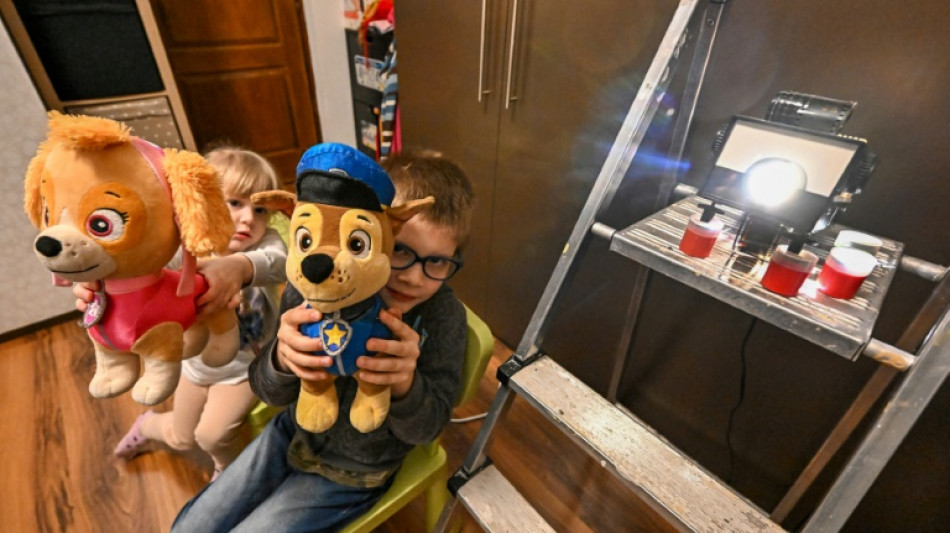
Filmstrip, Hungary's old-school projectors children love / Photo: ATTILA KISBENEDEK - AFP

 Kenya's economy faces climate change risks: World Bank

 British oil giant BP aims to sell North Sea business

 China factory activity slides as leaders seek spending boost

 Tech rebound fuels record-breaking rally in South Korean stocks

 Cables and cooling bring AI windfall to Indian suppliers

 Anthropic's models gained unauthorized 'real-world' access during testing

 Apple tops estimates in CEO Cook's final quarter, but shares fall

 Milei demands expulsion of foreigners expressing 'hate' against Argentina

 Italy's Po River valley on drought alert

 Prada profits pinched as growth hard to chase

 Stocks climb on earnings and rates, oil retreats

 US economic growth slows in second quarter, missing expectations

 Russia adds Telegram founder Durov to 'terrorist' blacklist

 Stocks diverge on earnings, as oil steadies

 Eurozone economy grows despite Middle East war

 Singapore group will develop 'most promising' Ebola vaccine

 Shell profit surges as Mideast war fuels oil prices

 Car maker Stellantis says back in profit in second quarter

 Samsung quarterly operating profit up 1,800% on AI boom

 South Korean stocks bounce after rout, oil holds gains on Mideast woes

 South Korea's women web sleuths fight AI deepfake porn

 Anything but programmable: New cost-efficient EC-power-supply-series for the DIN rail by CAMTEC PS

 Meta misses profit expectations, sticks to massive AI spending

 Campari - king of the spritz - hopes to conquer American heartland

 Air France-KLM and Lufthansa bid for Portugal's TAP airline

Tablets and mobile phones may have to be prised from the fingers of children elsewhere, but in Hungary storytime can be all about a 100-year-old piece of tech -- filmstrip.
Generations of kids there have been enthralled with stories told with the help of a projector.
Alexandra Csosz-Horvath turns off the lights and reads "Sleeping Beauty" from a series of still captioned images projected onto the bedroom wall -- her three- and seven-year-old clearly under her spell.
"We're together, it's cozier than the cinema yet it's better than a book," said the 44-year-old lawyer.
Filmstrip -- a century-old storytelling medium that was killed off in the West by the video cassette in the 1980s -- is not just hanging on in Hungary, it is thriving with a new wave of enthusiasts charmed by its slower-paced entertainment.
Printed on rolls of film, the still images were never meant to move.
- Long tradition -
"Between the 1940s and the 1980s filmstrips were used worldwide as a cost-effective visualisation tool in education and other fields," Levente Borsos, of Seoul's Hankuk University of Foreign Studies, told AFP.
But while it was surpassed by more advanced technologies in the West, it became a popular form of home entertainment in the Soviet bloc where TVs and videos were harder to come by.
When communism collapsed, filmstrip began to disappear -- except in Hungary, where the since privatised Diafilmgyarto company survives as the country's sole producer.
"Continuous filmstrip publishing and slide shows at home can be considered a Hungarian peculiarity, a special part of the country's cultural heritage," Borsos said.
- Revival -
Producer Diafilmgyarto has seen sales rebound from 60,000 in the 1990s to 230,000 rolls last year.
Each film -- produced solely for the domestic market -- costs around five euros ($5.50), less than a cinema ticket. Most are adaptations of classic fairy tales or children's books.
One bestseller, Hungarian classic "The Old Lady and the Fawn" about a woman taking care of a young deer, has been in the top 10 since its release in 1957, according to Diafilmgyarto's managing director Gabriella Lendvai.
The company also commissions artists, including some famous Hungarians, to create exclusive content for its filmstrips.
It's "an irreplaceable tradition in Hungarian culture", said Beata Hajdu-Toth, who attended a recent filmstrip screening in a Budapest cinema along with her son to celebrate Diafilmgyarto's 70th anniversary.
"I am very happy it's part of our life and hopefully I will be able to narrate to my grandchildren as well," the 37-year-old added.
At her home in the Budapest suburbs, Csosz-Horvath also hails the tradition, preferring it to fast-paced cartoons, which she said drive the children "wild".
"They just can't understand that what happens in three seconds on the screen happens in three hours in real life," she said.
With filmstrips "they don't believe that everything happens in the blink of an eye."
M.Davis--CPN