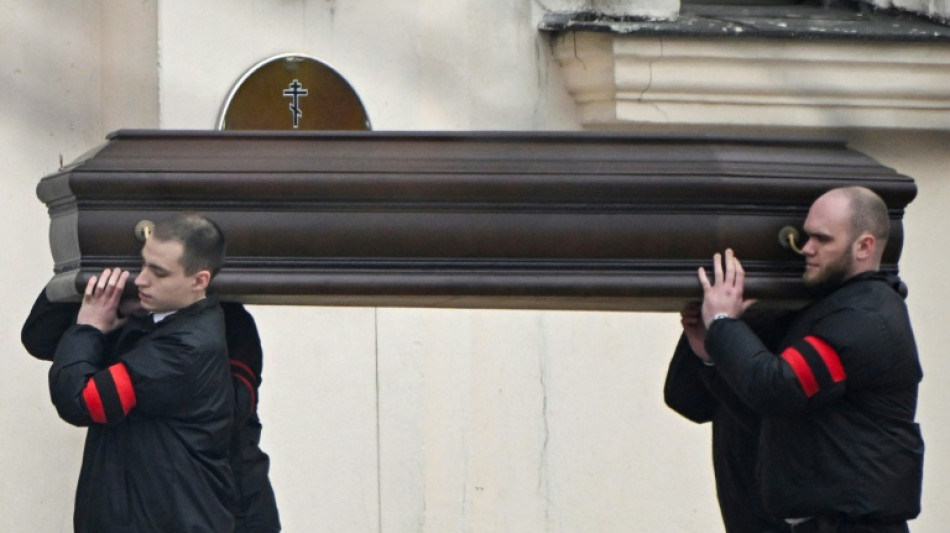
Thousands attend Navalny funeral as Kremlin warns against protests / Photo: Alexander NEMENOV - AFP

 Kenya's economy faces climate change risks: World Bank

 Profits surge at US oil giant amid Iran war supply shock
 Stock markets rally on tech rebound
 France, Spain assess scorched terrain as new wildfires threaten other regions

 Chipmaker Kioxia reports AI-driven 45-fold surge in quarterly net profit
 Far right and far left battle for power in polarised Berlin

 The last trio: S.Africa's zoo elephants await their fate
 Oil industry sees war windfall but girds for political blowback

 Amazon beats expectations with cloud and AI growth

 Blowout Microsoft results lift US stocks as oil retreats

 'Beginning of the end': Relief but no party as French wildfire winds down

 Southern Europe 'becoming more flammable' in hotter climate, experts say

 Mammoth bones found on parched bed of Danube in Bulgaria

 MEXC Lists Grvt (GRVT) with $60,000 Worth of GRVT and 10,000 USDT in Airdrop+ Rewards

 George and Amal Clooney flee French home due to wildfire

 MEXC Ventures Supports Alpha Arena's APAC Debut at Coinfest Bali

 AI data centre supplier Zhongji InnoLight slips on Hong Kong debut

 May, June heatwaves caused 2,877 extra deaths in England: govt

 BMW profit down a third as carmaker plans job cuts

 Seoul extends losses as most Asian markets drop, oil rises again

 Gambling.com Group Is Now Grandstand

 Meet the astronomer digging into the Milky Way's 'fossils'

 AI data centre supplier Zhongji InnoLight falls on Hong Kong debut

 Samsung operating profit up 1,800% in second quarter on AI boom

 Japanese population below 120 million for first time in decades

Thousands of mourners attended the funeral of Russian opposition leader Alexei Navalny in Moscow on Monday, two weeks after President Vladimir Putin's top critic died in an Arctic prison.
Many carried flowers and shouted support for the 47-year-old anti-corruption campaigner who galvanised mass protests against Putin, as the hearse arrived at a church for a short religious service.
The death has been widely condemned by Western leaders and Navalny's supporters have accused Putin of murder and of trying to prevent a dignified public burial.
The Kremlin, which has denied involvement and dismissed the accusations as "hysterical", warned against "unauthorised" protests around the funeral.
Navalny's body first lay in an open casket in a packed church in Maryino, southern Moscow, for a ceremony attended by his parents.
The coffin was closed immediately after the service, meaning many mourners who had wanted to file past were not able to pay their last respects at the Mother of God Quench My Sorrows church.
The coffin was then transported to the Borisovo cemetery, near the banks of the Moskva River, where several large wreaths were arranged around the grave.
"We won't forget you!" and "Forgive us!" some mourners shouted as the coffin arrived for burial.
- 'What are they afraid of?' -
Some 400 mourners have been detained at Navalny memorials since his death, rights organisation OVD-Info has said, and there was concern of more arrests at the funeral where a heavy police presence could be seen.
"Any unauthorised gatherings will be in violation of the law and those who participate in them will be held responsible," Kremlin spokesman Dmitry Peskov said, according to TASS news agency.
"What are they afraid of? Why so many cars?" one mourner, Anna Stepanova, told AFP outside the church.
"They are so afraid themselves," she said. "The people who came here, they are not scared. Alexei wasn't either."
"People like him shouldn't be dying: honest and principled, willing to sacrifice themselves," she added.
The French, German and US ambassadors were seen among mourners outside the church, as were some of Russia's last free independent politicians.
The dissident's widow, Yulia Navalnaya, earlier said she feared the funeral could be disrupted by further arrests.
"I'm not sure yet whether it will be peaceful or whether the police will arrest those who have come to say goodbye to my husband," Navalnaya told the European Parliament this week.
Navalnaya has blamed Putin for her husband's death.
Putin's spokesman Peskov has criticised the accusations made by her and some Western leaders as "vulgar".
On the day of the funeral, Peskov said he had "nothing to say" to the family of the deceased.
- 'Nothing to say' -
Navalny shot to prominence through his anti-corruption campaigning, exposing what he said was rampant graft at the top of Putin's administration.
Some mourners mentioned the huge influence Navalny had on their own political activism.
"Because of him I began to get involved in politics... He was the first public person that I listened to," said 26-year-old Denis, a volunteer at a charity.
Navalny was arrested in January 2021 when he returned to Russia after being treated in Germany for a poisoning attack.
"Alexei was tortured for three years," Navalnaya told lawmakers in Brussels.
"He was starved in a tiny stone cell, cut off from the outside world and denied visits, phone calls, and then even letters."
"And then they killed him. Even after that, they abused his body," she said.
- 'Ideas will live on' -
His body was held in a morgue for eight days before being returned to the family, which Navalny's team believed to be a bid to cover up responsibility for his death.
His family and his team have also accused authorities of trying to prevent a dignified public burial, fearing it could turn into a flashpoint for dissent.
Navalny's team said local investigators had threatened to bury him on the prison grounds if his mother did not agree to a "secret" funeral.
Once the body was released, allies struggled to find a place that would agree to hold a funeral ceremony, as well as hearse drivers.
And a civil ceremony allowing the general public to pay their respects to the body -- common in Russia -- has not been allowed.
Navalnaya has vowed to continue his life's work and urged to "fight more desperately, more fiercely than before."
"A person has died, but his ideas will live on thanks to those who have gathered here," said Alyona, a 22-year-old archaeologist who came to pay her respects.
T.Morelli--CPN