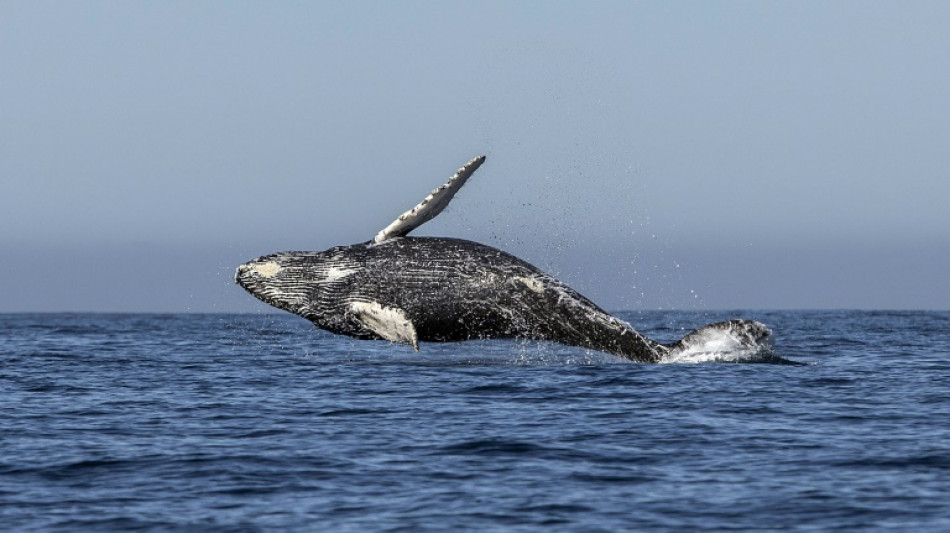
Heatwaves may be driving whale decline in Pacific: study / Photo: FERNANDO CASTILLO - AFP

 Kenya's economy faces climate change risks: World Bank

 Profits surge at US oil giant amid Iran war supply shock

 Stock markets rally on tech rebound

 France, Spain assess scorched terrain as new wildfires threaten other regions
 Chipmaker Kioxia reports AI-driven 45-fold surge in quarterly net profit

 Far right and far left battle for power in polarised Berlin

 The last trio: S.Africa's zoo elephants await their fate

 Oil industry sees war windfall but girds for political blowback

 Amazon beats expectations with cloud and AI growth

 Blowout Microsoft results lift US stocks as oil retreats

 'Beginning of the end': Relief but no party as French wildfire winds down

 Southern Europe 'becoming more flammable' in hotter climate, experts say

 Mammoth bones found on parched bed of Danube in Bulgaria

 MEXC Lists Grvt (GRVT) with $60,000 Worth of GRVT and 10,000 USDT in Airdrop+ Rewards

 George and Amal Clooney flee French home due to wildfire

 MEXC Ventures Supports Alpha Arena's APAC Debut at Coinfest Bali

 AI data centre supplier Zhongji InnoLight slips on Hong Kong debut

 May, June heatwaves caused 2,877 extra deaths in England: govt

 BMW profit down a third as carmaker plans job cuts

 Seoul extends losses as most Asian markets drop, oil rises again

 Gambling.com Group Is Now Grandstand

 Meet the astronomer digging into the Milky Way's 'fossils'

 AI data centre supplier Zhongji InnoLight falls on Hong Kong debut

 Samsung operating profit up 1,800% in second quarter on AI boom

 Japanese population below 120 million for first time in decades

The number of North Pacific humpback whales plummeted 20 percent in less than a decade, and marine heatwaves may be the main culprit, according to a study released Wednesday that spells a troubled future for the majestic sea mammals.
Thanks to conservation efforts and the end of commercial whaling in 1976, the region's humpback population steadily increased until 2012.
But over the last decade, whale numbers have declined sharply, researchers reported in the journal Royal Society Open Science.
A team of 75 scientists compiled the largest photo-identification dataset ever created for a large marine mammal to track North Pacific humpback populations from 2002 to 2021.
Using images of the whale's unique tails the team was able to log some 200,000 sightings of more than 33,000 individuals.
Up to 2012 the humpback population steadily increased, and it was widely assumed it would eventually level off at their natural "carrying capacity" -- the number of whales the ocean can support.
Instead, they saw a steep population decline.
From 2012 to 2021 the number of humpbacks fell 20 percent from some 33,000 individuals to just over 26,600.
For a subset of whales that wintered in Hawaii, the drop was even more pronounced: 34 percent.
That turned out to be a highly significant difference.
From 2014 through 2016 the strongest and longest marine heatwave ever recorded ravaged the Pacific northeast with temperate anomalies sometimes exceeding three to six degrees Celsius, altering the marine ecosystem and the availability of humpback prey.
"My jaw was on the floor," study author Ted Cheeseman, whale biologist and a PhD student at Southern Cross University in New South Wales, told AFP. "This is a much bigger signal than we expected."
"Our estimation is that about 7,000 whales mostly starved to death," he said.
It is normal even in healthy populations for numbers to fluctuate, but such an abrupt decline for a long-lived species points to a major disruption in the oceans.
- 'The ceiling crashed' -
In this case, the scientists speculate, the extreme marine heat actually reduced the carrying capacity threshold for humpbacks.
"Instead of the whales coming up to the ceiling, the ceiling crashed down on the whales," Cheeseman said.
The fact that humpbacks were unable to shift their already flexible diet is a telltale indicator for overall ocean health.
"It's not just the whales' food that declined," Cheeseman added, noting drops in the populations of tufted puffins, sea lions, and seals. "A warmer ocean produces less food."
Some commercial fisheries also felt the impact.
According to the Intergovernmental Panel on Climate Change, marine heatwaves -- already more frequent and intense -- are projected to increase globally over the course of this century.
- Still a success story -
For hundreds of years, whalers from across the planet hunted humpback whales for their oil, meat and baleen, their feeding filtration system.
By 1986, the IUCN had listed the species as globally endangered.
Humpback whales continue to face threats today, primarily from ship strikes and entanglements in fishing nets.
But international restrictions on commercial whaling allowed the global humpback whale population to rebound to more than 80,000 mature individuals.
But today conservation goes hand-in-hand with climate action.
"It is a great success story that these whales are no longer in immediate danger of extinction like they were 50 years ago," Cheeseman said.
"And yet, there's a new reality of changing oceans that we have to live with."
P.Schmidt--CPN
