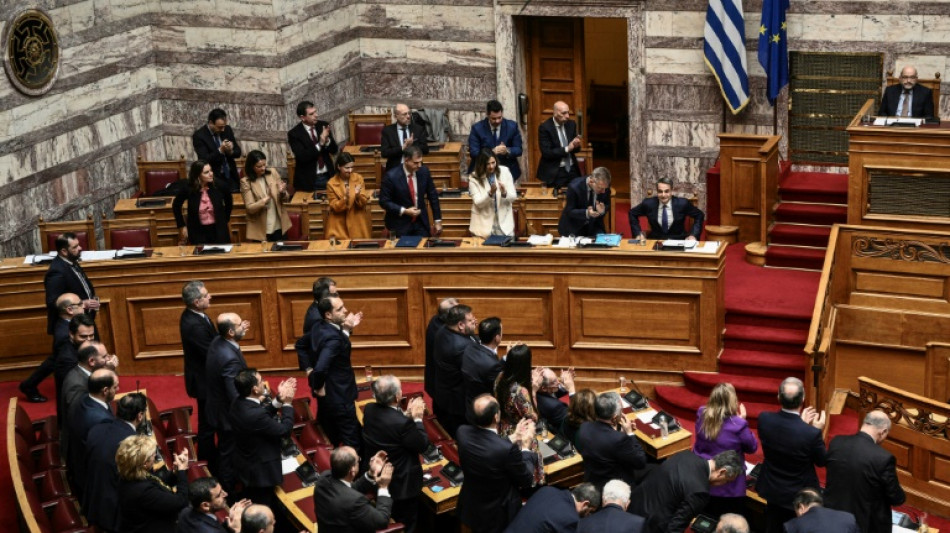
Greece legalises same-sex marriage, adoption / Photo: Angelos TZORTZINIS - AFP

 Kenya's economy faces climate change risks: World Bank

 Commerzbank agrees to talks with UniCredit after two-year standoff

 Fornaro Legal Releases Guidance to Help Businesses Maintain Clear Ownership Records During Growth

 Japan probe made closest-ever asteroid flyby: space agency

 British oil giant BP aims to sell North Sea business

 China factory activity slides as leaders seek spending boost
 Tech rebound fuels record-breaking rally in South Korean stocks

 Cables and cooling bring AI windfall to Indian suppliers

 Anthropic's models gained unauthorized 'real-world' access during testing

 Apple tops estimates in CEO Cook's final quarter, but shares fall

 Milei demands expulsion of foreigners expressing 'hate' against Argentina

 Italy's Po River valley on drought alert

 Prada profits pinched as growth hard to chase

 Stocks climb on earnings and rates, oil retreats

 US economic growth slows in second quarter, missing expectations

 Russia adds Telegram founder Durov to 'terrorist' blacklist

 Stocks diverge on earnings, as oil steadies

 Eurozone economy grows despite Middle East war
 Singapore group will develop 'most promising' Ebola vaccine

 Shell profit surges as Mideast war fuels oil prices
 Car maker Stellantis says back in profit in second quarter

 Samsung quarterly operating profit up 1,800% on AI boom

 South Korean stocks bounce after rout, oil holds gains on Mideast woes

 South Korea's women web sleuths fight AI deepfake porn

 Anything but programmable: New cost-efficient EC-power-supply-series for the DIN rail by CAMTEC PS
Greece's parliament on Thursday overwhelmingly adopted a bill legalising same-sex marriage and adoption in a landmark reform promoted by the conservative government despite opposition from the powerful Orthodox Church.
Once the law is promulgated, Greece will become the 37th country in the world and the first Orthodox Christian one to legalise adoption by same-sex families.
The bill, which was supported by the New Democracy party of Prime Minister Kyriakos Mitsotakis, was approved with 176 votes out of the 245 MPs present following two days of debates.
"This is a milestone for human rights, reflecting today's Greece -- a progressive, and democratic country, passionately committed to European values," Mitsotakis said on X, formerly Twitter.
When the result was announced, dozens of people waving rainbow flags celebrated in front of the parliament building in central Athens.
Although dozens of ruling New Democracy party legislators were expected to oppose the bill, support from opposition parties meant it was certain to pass.
Mitsotakis, who personally spearheaded the bill, had urged lawmakers to "boldly abolish a serious inequality" in Greek democracy that had rendered same-sex families "invisible".
The reform would "significantly improve the lives of quite a few of our fellow citizens, without taking away anything from the lives of the many", he added.
The vote had been hailed as historic by LGBTQ associations who said same-sex families faced a labyrinth of administrative challenges amounting to discrimination under present family law.
When their children fall ill in Greece, non-biological parents currently have no right to decide what medical procedures are necessary for them.
Children do not automatically inherit from their non-biological parents.
If a child has two fathers, they can only be registered with the civil registry and covered by social services by entering the name of the biological mother.
And if the biological parent dies, the state can take away children from the other parent.
- Church 'totally opposed' -
Dozens of Mitsotakis's conservative New Democracy party's 158 lawmakers were expected to oppose the bill or abstain.
However, support from the main opposition leftist Syriza party -- its leader, Stefanos Kasselakis, is gay -- the socialist Pasok party and other smaller parties, meant defet was almost impossible.
A simple majority in the 300-member parliament vote was needed for the bill to pass.
The Church of Greece -- which has close ties to many government MPs -- had said it was "totally opposed" to the reform, arguing that it "condemns" children to grow up in an "environment of confusion".
Archbishop Ieronymos, the head of the church, slammed the proposed law as part of a bid to impose a "new reality that seeks only to corrupt the homeland's social cohesion".
Some 4,000 people demonstrated in Athens against the measure on Sunday, many of them brandishing religious icons and crucifixes.
"It is said Greece is 30 years behind (the rest of the world). In such cases, thank God it is," the parliament spokesman for the hard-right party Niki said on Wednesday during the two-day debate.
Kasselakis, who married his partner in a US ceremony in October, has been subjected to homophobic insults, most recently from a central Greece mayor and an island group governor.
Mitsotakis was careful to stress last month that the changes would benefit just "a few children and couples".
The conservative leader, who comfortably won re-election in June, had promised to enact the reform during his second four-year term.
He announced it in January, just days after Kasselakis said Syriza would submit their own proposals for equality in marriage.
- 'Day of joy' -
Greek LGBTQ families, who had maintained a low profile since the reform was unveiled last month, called for a celebratory gathering in Athens on Thursday.
"This is a day of joy," Rainbow Families Greece, an NGO helping LGBTQ families, said on Facebook.
Same-sex couples will still not be able to use assisted reproduction or a surrogate mother, procedures reserved for single women or heterosexual couples who have trouble conceiving.
Greece had been condemned for anti-gay discrimination by the European Court of Human Rights in 2013, after gay couples were excluded from a 2008 civil uni.
Opinion polls indicate that most Greeks support same-sex marriage but oppose surrogacy.
Under the Greek constitution, single parents, regardless of gender, have been allowed to adopt since 1946 -- but until now the second partner in a same-sex union was left out of the process.
Under the previous Syriza government, Greece in 2015 legalised civil unions for same-sex couples, one of the last countries in the European Union to do so.
That law had resolved property and inheritance issues but made no provision for the adoption of children.
M.P.Jacobs--CPN