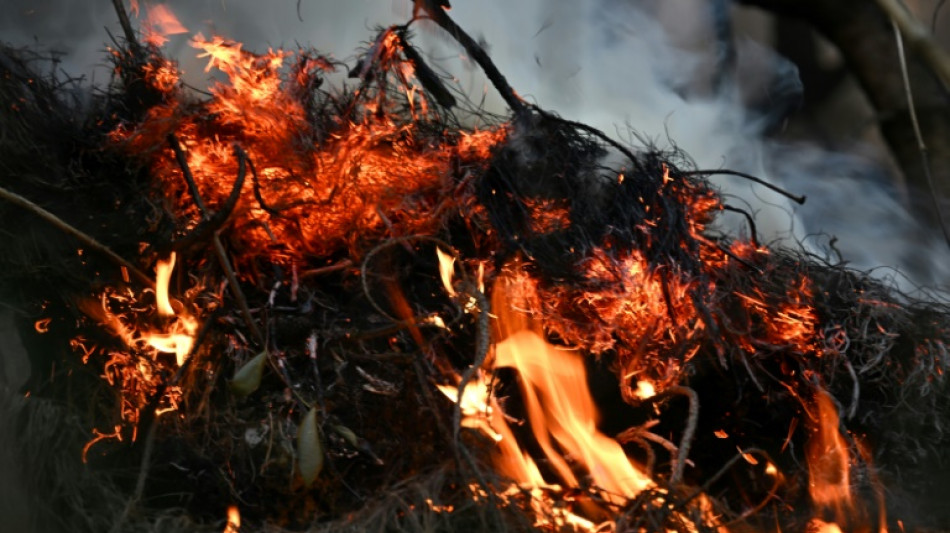
Invasive vegetation stoking fierce Bogota fires / Photo: Raul ARBOLEDA - AFP/File

 Kenya's economy faces climate change risks: World Bank

 New York sues online prediction markets giant Kalshi

 Profits surge at US oil giant amid Iran war supply shock

 Stock markets rally on tech rebound

 France, Spain assess scorched terrain as new wildfires threaten other regions

 Chipmaker Kioxia reports AI-driven 45-fold surge in quarterly net profit

 Far right and far left battle for power in polarised Berlin

 The last trio: S.Africa's zoo elephants await their fate

 Oil industry sees war windfall but girds for political blowback

 Amazon beats expectations with cloud and AI growth

 Blowout Microsoft results lift US stocks as oil retreats

 'Beginning of the end': Relief but no party as French wildfire winds down

 Southern Europe 'becoming more flammable' in hotter climate, experts say

 Mammoth bones found on parched bed of Danube in Bulgaria

 MEXC Lists Grvt (GRVT) with $60,000 Worth of GRVT and 10,000 USDT in Airdrop+ Rewards

 George and Amal Clooney flee French home due to wildfire

 MEXC Ventures Supports Alpha Arena's APAC Debut at Coinfest Bali

 AI data centre supplier Zhongji InnoLight slips on Hong Kong debut

 May, June heatwaves caused 2,877 extra deaths in England: govt

 BMW profit down a third as carmaker plans job cuts

 Seoul extends losses as most Asian markets drop, oil rises again

 Gambling.com Group Is Now Grandstand

 Meet the astronomer digging into the Milky Way's 'fossils'

 AI data centre supplier Zhongji InnoLight falls on Hong Kong debut

 Samsung operating profit up 1,800% in second quarter on AI boom

Forest fires which have engulfed Bogota in smoke over the past week have been fueled by highly flammable foreign plant species that have invaded Colombia's capital, experts say.
Eucalyptus, pine and gorse cover the Andean mountain range bordering the east of Bogota, where four wildfires have broken out in the past week.
These trees and shrubs contain oils and saps that are very flammable, and "help maintain the fire for hours and even days," said biologist Arnold Garcia Samaca, of the National University of Colombia.
Additionally, fire helps them reproduce and "they take over larger areas, displacing native vegetation."
Amid hot, dry conditions linked to the weather phenomenon El Nino, fires have devastated more than 17,000 hectares (42,000 acres) across Colombia over the past three months, the authorities say.
Eucalyptus trees, almost all of which are native to Australia, and the European pine, were introduced in Bogota at the start of the 20th century, as urban growth fueled demand for wood.
The common gorse shrub, native to much of western Europe, was planted in the 50s in a bid to halt soil erosion. The Bogota's mayor's office said it has since been declared one of the "100 most aggressive and invasive species in the world" and is "a threat to biodiversity."
Bogota authorities have removed more than 130 hectares of gorse in the past four years -- no easy task in the hard-to-access areas in which it grows.
Jose A. Munoz, who works with the Landscape Ecology and Ecosystem Modeling Laboratory (Ecolmod), said the underlying problem was authorities seeking the "fastest route" to control deforestation and other issues.
"Planting for the sake of planting is never going to be the solution," he said.
The environmental authority which manages the mountain range, the Regional Autonomous Corporation (CAR) of Cundinamarca, told AFP it would put in place a reforestation plan using local species such as cedar, encenillo, and white rosemary.
On Saturday, Bogota closed some 40 parks and hiking trails due to heavy smoke from the wildfires.
Authorities have recommended that residents remain inside as much as possible and wear masks if they must go out.
P.Schmidt--CPN
