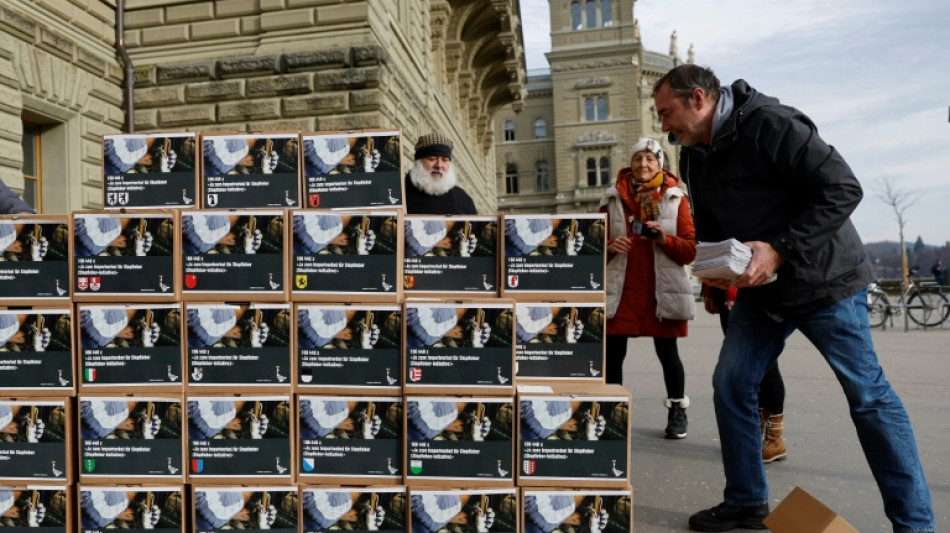
Swiss to vote on foie gras, fur imports / Photo: STEFAN WERMUTH - AFP

 Kenya's economy faces climate change risks: World Bank

 US Fed dissenters call for rate hikes over sustained inflation

 New York sues online prediction markets giant Kalshi

 Profits surge at US oil giant amid Iran war supply shock

 Stock markets rally on tech rebound

 France, Spain assess scorched terrain as new wildfires threaten other regions

 Chipmaker Kioxia reports AI-driven 45-fold surge in quarterly net profit

 Far right and far left battle for power in polarised Berlin

 The last trio: S.Africa's zoo elephants await their fate

 Oil industry sees war windfall but girds for political blowback

 Amazon beats expectations with cloud and AI growth

 Blowout Microsoft results lift US stocks as oil retreats

 'Beginning of the end': Relief but no party as French wildfire winds down

 Southern Europe 'becoming more flammable' in hotter climate, experts say

 Mammoth bones found on parched bed of Danube in Bulgaria

 MEXC Lists Grvt (GRVT) with $60,000 Worth of GRVT and 10,000 USDT in Airdrop+ Rewards

 George and Amal Clooney flee French home due to wildfire

 MEXC Ventures Supports Alpha Arena's APAC Debut at Coinfest Bali

 AI data centre supplier Zhongji InnoLight slips on Hong Kong debut

 May, June heatwaves caused 2,877 extra deaths in England: govt

 BMW profit down a third as carmaker plans job cuts

 Seoul extends losses as most Asian markets drop, oil rises again

 Gambling.com Group Is Now Grandstand

 Meet the astronomer digging into the Milky Way's 'fossils'

 AI data centre supplier Zhongji InnoLight falls on Hong Kong debut

The Swiss will decide whether to ban foie gras and fur imports after campaigners on Thursday handed in enough signatures to trigger a public vote on the twin issues.
Outside the Federal Palace parliament buildings in the capital Bern, campaigners from the Swiss Animal Alliance, which launched the move, piled up boxes symbolising the certified signatures.
The popular initiative on foie gras collected 106,448 signatures, while the one on fur attracted 116,140 -- both above the 100,000 threshold required to trigger a national vote.
Foie gras is widely consumed around the December holiday season, giving extra resonance to the campaign.
Force-feeding ducks and geese -- a key way of making foie gras -- has been banned in Switzerland for more than 40 years, but importing produce derived from this method is not.
The popular initiative "Yes to the ban on importing foie gras" wants to change the constitution to ban the import of such products.
The second proposal is entitled "Yes to the ban on importing fur products from mistreated animals".
With 200 tonnes of foie gras imported annually, "Switzerland unfortunately positions itself as one of the main importers of this product", says the Swiss Animal Alliance.
"Every year, 400,000 ducks and 12,000 geese are killed in order to meet the demand specifically in our country.
"It is hypocritical to ban Swiss breeders from producing foie gras under penalty of sanctions, while authorising the importation of this product."
As for fur, the Swiss Animal Alliance denounces "methods of breeding and killing (which) clearly contravene our legislation on the protection of animals and would be considered cruelty punishable by criminal sanctions in Switzerland".
It claims 350 tonnes of fur are imported each year, corresponding to the slaughter of around 1.5 million animals.
"More than half of these furs come from China, where the terrible conditions in which animals are detained and killed, some of which are skinned while still alive, are regularly denounced," it claims.
- Packaging change -
Almost all European countries prohibit the force-feeding of geese and ducks, with France, Hungary and Bulgaria notable exceptions.
In September, Switzerland's parliament rejected a bid to ban foie gras imports but ordered that the production methods had to be stated on the packaging.
Switzerland has direct democracy, with citizens able to trigger popular votes.
They can propose new laws themselves in initiatives, and challenge decisions taken by parliament in referendums.
A total of 100,000 valid signatures within 18 months are required to trigger a national initiative. A change of law requires a double majority of voters and cantons.
Popular votes take place every three months.
D.Avraham--CPN

