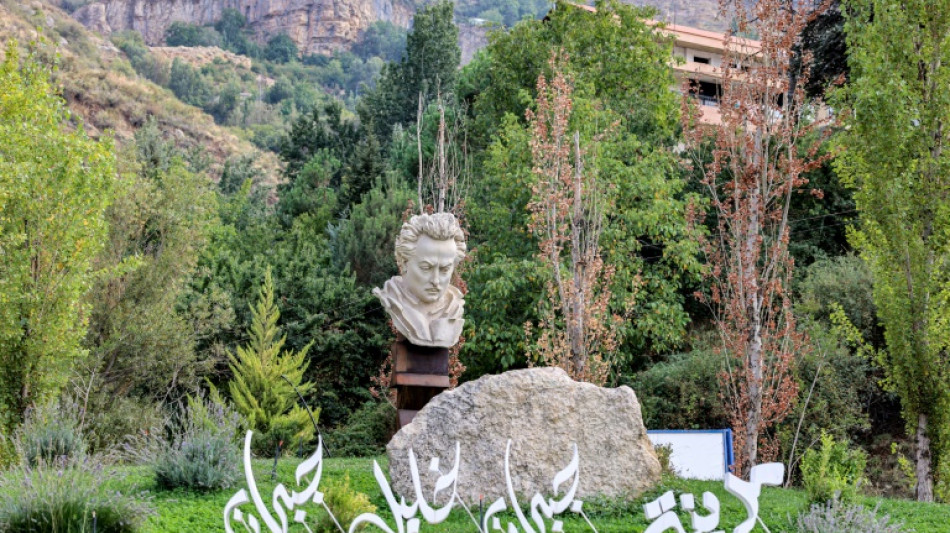
Kahlil Gibran's Lebanon hometown celebrates 'The Prophet' centennial / Photo: JOSEPH EID - AFP

 Kenya's economy faces climate change risks: World Bank
 New York sues online prediction markets giant Kalshi

 Profits surge at US oil giant amid Iran war supply shock

 Stock markets rally on tech rebound

 France, Spain assess scorched terrain as new wildfires threaten other regions

 Chipmaker Kioxia reports AI-driven 45-fold surge in quarterly net profit

 Far right and far left battle for power in polarised Berlin

 The last trio: S.Africa's zoo elephants await their fate
 Oil industry sees war windfall but girds for political blowback

 Amazon beats expectations with cloud and AI growth

 Blowout Microsoft results lift US stocks as oil retreats

 'Beginning of the end': Relief but no party as French wildfire winds down

 Southern Europe 'becoming more flammable' in hotter climate, experts say

 Mammoth bones found on parched bed of Danube in Bulgaria

 MEXC Lists Grvt (GRVT) with $60,000 Worth of GRVT and 10,000 USDT in Airdrop+ Rewards

 George and Amal Clooney flee French home due to wildfire

 MEXC Ventures Supports Alpha Arena's APAC Debut at Coinfest Bali

 AI data centre supplier Zhongji InnoLight slips on Hong Kong debut

 May, June heatwaves caused 2,877 extra deaths in England: govt

 BMW profit down a third as carmaker plans job cuts

 Seoul extends losses as most Asian markets drop, oil rises again

 Gambling.com Group Is Now Grandstand

 Meet the astronomer digging into the Milky Way's 'fossils'

 AI data centre supplier Zhongji InnoLight falls on Hong Kong debut

 Samsung operating profit up 1,800% in second quarter on AI boom

Nestled in the mountains of northern Lebanon, a museum dedicated to Kahlil Gibran in his hometown of Bsharre has been celebrating the centennial of "The Prophet", the renowned author's most famous work.
Since it was first published in the United States in 1923, millions of copies of "The Prophet" have been sold worldwide, with the book becoming a literary classic that has been translated into dozens of languages from the original English.
"Every reader, no matter where they're from, feels that this book relates to them and moves them deeply... whether they are Christian, Muslim, Jewish" or atheist, said museum director Joseph Geagea.
It "touches the spirituality of each individual, dealing with death, life, friendship, love, children" and other topics, he added.
A collection of poetic prose, "The Prophet" tells the story of Almustafa, who before returning to his homeland, speaks to residents of the city of Orphalese about various aspects of life.
Divided into 26 chapters, verses from "The Prophet" are often quoted at births, weddings and funerals around the world.
"Biblical style is pervasive" in "The Prophet", Lebanese author Alexandre Najjar said during a recent reading in Beirut, also noting the influence of Islam's mystic Sufi tradition.
"The Prophet" captured the hearts of students and hippies in the 1960s, Najjar said, including for the passage: "Your children are not your children... they come through you but not from you."
Elvis Presley "loved the book so much that he used to give it to his friends on their birthday", he added.
Other celebrities and leaders, from John Lennon to Japan's former Empress Michiko and late Indian prime minister Indira Gandhi, were also fond of the book, the museum's Geagea said.
- 'Deeply spiritual vision' -
Gibran was born in Bsharre in 1883, when Lebanon was under Ottoman rule, but wrote most of his books in the United States, where he headed the New York Pen League, the first Arab-American literary society.
Overlooking Lebanon's Qadisha Valley, the museum was set up in a former 18th century monastery and exhibits some 150 paintings by the author that show "his deeply spiritual vision of existence", Geagea said.
A table displays 11 translations of "The Prophet" released between 1923 and 1931.
"Gibran strongly wished to return to Bsharre, which he left at age 12," said Geagea, but the writer died before he could get the chance.
The monks decided to sell the monastery and the surrounding land to Gibran's sister after the author's death in 1931, when he was just 48.
The site was transformed into his burial place and then into a museum for his artworks and other objects, and receives around 50,000 visitors a year from five continents, Geagea said.
Despite his popularity among readers, Gibran's most famous work received a lukewarm reception at the time of writing from American critics, who criticised it as simplistic and moralising.
In April this year, an exhibition at the United Nations headquarters in New York also marked the work's centenary.
M.Mendoza--CPN
