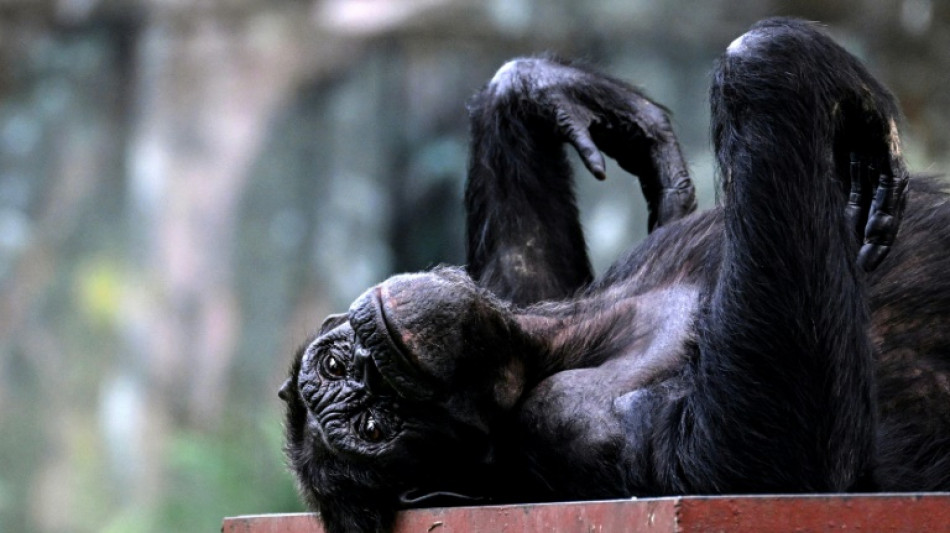
Grandma chimps offer clues for evolution of menopause in humans / Photo: Mohd RASFAN - AFP/File

 Kenya's economy faces climate change risks: World Bank

 New York sues online prediction markets giant Kalshi

 Profits surge at US oil giant amid Iran war supply shock

 Stock markets rally on tech rebound
 France, Spain assess scorched terrain as new wildfires threaten other regions

 Chipmaker Kioxia reports AI-driven 45-fold surge in quarterly net profit

 Far right and far left battle for power in polarised Berlin

 The last trio: S.Africa's zoo elephants await their fate

 Oil industry sees war windfall but girds for political blowback

 Amazon beats expectations with cloud and AI growth

 Blowout Microsoft results lift US stocks as oil retreats

 'Beginning of the end': Relief but no party as French wildfire winds down

 Southern Europe 'becoming more flammable' in hotter climate, experts say

 Mammoth bones found on parched bed of Danube in Bulgaria

 MEXC Lists Grvt (GRVT) with $60,000 Worth of GRVT and 10,000 USDT in Airdrop+ Rewards

 George and Amal Clooney flee French home due to wildfire

 MEXC Ventures Supports Alpha Arena's APAC Debut at Coinfest Bali

 AI data centre supplier Zhongji InnoLight slips on Hong Kong debut

 May, June heatwaves caused 2,877 extra deaths in England: govt

 BMW profit down a third as carmaker plans job cuts

 Seoul extends losses as most Asian markets drop, oil rises again

 Gambling.com Group Is Now Grandstand

 Meet the astronomer digging into the Milky Way's 'fossils'

 AI data centre supplier Zhongji InnoLight falls on Hong Kong debut

 Samsung operating profit up 1,800% in second quarter on AI boom

Humans and some whales are the only known species in which females live long after they stop being able to reproduce.
A new paper in the journal Science on Thursday argues that chimpanzees should now be added to the list, and offers clues about the evolutionary imperatives behind menopause in women.
"Chimpanzees have been studied in the wild for a long time, and you might think there's nothing left to learn about them," senior author Kevin Langergraber of Arizona State University told AFP. "I think this research shows us that's not true."
The vast majority of mammal females produce offspring until the end of their lives, but humans experience a decline in reproductive hormones and the permanent cessation of ovary function around age 50.
Females of five species of toothed whale, including orcas and narwhals, similarly survive well beyond fertile age.
It isn't obvious why natural selection would favor this trait, and only among a handful of species.
Some scientists have put forward the "grandmother hypothesis" as a possible explanation: the idea that older females enter a post-reproductive state to consume fewer resources and focus on improving their grandchildren's odds of survival.
- Demographics and hormones -
In the new paper, researchers examined the mortality and fertility rates of 185 female chimpanzees in the Ngogo community of wild chimpanzees in Kibale National Park, Uganda, between 1995 and 2016.
Specifically, the team calculated a metric called the post-reproductive representation (PrR), which is the average proportion of the adult life span that is spent in a post-reproductive state.
Past attempts that used demographic data to study whether chimps underwent menopause were hampered by haphazard statistical methods, lead author Brian Wood of the University of California, Los Angeles, told AFP, with PrR proving a more robust measure.
It showed Ngogo chimpanzee females -- but not other chimpanzees from other populations -- lived on average 20 percent of their adult years in a post-reproductive state, just a little under what has been observed in humans.
To exclude the possibility that, say, an STD swept through the community causing mass sterility among older females in the past, the team paired the demographic data with hormonal status.
They took urine samples of 66 females ranging in age and reproductive status, and measured the levels of gonadotropins, estrogens, and progestins, finding the hormonal patterns closely mirrored what was seen in human females experiencing menopausal transition.
- Chimps aren't good grandmas -
Still, the case for menopause in chimps isn't quite closed, say the authors, offering two possible interpretations.
Wild animals have been found to have substantial post-reproductive life spans in captivity where they are protected from predators and disease, and it's possible the Ngogo chimps similarly experienced unusually favorable conditions, such as an absence of leopards that were hunted to extinction in the area.
Alternatively, the remote Ngogo chimps might be more typical of historic populations that were untouched by human activities such as hunting and logging.
If that's so, said Wood, then scientists need to update their evolutionary theories of menopause.
In chimpanzee society, daughters leave the community in which they are born, while the males who remain mate promiscuously.
That means males don't know who their offspring are, and by extension, grandmothers don't know which grandoffspring are theirs -- so the "grandmother hypothesis" won't apply.
Instead, Wood said that menopause might have evolved to reduce competition for limited breeding opportunities between aging females and their daughters.
When a female chimp first enters a new group, she starts out with a low level of relatedness to other members, though this increases over time as she breeds.
Since her genes are by then widespread, she has less to gain in breeding conflict against a younger female.
Dan Franks of the University of York who has studied postmenopausal killer whales, described the study as "fascinating".
"This research presents the first instance of menopause occurring in non-human primates in the wild," he said, adding that the second interpretation offered by the authors was "tantalizing" in terms of its evolutionary implications.
The authors hope to study the question further among bonobos, who along with chimpanzees are our closest relatives in the animal kingdom.
P.Gonzales--CPN
