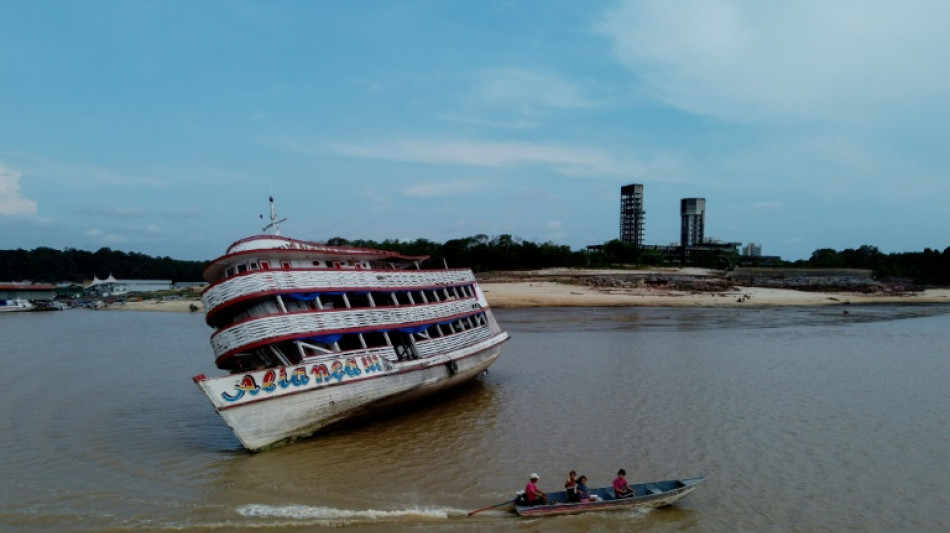
10% of dolphins killed as Amazon drought hits lake: study / Photo: MICHAEL DANTAS - AFP

 Nintendo producer 'all nervous' as Zelda classic remake hits shelves

 Three killed by storm in southern India

 Two hundred 'Cruise for life' passengers stranded in Cambodia

 Billionaire Ambani's Jio jumps 21% in market debut after record India IPO

 Sri Lanka's Tamil farmers fight to reclaim land after civil war

 'They don't care about us': Trump food aid cuts leave Americans struggling and angry

 Palestinian activist Khalil returns to Columbia after US detention

 Youths testify about 'despair' in unprecedented Canadian climate trial

 Storied Paris department store seeks bankruptcy protection

 Boeing shares tumble after it releases cautious growth forecast

An estimated 10 percent of the dolphins in a picturesque lake in the Brazilian Amazon were killed in a week as a record drought and searing temperatures devastate the region, researchers said Tuesday.
Emergency teams found 153 dolphins dead in the last week of September in Lake Tefe, where water temperatures reached 39.1 degrees Celsius, more than seven degrees higher than the normal maximum, according to the Mamirau Institute for Sustainable Development (IDSM) and environmental group WWF-Brasil.
The lake is located in the drought-hit northern state of Amazonas, at the spot where the Tefe river empties into the Amazon, in the heart of the world's biggest rainforest.
Researchers reported 130 pink dolphins and 23 tucuxi dolphins killed. Both are listed as species with declining populations by the International Union for Conservation of Nature (IUCN).
Huge numbers of fish have also died off, they said.
"What's happening in Lake Tefe is staggering. The impact of losing these animals is enormous and affects the entire local ecosystem," said Mariana Paschoalini Frias, conservation specialist at WWF-Brasil.
"Dolphins are considered 'sentinels.' They're indicators of the health of their environment. What's happening to them is reflected in other species, as well, including humans," she said in a statement.
Besides killing fish and dolphins, the drought has dramatically reduced river levels, devastating a region that relies on its labyrinth of waterways for transportation and basic needs.
The federal government has sent emergency aid to the stricken region, where normally bustling river banks have turned to eerie, dessicated landscapes dotted with stranded boats.
Experts say the Amazon dry season has been worsened this year by the El Nino warming phenomenon.
Environment Minister Marina Silva has also blamed "uncontrolled climate change."
In state capital Manaus, located at the junction of the Amazon and Negro rivers, authorities reported the water level at the city's port reached its lowest level in 121 years Tuesday, hitting record low for the second straight day.
The Negro's water level stood at 13.49 meters (44 feet), the lowest since records began in 1902, port officials said.
Heavy smoke from forest fires has also engulfed Manaus in recent days, forcing the cancelation of the city's marathon last Sunday.
Y.Ibrahim--CPN