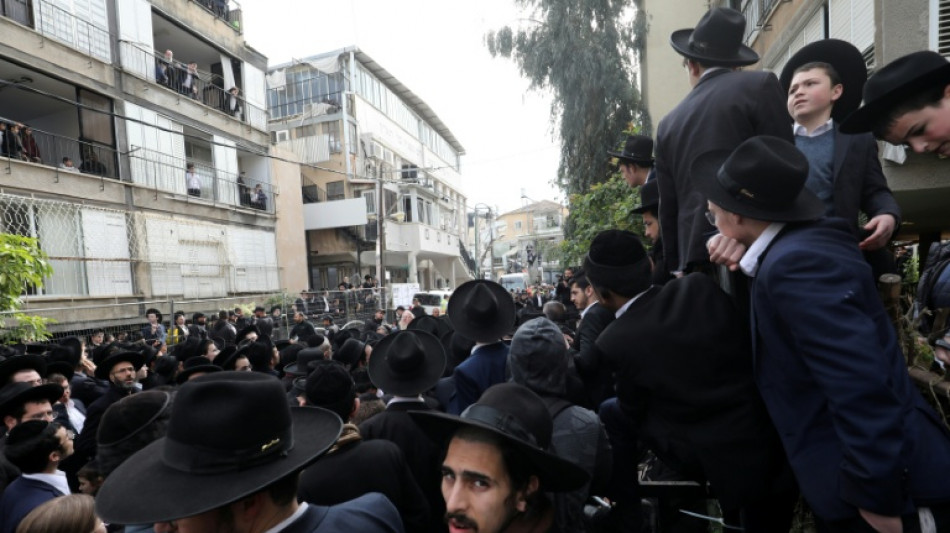
Huge crowd due for Israel rabbi funeral under heavy guard

 Lights out in Laos as electricity exports surge

 Steven Strogatz weighs AI mathematics advances and their consequences for researchers

 Anthropic boss calls for AI slowdown, Altman and Musk agree

 French IT giant Capgemini sells subsidiary after row over ICE links

 Quebec Brokerage Qubit Insurance Announces New Data on Coverage Shortfalls as Rebuilding Costs Rise

 Lady Gaga welcomes first child with fiance: US media

 Bhutan business bets on hazelnuts for farming future

 'Widow's Bay' and 'The Pitt' are favorites for Emmys night

 Coastal erosion forces cancellation of California music festival

 Argentina's Dirty War rears its head in Venice film

 UK lawmakers throw out bill to legalise assisted dying

 US inflation steady in August, fueling Fed rate hike expectations

 New York marks 25th anniversary of 9/11 attacks

 Nepal flood reconstruction bill to be $4.78 bn: foreign ministry

 JUMO and Standard Bank launch Social Finance Framework to scale inclusive finance in Africa

 Doomsday tech: could AI really kill us all?

 French comedy show 'Call my agent' makes film comeback

 It's all coming back: Celine Dion fans gear up for Paris return

 Researchers eye AI revolution in natural disaster forecasts

 US braces for inflation report that may push Fed to hike rates

 Musk threatens legal action over documentary

 Latin America fact-check group asks Meta not to replace verification practice

 AI Risks to Enter 60–80% of Liability and Cyber Insurance Underwriting by 2028, ScienceSoft Predicts

 Tribal Launches Campfire, Letting Business and Technical Teams Build on Salesforce Together

 Stocks fall as fresh oil surge fans inflation fears

Hundreds of thousands of ultra-Orthodox Jews were expected at the funeral Sunday of influential rabbi Chaim Kanievsky, known to followers as the "Prince of Torah", with authorities warning of dangers from massive overcrowding.
Born in the Belarussian city of Pinsk, Kanievsky died Friday aged 94 and was to be buried at midday in the mainly ultra-Orthodox city of Bnei Brak, near Tel Aviv.
The funeral, for which thousands of police and paramilitary officers as well as volunteers have been deployed to provide security, comes 11 months after a disaster at Mount Meron, an ultra-Orthodox pilgrimage site where 45 people died in a stampede.
The Magen David Adom, Israel's equivalent of the Red Cross, said the funeral could be one of the largest gatherings in "Israeli history" and that hundreds of paramedics and other first responders were in place.
The MDA said it was "prepared for any mass casualty event".
- 'Our master, the Prince of Torah' -
Kanievsky was the de facto head of what is commonly called the Lithuanian branch of ultra-Orthodox Judaism, and his knowledge of Jewish law was so revered that his rulings were thought to require total compliance within his community.
To some followers, he was known as "our master, the Prince of Torah", comprising the religion's laws and traditions.
Israel's ultra-Orthodox Jews, or haredim, are split among various factions and groups, but Kanievsky was seen by some as a unifying figure.
Aryeh Deri, a political leader and rabbi from the Sephardic haredi group -- which has its roots in southern Europe and North Africa, rather than the Middle East -- said Kanievsky transcended "definition".
He "was my rabbi", Deri told Israel's public Channel 11 television on Saturday.
Despite his prominence, Kanievsky lived in a modest Bnei Brak apartment, where religious texts lined the walls of a small study.
His notoriety within Israel and abroad surged in 2020 when he was accused of encouraging followers to ignore social distancing restrictions and continue gathering to study Torah.
A Jerusalem Post op-ed accused Kanievsky of committing an act of "civil disobedience" unprecedented in Israel's history, at a time when the rest of the Jewish state was required to isolate.
Widespread resistance among some haredim to respect restrictions, including orders to close schools and houses of worship, fostered deep resentment among mainstream Israeli society.
Yaakov Kanievsky, the rabbi's grandson and top advisor, told AFP at the time that the rabbi had not been not seeking to appear "defiant" in response to Covid lockdown rules.
But he stressed that for a prominent haredi rabbi like Kanievsky, limiting viral transmission could not be not be the main consideration.
"For the rabbi, the most important thing in the world is the study of Torah. Without that, there is no point to anything," Yaakov Kanievsky told AFP in November 2020.
"The rabbi believes that the Jewish people have no existence without Torah. You can't separate the two, you must study."
H.Müller--CPN