Dozens of whales die in New Zealand mass stranding

 Lights out in Laos as electricity exports surge

 Steven Strogatz weighs AI mathematics advances and their consequences for researchers

 Anthropic boss calls for AI slowdown, Altman and Musk agree

 French IT giant Capgemini sells subsidiary after row over ICE links

 Quebec Brokerage Qubit Insurance Announces New Data on Coverage Shortfalls as Rebuilding Costs Rise

 Lady Gaga welcomes first child with fiance: US media

 Bhutan business bets on hazelnuts for farming future

 'Widow's Bay' and 'The Pitt' are favorites for Emmys night

 Coastal erosion forces cancellation of California music festival

 Argentina's Dirty War rears its head in Venice film

 UK lawmakers throw out bill to legalise assisted dying

 US inflation steady in August, fueling Fed rate hike expectations

 New York marks 25th anniversary of 9/11 attacks

 Nepal flood reconstruction bill to be $4.78 bn: foreign ministry

 JUMO and Standard Bank launch Social Finance Framework to scale inclusive finance in Africa

 Doomsday tech: could AI really kill us all?

 French comedy show 'Call my agent' makes film comeback

 It's all coming back: Celine Dion fans gear up for Paris return

 Researchers eye AI revolution in natural disaster forecasts

 US braces for inflation report that may push Fed to hike rates

 Musk threatens legal action over documentary

 Latin America fact-check group asks Meta not to replace verification practice

 AI Risks to Enter 60–80% of Liability and Cyber Insurance Underwriting by 2028, ScienceSoft Predicts

 Tribal Launches Campfire, Letting Business and Technical Teams Build on Salesforce Together

 Stocks fall as fresh oil surge fans inflation fears

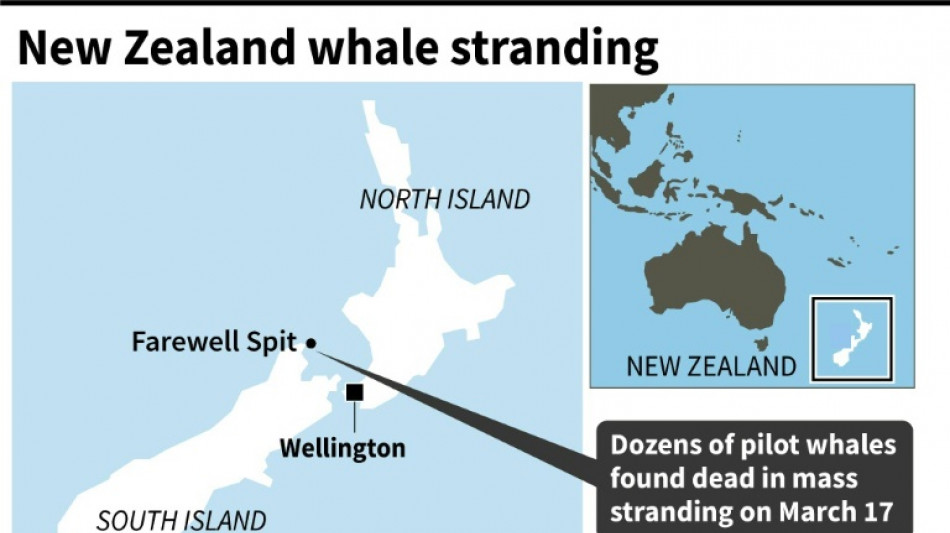
More than two dozen whales died in a mass stranding at a New Zealand beach renowned as a death trap for the ocean giants, wildlife rangers said Friday.
The Department of Conservation said 29 long-finned pilot whales were already dead when the pod of 34 marine mammals was found at remote Farewell Spit on the South Island late Thursday.
Department spokesman Dave Winterburn said rangers were providing care for five survivors but noted "the whales have now been out of the water for some time".
"While this event is unfortunate, whale strandings are a natural phenomenon," he said.
"The cause of this stranding is not known."
Farewell Spit, a 26-kilometre (16 mile) hook of sand that protrudes into the sea, has been the scene of more than 10 pilot whale strandings in the past 15 years.
The largest was in February 2017, when almost 700 of the mammals beached, resulting in 250 deaths.
Scientists are unclear about why the beach is so deadly. One theory is that the spit creates a shallow seabed in the bay that interferes with the whales' sonar navigation systems.
Pilot whales, the most common species of whale in New Zealand waters, are particularly susceptible to mass strandings.
The whales, which grow up to six metres (20 feet) long, are regularly found beached in large numbers.
St.Ch.Baker--CPN