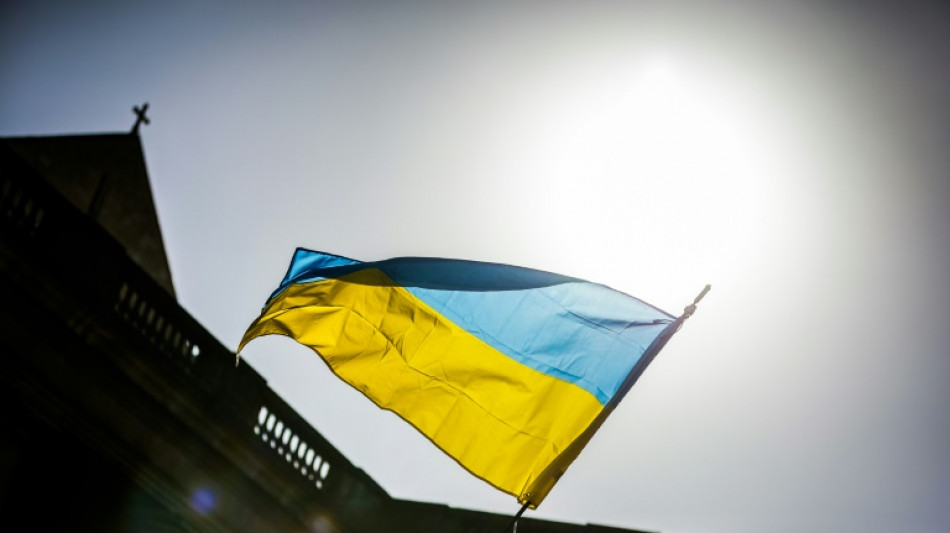
Five things to know about Ukraine

 Lights out in Laos as electricity exports surge

 Steven Strogatz weighs AI mathematics advances and their consequences for researchers

 Anthropic boss calls for AI slowdown, Altman and Musk agree

 French IT giant Capgemini sells subsidiary after row over ICE links

 Quebec Brokerage Qubit Insurance Announces New Data on Coverage Shortfalls as Rebuilding Costs Rise

 Lady Gaga welcomes first child with fiance: US media

 Bhutan business bets on hazelnuts for farming future

 'Widow's Bay' and 'The Pitt' are favorites for Emmys night

 Coastal erosion forces cancellation of California music festival

 Argentina's Dirty War rears its head in Venice film

 UK lawmakers throw out bill to legalise assisted dying

 US inflation steady in August, fueling Fed rate hike expectations

 New York marks 25th anniversary of 9/11 attacks

 Nepal flood reconstruction bill to be $4.78 bn: foreign ministry

 JUMO and Standard Bank launch Social Finance Framework to scale inclusive finance in Africa

 Doomsday tech: could AI really kill us all?

 French comedy show 'Call my agent' makes film comeback

 It's all coming back: Celine Dion fans gear up for Paris return

 Researchers eye AI revolution in natural disaster forecasts

 US braces for inflation report that may push Fed to hike rates

 Musk threatens legal action over documentary

 Latin America fact-check group asks Meta not to replace verification practice

 AI Risks to Enter 60–80% of Liability and Cyber Insurance Underwriting by 2028, ScienceSoft Predicts

 Tribal Launches Campfire, Letting Business and Technical Teams Build on Salesforce Together

 Stocks fall as fresh oil surge fans inflation fears

As Russian troops approach the Ukrainian capital in an all-out offensive, here are five facts about the country that has long been disputed by great empires.
- Disputed history -
Ukraine literally means "on the edge".
Modern-day Russia and Ukraine both trace their roots to the medieval state of Kievan Rus, which at its height stretched from the Black Sea to the Baltic.
Indeed Russian President Vladimir Putin has written a 5,000-word essay trying to prove that "Russians and Ukrainians are one people".
But Ukrainians speak their own language and much of what is now Ukraine was part of the Polish-Lithuanian Commonwealth, with other areas controlled by the Cossacks and Crimean Tatars up to the end of the 18th century.
It then became part of the Tsarist Russian empire although some western regions belonged to the Austro-Hungarian Empire.
- Stalin's famine -
Ukraine later became part of the Soviet Union, suffering during a devastating famine known as the Holodomor caused by Joseph Stalin's policies that killed up to five million people there.
Tensions between Kiev and Moscow flared again in the decades following the break-up of the Soviet Union in 1991 when an overwhelming majority of Ukraine's people voted for independence.
After a pro-Western popular uprising led to Russian-backed president Viktor Yanukovych fleeing in 2014, Moscow annexed the Crimean peninsula and supported separatists in the east of Ukraine.
The conflict has claimed around 14,000 lives.
- Economic trouble -
The annexation of Crimea and the loss of the industrial Donbas in 2014 threw the Ukrainian economy into freefall. GDP dropped by more than six percent, and the following year it fell nearly a tenth, with inflation hitting more than 40 percent.
The economy has since recovered somewhat but the country of 45 million people remains one of the poorest in Europe.
An average monthly salary is $615 (550 euros).
The country relies on transit fees for Russian gas towards Europe but new Moscow energy pipelines like Nord Stream bypass it.
During disputes in 2006 and 2009, Moscow cut supplies to Ukraine during the winter, sparking knock-on shortages in Europe.
The country also suffers from endemic corruption, with anti-corruption campaigners regularly suffer physical attacks.
- Chernobyl -
The world's worst nuclear accident took place in Ukraine on April 26, 1986, at the Chernobyl nuclear power station.
Many hundreds died though the exact figure remains disputed. Soviet authorities initially tried to cover up the disaster.
Eventually 350,000 people were evacuated from within a 30-kilometre (19-mile) radius around the plant, an exclusion zone that remains uninhabited, apart from some elderly residents who returned despite an official ban.
Humans will only be safe to live there again in 24,000 years.
In recent years the site has become a tourist attraction, with the success of HBO's mini-series "Chernobyl".
- Borscht and Chicken Kiev -
While some in the West think of borscht as synonymous with Russian cuisine, Ukraine claims the beetroot-based soup with cabbage as part of its national heritage dating back to the 14th century.
A number of other dishes are contested by Russia and Ukraine, including Chicken Kiev.
A.Zimmermann--CPN