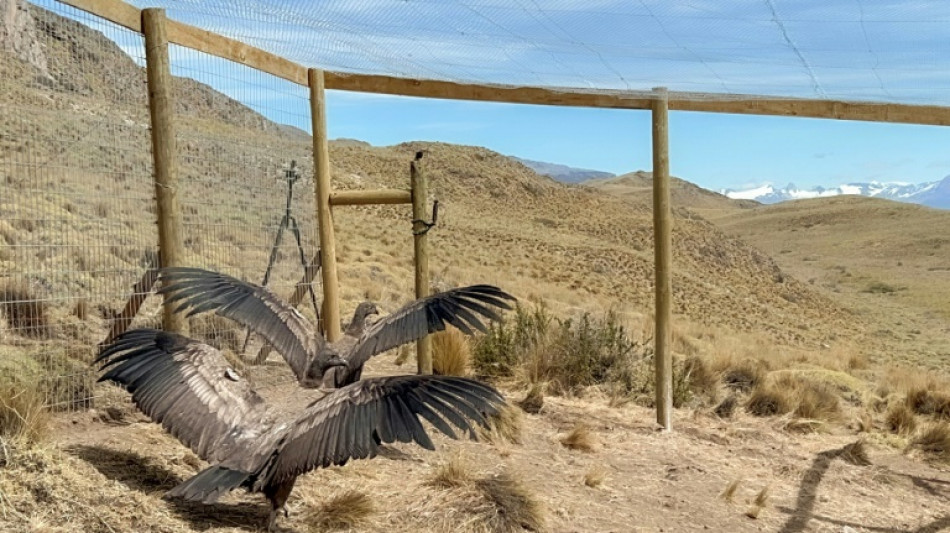
Rescued condors spread wings in Chilean Andes

 Lights out in Laos as electricity exports surge

 Steven Strogatz weighs AI mathematics advances and their consequences for researchers

 Anthropic boss calls for AI slowdown, Altman and Musk agree

 French IT giant Capgemini sells subsidiary after row over ICE links

 Quebec Brokerage Qubit Insurance Announces New Data on Coverage Shortfalls as Rebuilding Costs Rise

 Lady Gaga welcomes first child with fiance: US media

 Bhutan business bets on hazelnuts for farming future

 'Widow's Bay' and 'The Pitt' are favorites for Emmys night

 Coastal erosion forces cancellation of California music festival

 Argentina's Dirty War rears its head in Venice film

 UK lawmakers throw out bill to legalise assisted dying

 US inflation steady in August, fueling Fed rate hike expectations

 New York marks 25th anniversary of 9/11 attacks

 Nepal flood reconstruction bill to be $4.78 bn: foreign ministry

 JUMO and Standard Bank launch Social Finance Framework to scale inclusive finance in Africa

 Doomsday tech: could AI really kill us all?

 French comedy show 'Call my agent' makes film comeback

 It's all coming back: Celine Dion fans gear up for Paris return

 Researchers eye AI revolution in natural disaster forecasts

 US braces for inflation report that may push Fed to hike rates

 Musk threatens legal action over documentary

 Latin America fact-check group asks Meta not to replace verification practice

 AI Risks to Enter 60–80% of Liability and Cyber Insurance Underwriting by 2028, ScienceSoft Predicts

 Tribal Launches Campfire, Letting Business and Technical Teams Build on Salesforce Together

 Stocks fall as fresh oil surge fans inflation fears

Pumalin and Liquine, two juvenile condors rescued from certain death, have been released back into the wild in a much-needed boost for a dwindling species emblematic of the Chilean Andes.
After 14 months of rehabilitation, the pair of scavengers were freed last week in the Patagonian National Park in Chile's extreme south, where every individual counts for a species listed by the International Union for Conservation of Nature (IUCN) as "vulnerable" to extinction.
From a vast cage perched on the edge of a cliff overlooking the Patagonian valley, the pair spread their massive wings, waddled to the ledge, and took the leap of freedom, soaring away graciously.
"Today we have witnessed a milestone," Christian Saucedo of the Rewilding Chile Foundation told AFP.
"It is a very complex process... but it means returning individuals who would otherwise be condemned to live in captivity," he said.
According to the IUCN, the Andean condor -- a type of scavenging vulture -- is a declining species, with fewer than 7,000 left in the wild.
- Human 'persecution' -
The main threat is "direct and indirect persecution by humans," it states.
Dominic Duran, the executive director of the Manku Project for condor conservation, told AFP "the biggest threat is toxic baits set by humans to poison... pumas or wild dogs eating their livestock."
When the condors feed on these carcasses, up to 30 at a time, they get poisoned in turn.
The first to eat, he added, are usually the breeding males and females, and "when condors are killed by toxic bait, all the reproductive individuals at the top of the chain die."
Other threats are hunting by humans, intoxication from poorly-managed landfills and dwindling numbers of the wild animals that make up their diet.
The foundation that rescued Pumalin and Liquine is a legacy of US philanthropist Douglas Tompkins, who in 1990 donated 8,000 square kilometers (3,088 square miles) of land to Chile and Argentina for conservation.
The Patagonia National Park now housed there holds an estimated 70 percent of Chile's Andean condors -- the largest population in South America.
Pumalin, a male, was found over a year ago unable to fly after getting caught in a heavy storm, and Liquine, a female, was rescued struggling to make it in the wild after an earlier attempt to rehabilitate her.
They will now go back to "learning the codes of condor society," said Saucedo.
The pair's progress will be monitored with radio transmitters implanted in their wings.
A.Leibowitz--CPN