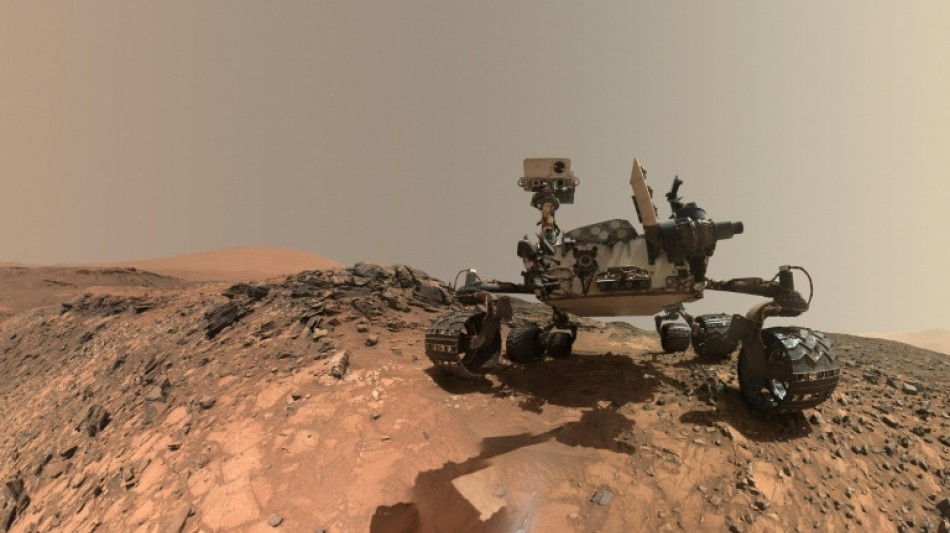
Rover discovers more building blocks of life on Mars / Photo: Handout - NASA/AFP/File

 Emporio Armani names Dario Vitale new creative director

 EU to ban social media for under 13s, curb access until 15

 Wildfires push endangered Sumatran elephants to brink: Indonesian NGO

 Bank of Japan set to raise rates under pressure from inflation, US

 EU chief to unveil social media, gaming curbs for under-15s

 'Resident Evil' film brings video game's ethos to the big screen

 i-payout Expands U.S. Money Transmitter Licensing Footprint and Advances European EMI Strategy

 US Senate crypto bill collapses amid partisan deadlock

 OpenAI, Anthropic and Google are working to create an AI standards body

 Protesting shepherds, farmers clash with Romanian police

 Foundation Lets Ledger Users Switch to Open Source Without Starting Over

 EU to propose curbing social media, online games for under 15s

 FX Junction Reaches 40,600 Members and 26 Million Trades

 'We unleashed the beast': the world's fears and hopes about AI

 Hospitality leaders ask Burnham to halve VAT amid rising costs

 Worcestershire invited to nominate groups for 2027 King’s volunteer award

 Berlin's run-down public spaces at heart of election campaign

 'Widow's Bay' and 'The Pitt' win big at Emmy Awards

 Most markets drop as oil extends gains ahead of expected US rate hike

 Sri Lanka's famed beach shack battles demolition

 Vserv targets ₹1,000 crore revenue by 2030 through AI expansion

 India prohibits bank fees on UPI payments up to ₹2,000

 Brazil's Amazon defender Raoni has cancer

 Trump rejects AI slowdown concerns as UN urges coordinated controls

 Higher wages draw migrant workers to Kashmir despite attacks

A NASA rover has discovered more building blocks of life on Mars after carrying out a chemistry experiment never before conducted on another planet, scientists said Tuesday.
The organic molecules are not definitive evidence of past life, the NASA-led team emphasised, because they could also have formed on the red planet or crash-landed on meteorites.
But it proves that these important clues to Martian history have been preserved on the surface for more than three billion years, they added.
Back then, the surface of Mars was thought to have been dotted with huge lakes and rivers full of liquid water, a key ingredient for life as we know it.
NASA's Curiosity rover landed in a former lake bed called the Gale crater in 2012, and has been searching for signs of possible past life since.
The car-sized rover carried two tubes of a chemical called TMAH, which can break apart organic matter to see what it is made out of.
"This experiment's never been run before on another world," Amy Williams, an astrobiologist working on the Curiosity mission told AFP.
The team were under pressure because they only had "two shots to get it right", added Williams, the lead author of a new study describing the results.
The experiment, conducted in 2020, detected more than 20 organic molecules, including several that had never before been confirmed on Mars.
These included a molecule called benzothiophene, which has also been found in meteorites and asteroids.
"The same stuff that rained down on Mars from meteorites is what rained down on Earth, and it probably provided the building blocks for life as we know it on our planet," Williams said.
Another molecule containing nitrogen "is a precursor to how DNA is eventually built," she added.
"We're seeing the building blocks for life -- prebiotic chemistry on Mars -- preserved in these rocks for billions of years."
- Future missions -
But none of this can prove that life -- even tiny, microbial organisms -- once flourished on Mars.
One way to potentially make such an "extraordinary claim" would be to bring some Martian rocks back to Earth so scientists can study them more closely, Williams said.
NASA's Perseverance rover has already collected a bunch of rocks for such a mission, called Mars Sample Return.
However the mission has effectively been cancelled by the administration of President Donald Trump following a US Congress vote in January.
Future missions could still benefit from Curiosity's demonstration that experiments using the TMAH chemical work on other worlds, the new study in Nature Communications said.
The European Space Agency's Rosalind Franklin rover, which has a much longer drill than Curiosity, will take the chemical to Mars.
After years of delays, NASA announced last week that the ESA's rover is now scheduled to blast off towards the red planet in late 2028.
The chemical will also be on board the Dragon rotorcraft, which is planned to launch in 2028 on a mission to explore Saturn's moon Titan.
A.Samuel--CPN