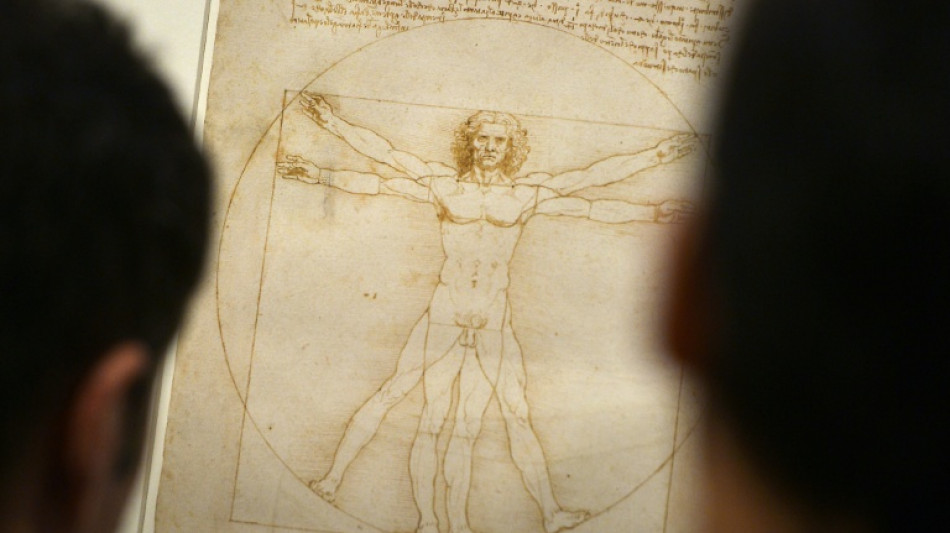
Desmond Morris: from 'Naked Ape' to watching 'Big Brother' / Photo: Gabriel BOUYS - AFP/File

 Emporio Armani names Dario Vitale new creative director

 EU to ban social media for under 13s, curb access until 15

 Wildfires push endangered Sumatran elephants to brink: Indonesian NGO

 Bank of Japan set to raise rates under pressure from inflation, US

 EU chief to unveil social media, gaming curbs for under-15s

 'Resident Evil' film brings video game's ethos to the big screen

 i-payout Expands U.S. Money Transmitter Licensing Footprint and Advances European EMI Strategy

 US Senate crypto bill collapses amid partisan deadlock

 OpenAI, Anthropic and Google are working to create an AI standards body

 Protesting shepherds, farmers clash with Romanian police

 Foundation Lets Ledger Users Switch to Open Source Without Starting Over

 EU to propose curbing social media, online games for under 15s

 FX Junction Reaches 40,600 Members and 26 Million Trades

 'We unleashed the beast': the world's fears and hopes about AI

 Hospitality leaders ask Burnham to halve VAT amid rising costs

 Worcestershire invited to nominate groups for 2027 King’s volunteer award

 Berlin's run-down public spaces at heart of election campaign

 'Widow's Bay' and 'The Pitt' win big at Emmy Awards

 Most markets drop as oil extends gains ahead of expected US rate hike

 Sri Lanka's famed beach shack battles demolition
 Vserv targets ₹1,000 crore revenue by 2030 through AI expansion
 India prohibits bank fees on UPI payments up to ₹2,000

 Brazil's Amazon defender Raoni has cancer

 Trump rejects AI slowdown concerns as UN urges coordinated controls

 Higher wages draw migrant workers to Kashmir despite attacks

Celebrated British zoologist Desmond Morris, who died Sunday aged 98, shook up the world in 1967 when his book "The Naked Ape" posited that humans are essentially primates still captive to evolutionary impulses.
The idea that homo sapiens -- while cleverer and less hirsute than the average ape -- should be analysed as a belonging to the animal world was not new to anthropologists.
But it was not mainstream among the general public, in a less secular age when, still for most, man was made in the image of God. The book sold upwards of 20 million copies in at least 23 languages.
His death, confirmed Monday to AFP by his son Jason Morris, followed what he called "a lifetime of exploration, curiosity and creativity".
"A zoologist, manwatcher, author and artist, he was still writing and painting right up until his death," Jason Morris said in a statement.
"He was a great man and an even better father and grandfather."
Morris's career was not without controversy.
Feminists and some other scientists objected to his contention that men and women evolved to do different tasks -- split between hunting and managing the home -- and that the modern world was shaped around that.
Gender differences were hard-wired, Morris argued, but he said urbanisation had entrenched an inappropriate split which favours competitive traits in business -- the modern equivalent to prehistoric hunting grounds.
"Because of the structure of urban life, men have been unfairly favoured over women," he told The Oldie magazine in 2021, marking his 93rd birthday.
- TV fame -
Morris denied he set out to be provocative when he wrote "The Naked Ape" over a four-week rush just after the counter-cultural "Summer of Love" in 1967.
He said he was simply setting down observations from working as a curator of mammals at London Zoo.
In fact, his early ambition was to change how we view the world but through modern art.
Born in southern England in 1928, Morris watched his father die a slow death from wounds suffered in World War I, an experience that informed his youthful desire to find expression through surrealism after World War II.
After a post-war stint as an army conscript, Morris exhibited some of his works alongside the Spanish master Joan Miro in 1950, and said he only studied zoology to better understand the natural world for his art.
In 1993, he told the Swindon Advertiser newspaper -- founded by his great-grandfather -- that his early fascination with wildlife was honed at a local park.
While he continued to paint and exhibit throughout his long life, Morris found his professional calling in popular science, becoming head of a television and film unit at London Zoo in 1956.
- 'Monkey Matisse' -
His contemporary, David Attenborough, became a friendly rival on a different TV channel, both using the newly emerging medium to bring zoology into the home.
Morris's two passions overlapped in 1957 when he curated an exhibition of chimpanzee paintings and drawings in London.
One three-year-old chimp called Congo produced more than 400 works, and was hailed as "the monkey Matisse" and "the Picasso of the Simian world".
The success of "The Naked Ape" -- which inspired a Eurovision Song Contest entry in 2017 by Italy featuring a dancer in a gorilla suit -- brought global fame.
But a stinging tax bill in Britain saw Morris move in 1968 with his wife to Malta, where he worked on a sequel about city-dwellers called "The Human Zoo".
Five years later, with the addition of their son, the couple moved back to England where Morris took up a fellowship at Oxford University.
A succession of books and TV series followed.
In the 2000s, Morris wrote opinion pieces from an anthropological perspective on the contestants in the reality television hit "Big Brother".
Asked by The Guardian newspaper in 2007 if he had any regrets, he lamented not sticking to art.
"I still consider myself a serious artist but a very minor one, and I'm a minor artist because I've been doing too many other things."
In 2019 he moved to Ireland, and acquired a property near Dublin which was transformed into the Dun Laoghaire Institute of the Visual Arts (DIVA), according to a website dedicated to Morris's life.
"He sees it as his gift to Ireland for welcoming him in his final years," the site said.
M.P.Jacobs--CPN