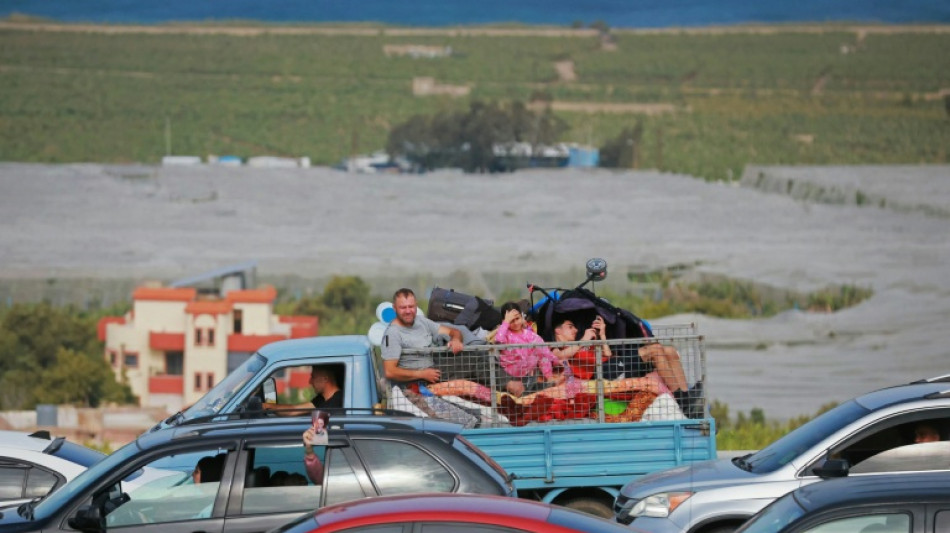
Lebanese civilians head home despite Israel warning on truce / Photo: ibrahim AMRO - AFP

 Princess Diana's brother makes new explosive claims against Charles

 Trump admin overhauls key protection for endangered species

 Mbappe draws political fire over Ceuta t-shirt controversy

 Third malaria death in Germany from outbreak tied to Frankfurt airport

 AtlasClear Holdings Reports Preliminary Fiscal 2026 Revenue of Approximately $20.1 Million, Up 85%; Revenue Plus Interest Income of Approximately $21.9 Million

 'Another arrow to the quiver': World Bank posts record private capital mobilization

 Ireland to boycott Eurovision 2027 over Gaza

 India's Tata Sons reappoints N. Chandrasekaran as chairman

 Germany urges EU action against China to defend carmakers

 Japan eyes changing prostitution law to punish sex buyers

 Modi pitches India as global chipmaking hub

 Ukraine plans record defence spending in 2027

 NASA scan discovers new, 'once in a century' Moon crater

 Most stocks rise as Fed hikes and indicates drive to curb inflation

 UK-Sudanese author pens book to give children 'African history of Africa'

 Argentine judge orders suspension of Falklands oil project

 US Fed raises rates to tackle 'too high' inflation, irking Trump

 Turkey releases 106 protesters, jails more LGBTQ activists

 Candidate for UN chief calls for AI regulation akin to nuclear weapons

 'We're losing control,' AI pioneer Yoshua Bengio tells AFP

 IR-MED and Dice Technologies Announce collaboration to Evaluate and Advance Pressure-Injury Prevention Platform in Japan

 Watts, Pitt, Cruz to light up Spain's top film festival

 Toogood Gold's Table Mountain Sits in the Shadow of a Nevada Gold Rush

 MEXC July–August Security Report: 38.66M USDT in Risk Funds Intercepted, Futures Insurance Fund Hits 792M USDT

 Emporio Armani names Dario Vitale new creative director

Thousands of displaced Lebanese civilians took to the road on Friday, hoping a 10-day ceasefire with Israel would allow them to return to their homes in southern Beirut and the country's war-torn south.
Roads heading south from the capital were clogged with traffic, despite Israel's defence minister warning that its operation against Hezbollah was not yet complete and that civilians may have to evacuate once again.
Minutes before the ceasefire came into effect at midnight, a series of Israeli strikes in the southern city of Tyre killed at least 13 people and destroyed six residential buildings, a city official said.
For some returnees, the short, temporary truce between Israel and the Lebanese government, brokered under pressure from US President Donald Trump, was a new source of hope.
"Our feelings are indescribable, pride and victory," 37-year-old Amani Atrash told AFP from her car seat on a road leading to a bridge into southern Lebanon, adding that she hoped the truce would be extended.
- 'Security zone' -
Under the terms of the ceasefire, Israel reserves the right to continue targeting Hezbollah to prevent "planned, imminent, or ongoing attacks", and it says it will maintain a 10-kilometre (six-mile) security zone along the border in southern Lebanon.
Israeli defence minister Israel Katz said the area stretching from this security zone north to the Litani River had not yet been "cleared of terrorists and weapons" and that if diplomatic pressure did not achieve that goal, then military action could resume.
"If the fighting resumes, those residents who return to the security zone will have to be evacuated to allow completion of the mission," he said.
According to details of the truce deal released by the US State Department, Lebanon "with international support... will take meaningful steps to prevent Hezbollah" from undertaking hostile acts against Israeli targets.
Lebanon's President Jospeh Aoun, who had been resisting US pressure to talk directly to Israel's Prime Minister Benjamin Netanyahu before the ceasefire was in place, said nonetheless that direct negotiations with Israel were "crucial".
Beirut's goal, he said in a statement, was to "consolidate a ceasefire, secure the withdrawal of Israeli forces from the occupied southern territories, recover prisoners, and address outstanding border disputes".
The Iran-backed movement Hezbollah, meanwhile, said its finger remains "on the trigger" in the event of any Israeli violations.
Despite the warnings against returning to the south, long queues of displaced families began traversing the bomb-damaged Qasmiyeh bridge near the southern city of Tyre on Friday after bulldozers restored the crossing so they could head home, according to AFP journalists.
Across the border in Israel, the military's home front command had not yet removed restrictions on civilian movements in vulnerable border areas.
Still, some civilians there were daring to hope for a return to a more normal life.
"I've got a three-year-old girl and a two-month-old baby, and the whole time we've just not left the house because you never know when there'll be a rocket attack," 31-year-old Ofir Ben-Ari told AFP.
"It's been crazy, but I think things will be quiet now and I'll be able to take my daughter to the park", she added.
- 'Historic' opportunity -
The ceasefire represents a key step in Washington's efforts to reach a deal to end its war with Iran, after Tehran insisted that halting the Lebanon fighting must be part of any agreement.
Pakistan has been leading a diplomatic push to restart face-to-face talks between Tehran and Washington, and Trump said they were "very close" to striking an agreement.
The fighting broke out in Lebanon on March 2 when Hezbollah fired rockets at Israel a few days after the start of the Middle East war in retribution for the killing of Iran's supreme leader Ali Khamenei.
Trump said he had spoken to both Netanyahu and Aoun ahead of the truce, which he said they had agreed "in order to achieve PEACE between their Countries".
He later said he expected Netanyahu and Aoun to visit the White House in the coming days.
A top-level face-to-face meeting between the Lebanese and Israeli leadership would be a watershed moment for the region. But it remained to be seen whether it would take place.
Netanyahu said the ceasefire with Lebanon offered an opportunity for a "historic peace agreement" with Beirut -- but insisted that the disarmament of Hezbollah remained a precondition.
Lebanese Prime Minister Nawaf Salam welcomed Trump's announcement, saying a truce was a "key Lebanese demand that we have pursued since the very first day of the war".
burs/dc/smw
M.Davis--CPN