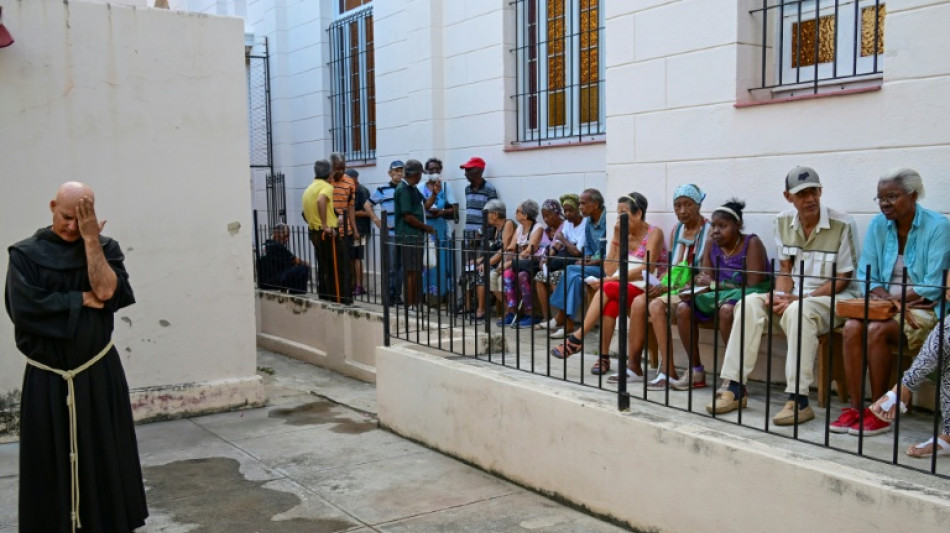
Churches to the rescue of Cuba's legions of poor / Photo: YAMIL LAGE - AFP

 Princess Diana's brother makes new explosive claims against Charles

 Trump admin overhauls key protection for endangered species

 Mbappe draws political fire over Ceuta t-shirt controversy

 Third malaria death in Germany from outbreak tied to Frankfurt airport

 AtlasClear Holdings Reports Preliminary Fiscal 2026 Revenue of Approximately $20.1 Million, Up 85%; Revenue Plus Interest Income of Approximately $21.9 Million

 'Another arrow to the quiver': World Bank posts record private capital mobilization

 Ireland to boycott Eurovision 2027 over Gaza

 India's Tata Sons reappoints N. Chandrasekaran as chairman

 Germany urges EU action against China to defend carmakers

 Japan eyes changing prostitution law to punish sex buyers

 Modi pitches India as global chipmaking hub

 Ukraine plans record defence spending in 2027

 NASA scan discovers new, 'once in a century' Moon crater

 Most stocks rise as Fed hikes and indicates drive to curb inflation

 UK-Sudanese author pens book to give children 'African history of Africa'

 Argentine judge orders suspension of Falklands oil project

 US Fed raises rates to tackle 'too high' inflation, irking Trump

 Turkey releases 106 protesters, jails more LGBTQ activists

 Candidate for UN chief calls for AI regulation akin to nuclear weapons

 'We're losing control,' AI pioneer Yoshua Bengio tells AFP

 IR-MED and Dice Technologies Announce collaboration to Evaluate and Advance Pressure-Injury Prevention Platform in Japan

 Watts, Pitt, Cruz to light up Spain's top film festival

 Toogood Gold's Table Mountain Sits in the Shadow of a Nevada Gold Rush

 MEXC July–August Security Report: 38.66M USDT in Risk Funds Intercepted, Futures Insurance Fund Hits 792M USDT

 Emporio Armani names Dario Vitale new creative director

In communist Cuba, where priests were once persecuted, churches are acting as a lifeline for the needy during a severe economic crisis aggravated by a crippling US oil blockade.
Dozens of people queue outside Santa Cruz de Jerusalen Catholic church in Havana twice a week for free medicine, which, like food and electricity, is in short supply on the island.
The crisis, which began six years ago during the Covid pandemic, has deepened since January, when the United States began piling pressure on its arch foe after overthrowing the leader of Cuba's closest ally, Venezuela.
To force Cuba's leadership to the negotiating table, President Donald Trump cut off oil exports to the island, pushing the already teetering economy to the brink of collapse.
Churches, which for the first three decades after Fidel Castro's 1959 revolution were hounded by atheist authorities, are increasingly filling the vacuum left by a cash-strapped state.
Juana Emilia Zamora, a 71-year-old retiree who suffers from hypertension, came to Santa Cruz de Jerusalen because the state-run pharmacy is out of the drugs she needs.
"The other way to get them would be from people who sell them (on the black market), but the prices are very high," Zamora, who survives on a monthly pension of 2,000 Cuban pesos (under $4), told AFP.
The aid comes with no strings attached but before the donated medicine is handed over, Friar Luis Perna, one of the church's Franciscan priests, recites an "Our Father."
- Bare necessities -
When the church began the distributions in 2022, only one or two people came each week, Gretel Agrelo, a lay volunteer, recalled.
But in recent months, up to 300 people have begun seeking assistance, leaving the congregation struggling to meet demand.
Perna said that a growing number of Cubans were "deprived of the bare necessities of life."
Some leave crumpled, virtually worthless pesos in a donation box as a gesture of gratitude.
- A line to Washington -
The Catholic Church had a fraught relationship with the state in the early years of communist rule.
In 1961, its schools and other social programs were confiscated by the State, eager to maintain control over the two main planks of the revolution: education and healthcare.
The end of state atheism in the 1990s and a succession of economic crises gave the Catholic Church room to play a bigger role, both in social upliftment and as the Vatican's mediator in talks between Havana and Washington.
It was to the church and its NGO Caritas that Washington turned to when seeking a non-state partner to distribute $9 million in humanitarian aid for the victims of Hurricane Melissa.
The hurricane struck eastern Cuba in October but the US aid is still slowly making its way to remote villages.
- Meat and beans -
Protestant congregations have also stepped up their charitable operations in response to the crisis.
Three times a week, around 400 people -- up from 90 two years ago -- attend a service at Nazareth Baptist Church in Havana, after which lunch is served and those who need can see a doctor.
"Most are elderly people who live alone or come from very low-income families, but we also have single mothers and people with disabilities," pastor Karell Lescay, a 52-year-old pediatrician, told AFP.
The aroma of meat and black beans served with rice and coleslaw -- mostly donated by families living on the island -- fills the pews.
Keeping the soup kitchen running is "a huge challenge," said Lescay, pointing to prolonged power outages and "exorbitant" prices for food.
With supplies of subsidized rice, sugar, oil, bread and other basics dwindling, these meals are a lifeline for the diners.
"In these difficult times...the church is here, steadfast, strong, and helping," said 84-year-old Aleida Rodrigue.
O.Hansen--CPN