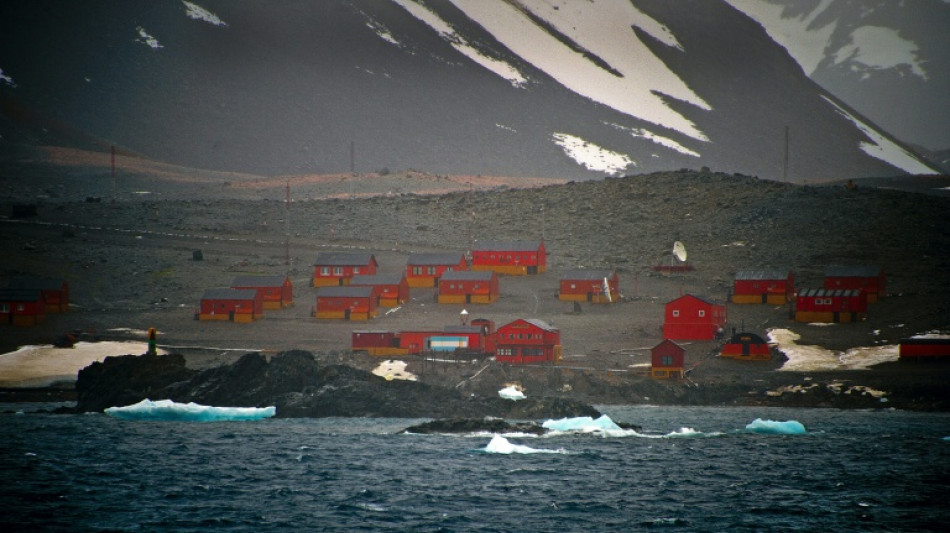
Antarctic Peninsula sees record high June temperatures / Photo: VANDERLEI ALMEIDA - AFP/File

 S.African activists push back on data centre rush

 Billionaire Ambani's Jio to debut after record India IPO

 UK set for cautious budget as borrowing costs climb

 US Fed expected to hold rates steady ahead of key midterm elections

 AI chip giant SK hynix says quarterly operating profit soars 630%

 Charles tackles thorny legacy of slavery on Caribbean trip

 UN nuclear watchdog chief urges Iran to grant access

 Boeing releases cautious growth plan as shares fall sharply

 Tech firms gain on Anthropic IPO optimism; HSBC slumps in London

 Tech firms track Wall St rally on mixed day for stock markets

 HSBC profit jumps on higher rates, lower costs

 Reparations calls follow Charles on tough Caribbean trip

 China brands drop Mbappe for 'offending national sentiments'

 Critical coal inventories affect nearly half of India’s domestic power plants

 Gold ETF flows turn negative after 13 weeks as bullion loses 4%
Temperatures in the Antarctic Peninsula have reached a record-breaking high of 15.4C for June, and ice is melting at abnormal rates during the current winter, climate scientists told AFP on Thursday.
Esperanza Base, an Argentine research station located in the north of the peninsula, recorded the unprecedented figure on June 6.
The previous highest temperature on record for that month -- 13.3C -- dates back to 1998. The current heat also significantly exceeds Esperanza's June average of -6.2C.
Such a figure is "very unusual for this time of year," Jose Luis Stella, a climatologist at Argentina's National Meteorological Service, told AFP.
Argentine bases Marambio and San Martin also recorded unequalled temperatures between June 5 and 6.
Marambio recorded 11.8C, surpassing a previous high of 9.2C and its June average of -10.7C.
San Martin meanwhile saw 9.4C compared to its previous 7.8C record and June average of -5.6C.
- 'Confirms a trend' -
The northern Antarctic heatwave is not an isolated event, University of Groningen professor Raul Cordero told AFP.
"It confirms a trend," he said, warning that "these kinds of events will continue to occur with increasing frequency" if global warming is not derailed.
Thomas Caton Harrison, a polar climate scientist at the British Antarctic Survey, believes a combination of factors including climate change resulted in the current heat.
"There is credible evidence that climate change is playing a role, but the effect is complex in this region," he said.
"Because Antarctica sees such big swings in temperature, we have to collect lots of data over many years to build a picture of the underlying climate."
Both specialists agree that regional temperatures have been rising for years and are already showing visible effects.
"A surprising amount of precipitation has been falling as rain rather than snow," Caton Harrison said.
"This has implications for polar ecosystems such as penguin colonies," he said, adding that "it poses a challenge to my colleagues working on Antarctic bases because a lot of liquid rain has been falling and creating runoff and ice."
Esperanza Base has been recording above-zero temperatures daily for three consecutive weeks.
This trend has caused "large areas in the far north of the white continent to remain free of snow," according to Cordero, who called it "an unusual scene in the Antarctic landscape during winter."
Y.Jeong--CPN