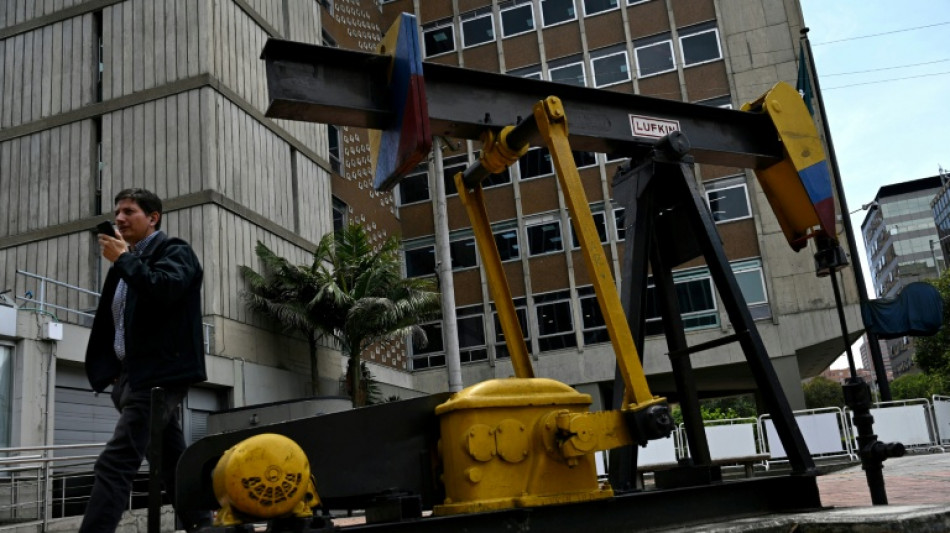
Colombian environmental activist honored amid threats and exile / Photo: Pablo VERA - AFP/File

 Mbappe draws political fire over Ceuta t-shirt controversy

 Third malaria death in Germany from outbreak tied to Frankfurt airport

 AtlasClear Holdings Reports Preliminary Fiscal 2026 Revenue of Approximately $20.1 Million, Up 85%; Revenue Plus Interest Income of Approximately $21.9 Million

 'Another arrow to the quiver': World Bank posts record private capital mobilization

 Ireland to boycott Eurovision 2027 over Gaza

 India's Tata Sons reappoints N. Chandrasekaran as chairman

 Germany urges EU action against China to defend carmakers

 Japan eyes changing prostitution law to punish sex buyers

 Modi pitches India as global chipmaking hub

 Ukraine plans record defence spending in 2027

 NASA scan discovers new, 'once in a century' Moon crater

 Most stocks rise as Fed hikes and indicates drive to curb inflation

 UK-Sudanese author pens book to give children 'African history of Africa'

 Argentine judge orders suspension of Falklands oil project

 US Fed raises rates to tackle 'too high' inflation, irking Trump

 Turkey releases 106 protesters, jails more LGBTQ activists

 Candidate for UN chief calls for AI regulation akin to nuclear weapons

 'We're losing control,' AI pioneer Yoshua Bengio tells AFP

 IR-MED and Dice Technologies Announce collaboration to Evaluate and Advance Pressure-Injury Prevention Platform in Japan

 Watts, Pitt, Cruz to light up Spain's top film festival

 Toogood Gold's Table Mountain Sits in the Shadow of a Nevada Gold Rush

 MEXC July–August Security Report: 38.66M USDT in Risk Funds Intercepted, Futures Insurance Fund Hits 792M USDT

 Emporio Armani names Dario Vitale new creative director

 EU to ban social media for under 13s, curb access until 15

 Wildfires push endangered Sumatran elephants to brink: Indonesian NGO

Afro-Colombian woman Yuvelis Morales, a 25-year-old who has spent most of her adult life working to block the world's biggest oil companies from exploiting fragile ecosystems, won the environmental equivalent of a Nobel prize on Monday.
Morales spoke to AFP about standing up to such multinationals, protecting natural resources in her native Colombia during what she called "the beginning of the end" of the fossil fuel era, and facing the fear of death threats.
Born to a fishing family in the world's deadliest country for environmentalists, the recipient of this year's Goldman Environmental Prize began her activism at age 18.
She grew up on the banks of the Magdalena River, near Colombia's largest oil refinery, in a sweltering region long shaped by oil, conflict and poverty.
Successive Colombian governments have eyed fracking projects in the area, hoping to bring revenue and jobs.
But worried that fracking would threaten water supplies and local livelihoods, Morales organized protests.
Under the slogan "No to fracking," her campaign drew local support -- and national attention.
That pressure helped stop pilot projects backed by state oil company Ecopetrol and US energy giant ExxonMobil.
Morales said she was proud to receive the Goldman prize, often described as the "Green Nobel," alongside five other activists.
But speaking from the US state of California, Morales acknowledges her work has come at a cost.
In 2022, armed men came to her home to issue a warning.
Colombia is the deadliest country in the world for environmental defenders, with nearly 150 murdered in 2024 alone, according to Global Witness.
After receiving repeated threats, Morales decided to leave Colombia and sought asylum in France.
She spent several months in exile and prefers not to speak in detail about that period.
- Fighting fear -
Fear "will always be present because of the anxiety that comes with defending territory," Morales told AFP.
"You decide what to do with that fear," she said. "Whether it immobilizes us, or instead we denounce and shout to the world what is happening."
Morales said her opposition to projects that threaten the Magdalena is "non-negotiable."
The river, Colombia's longest, stretches about 1,540 kilometers (957 miles) and supports fishing, farming and transport across much of the country.
It is home to many Afro-Colombians, who make up about a tenth of Colombia's population.
Many live in poor, rural regions rich in oil and minerals, where communities have long borne the brunt of violence, exclusion and environmental damage.
Fracking, she said, "destroys community harmony, ends agricultural livelihoods, and displaces not only people but also fauna and flora."
But the activist said she is already focused on the next fight.
Her award comes as Colombia hosts a global summit on ending fossil fuels this week in Santa Marta, a city on the Caribbean coast.
Morales said she believes the moment marks "the beginning of the end of the era and expansion of fossil fuels" in Colombia.
President Gustavo Petro has halted new fracking contracts, though efforts to ban the practice in law have stalled in Congress.
"Petro can't finish his term" in August "without a ban on fracking," she insisted.
Morales compares the work of environmental defenders to a "shield."
"I will keep shouting to the world," she said. "We must live in our territories and never give them up."
Y.Ponomarenko--CPN
