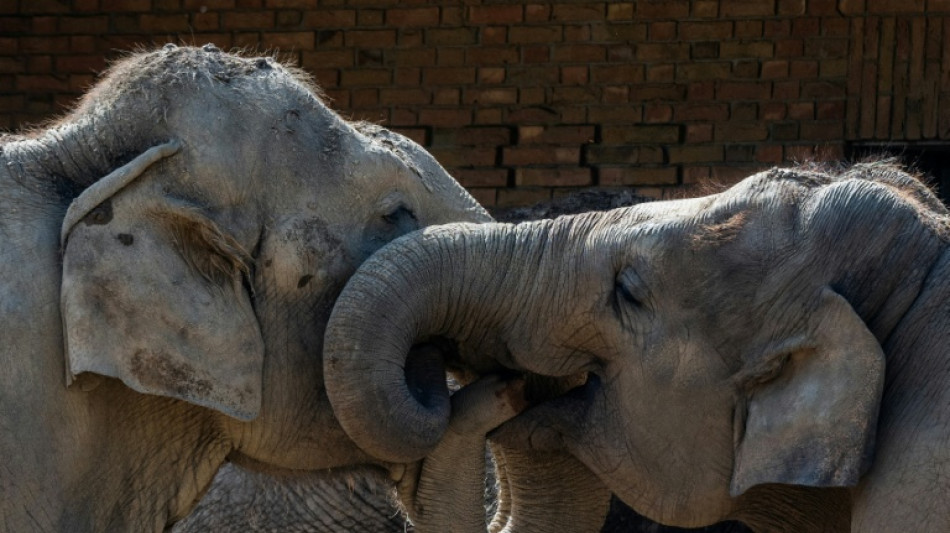
The secret to an elephant's grace? Whiskers / Photo: John MACDOUGALL - AFP

 US House faces test on sweeping Russia sanctions bill

 British PM says to make 'difficult decisions' as inflation rises

 Global fuel price demos: a round-up

 Leverate Launches MCP for Traders to Connect AI Assistants With Trading Platforms

 MEXC Launches $1M "Discover Your Wall Street DNA" Campaign to Help Traders Find Their Market Fit

 Stocks edge higher ahead of US Fed rate call

 BASIS.pro Expands On-Chain Infrastructure with XDC Network Partnership and Zypher DAO as Auto Earn Goes Live

 Pickle-flavoured tart? AI inspires Japan's convenience stores

 EU chief hosts Canada's Carney in push to 'deepen' alliance

 Meta chief pushes back on AI slowdown calls

 US Fed to deliver rate decision with markets betting on hike

 Sanders, Bannon warn of AI dangers in rare US left-right alignment

 Empty benches as schools reopen in Venezuela's quake-hit Guaira

 Tiny English village holds 'independence' vote over asylum seeker housing

 US Treasury chief says to meet Chinese counterpart at weekend

 BingX Evolves into a Multi-Asset Trading Platform, Connecting Users to Global Opportunities

 International Trading Institute Expands Professional Trader Development Beyond the Master’s in Trading

 Lake Energy Secures $80 Million for U.S. Renewable Energy Expansion

 Stocks drop, oil climbs and Treasury yields hit 19-year high

 SkySail Strategies Outperforms Wall Street's 30-Year Risk Standard With Proprietary AI Inference Model

 Just add fish: Scientists pursue more rice, less disease in Senegal paddies

 Belgium completes outer structure of offshore energy island

 China retail sales growth weakens further in August
 In Kashmir, lake weeds mix with traditional art

 'Widow's Bay' and 'The Pitt' take key Emmy awards

An elephant's trunk can surpass a human's height and lift trees -- a marvel of strength that's conversely so gentle it can grasp a tortilla chip without breaking it.
So how do the thick-skinned animals with poor eyesight pull off such delicate tasks? In a word, whiskers.
New research published Thursday in the journal Science details how the whiskers that cover an elephant's trunk have unique properties that lend the largest land mammals remarkable dexterity.
Elephants are born with about 1,000 of these bristles, lead author Andrew Schulz told AFP, many of them anchored in the trunk's wrinkles to act like feelers and help the animals assess their surroundings.
A team of engineers, materials scientists and neuroscientists analyzed the geometry, porosity and material properties of these whiskers, and expected them to mimic the whiskers found on mice or rats -- circular at a cross-section, solid and uniformly stiff.
In fact, elephant whiskers are almost blade-like, with a porous architecture similar to sheep horns, which helps with shock absorption while eating.
And a gradiated shape and structure from base to tip allows for an amplified sense of touch, Schulz said.
"The craziest finding that we had, I think, was that these whiskers have this transition from a really, really rigid base to a very, very soft tip," said the researcher at the Max Planck Institute for Intelligent Systems in Stuttgart, Germany.
Part of elephants' whisker evolution is to prevent breakage, said Schulz. Unlike most mammals with whiskers, those of elephants don't grow back.
- Elephant-inspired advances -
Many animals have sensory hairs that can act as a radar, but few quite so precise as the elephant's.
Schulz said a rat's whiskers, for example, also picks up vibrations -- but it's akin to smashing down a handful of keys on a piano.
To an elephant's whiskers, it's more like hitting specific notes.
Researchers voiced excitement that cat whiskers have a similar kind of material intelligence and stiffness gradient.
The elephant's gradiated structure can help with things like object differentiation while foraging and eating -- which they spend the vast majority of their time doing.
Elephants are also well-documented using their trunks for social touch -- "they're using the outside of their trunk," Schulz said, "so they're using those portions that are covered in the whiskers."
Caitlin O'Connell-Rodwell -- a behavioral ecologist and elephant expert who has focused on how the giant mammals communicate and detect signals through their feet -- called the findings "fascinating."
"This is really exciting for me to see just more affirmation of how sensitive their trunks really are," she told AFP.
"There's some really interesting, intriguing thoughts for the next steps, for what one could ask in terms of the behavioral application of this," O'Connell-Rodwell said.
"Not only would this allow them to say, reach up into a tree and feel around for fruit or a seed pod with better agility, but it also has implications for communication."
There's also a wealth of technological possibilities elephant whiskers could inspire, not least when it comes to robotics, Schulz said.
And "part of the novelty of this work is functional gradients exist everywhere in biology," the researcher said.
The stiff base-to-soft tip structure also appears in rotator cuffs or ACL ligaments, he said for example -- and better understanding those structures and how they might impact sensing could perhaps allow for improved repair techniques.
O.Hansen--CPN