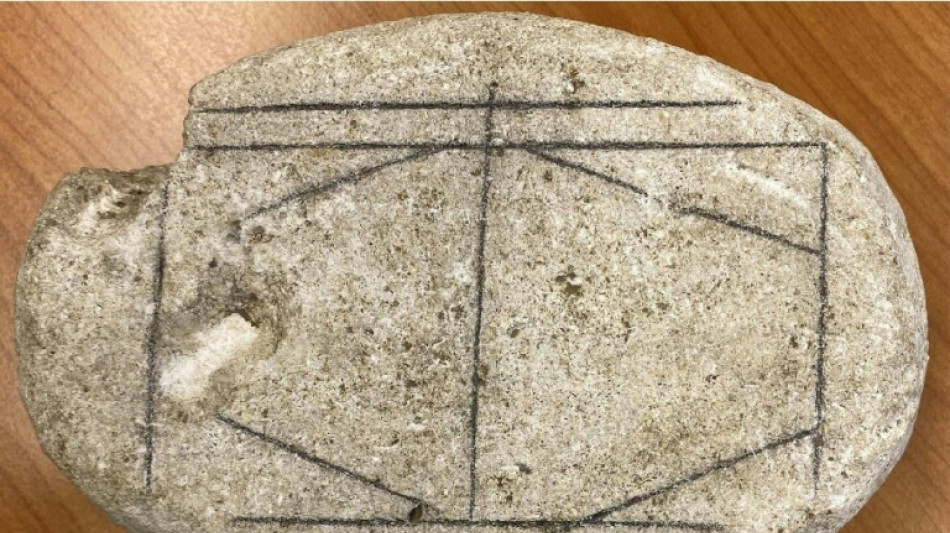
AI cracks Roman-era board game / Photo: Handout - Antiquity/AFP

 US House faces test on sweeping Russia sanctions bill

 British PM says to make 'difficult decisions' as inflation rises

 Global fuel price demos: a round-up

 Leverate Launches MCP for Traders to Connect AI Assistants With Trading Platforms

 MEXC Launches $1M "Discover Your Wall Street DNA" Campaign to Help Traders Find Their Market Fit

 Stocks edge higher ahead of US Fed rate call

 BASIS.pro Expands On-Chain Infrastructure with XDC Network Partnership and Zypher DAO as Auto Earn Goes Live

 Pickle-flavoured tart? AI inspires Japan's convenience stores

 EU chief hosts Canada's Carney in push to 'deepen' alliance

 Meta chief pushes back on AI slowdown calls

 US Fed to deliver rate decision with markets betting on hike

 Sanders, Bannon warn of AI dangers in rare US left-right alignment

 Empty benches as schools reopen in Venezuela's quake-hit Guaira

 Tiny English village holds 'independence' vote over asylum seeker housing

 US Treasury chief says to meet Chinese counterpart at weekend

 BingX Evolves into a Multi-Asset Trading Platform, Connecting Users to Global Opportunities

 International Trading Institute Expands Professional Trader Development Beyond the Master’s in Trading

 Lake Energy Secures $80 Million for U.S. Renewable Energy Expansion

 Stocks drop, oil climbs and Treasury yields hit 19-year high

 SkySail Strategies Outperforms Wall Street's 30-Year Risk Standard With Proprietary AI Inference Model

 Just add fish: Scientists pursue more rice, less disease in Senegal paddies

 Belgium completes outer structure of offshore energy island

 China retail sales growth weakens further in August

 In Kashmir, lake weeds mix with traditional art

 'Widow's Bay' and 'The Pitt' take key Emmy awards

A smooth, white stone dating from the Roman era and unearthed in the Netherlands has long baffled researchers.
Now with the help of artificial intelligence, scientists believe they have cracked the mystery: the stone is an ancient board game and they have even guessed the rules.
The circular piece of limestone has diagonal and straight lines cut into it.
Using 3D imaging, scientists discovered some lines were deeper than others, suggesting pieces were moved along them, some more than others.
"We can see wear along the lines on the stone, exactly where you would slide a piece," said Walter Crist, an archaeologist at Leiden University who specialises in ancient games.
Other researchers at Maastricht University then used an artificial intelligence programme that can deduce the rules to ancient games.
They trained this AI, baptised Ludii, with the rules of about 100 ancient games from the same area as the Roman stone.
The computer "produced dozens of possible rule sets. It then played the game against itself and identified a few variants that are enjoyable for humans to play," said Dennis Soemers, from Maastricht University.
They then cross-checked the possible rules with the wear on the stone to uncover the most likely set of movements in the game.
However, Soemers also sounded a note of caution.
"If you present Ludii with a line pattern like the one on the stone, it will always find game rules. Therefore, we cannot be sure that the Romans played it in precisely that way," he said.
The aim of the "deceptively simple but thrilling strategy game" was to hunt and trap the opponent's pieces in as few moves as possible.
The research and the possible rules were published in the journal Antiquity.
A.Leibowitz--CPN