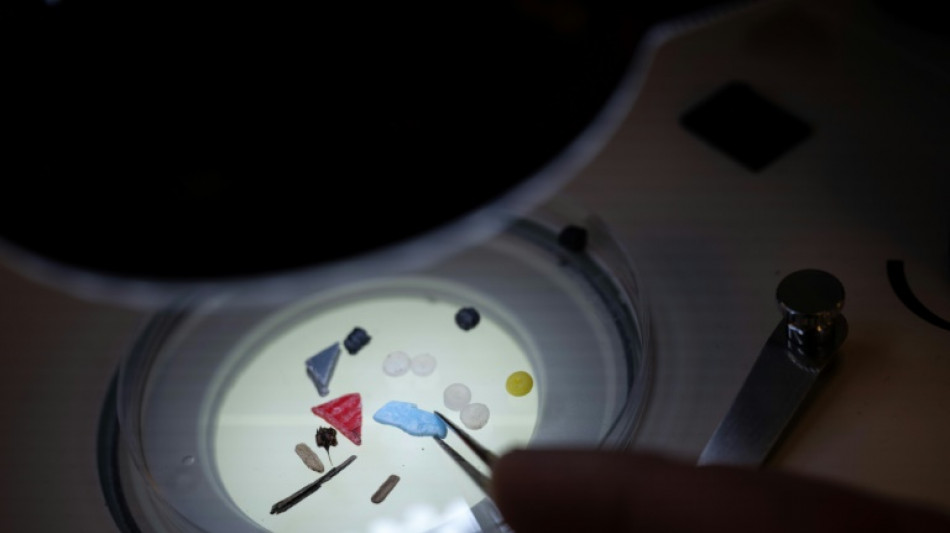
'Alarming' microplastic pollution in Europe's great rivers / Photo: Ben Stansall - AFP/File

 Where the US-China tariff row stands ahead of White House summit

 Indonesia cash-for-photos scheme turns animal hunters into protectors

 Argentine judge orders suspension of Falklands oil project

 US Fed raises rates to tackle 'too high' inflation, irking Trump

 Turkey releases 106 protesters, jails more LGBTQ activists

 Candidate for UN chief calls for AI regulation akin to nuclear weapons

 'We're losing control,' AI pioneer Yoshua Bengio tells AFP

 IR-MED and Dice Technologies Announce collaboration to Evaluate and Advance Pressure-Injury Prevention Platform in Japan

 Watts, Pitt, Cruz to light up Spain's top film festival

 Toogood Gold's Table Mountain Sits in the Shadow of a Nevada Gold Rush

 MEXC July–August Security Report: 38.66M USDT in Risk Funds Intercepted, Futures Insurance Fund Hits 792M USDT

 Emporio Armani names Dario Vitale new creative director

 EU to ban social media for under 13s, curb access until 15

 Wildfires push endangered Sumatran elephants to brink: Indonesian NGO

 Bank of Japan set to raise rates under pressure from inflation, US

 EU chief to unveil social media, gaming curbs for under-15s

 'Resident Evil' film brings video game's ethos to the big screen

 GA-ASI Mojave First UAS To Complete Battlefield Short Field Ops

 Sanders, Bannon warn of AI dangers in rare US left-right alignment

 Empty benches as schools reopen in Venezuela's quake-hit Guaira

 Tiny English village holds 'independence' vote over asylum seeker housing

 US Treasury chief says to meet Chinese counterpart at weekend

 BingX Evolves into a Multi-Asset Trading Platform, Connecting Users to Global Opportunities

 International Trading Institute Expands Professional Trader Development Beyond the Master’s in Trading

 Lake Energy Secures $80 Million for U.S. Renewable Energy Expansion

"Alarming" levels of microplastic have been found in major rivers across Europe according to scientists in 14 studies published simultaneously Monday.
"The pollution is present in all European rivers" studied, said French scientist Jean-François Ghiglione, who coordinated the large-scale operation across nine major rivers from the Thames to the Tiber.
"Alarming" pollution of on average "three microplastics per cubic metre of water" was observed in all of them, according to the results published in the journal of Environmental Science and Pollution Research.
This is far from the 40 microplastics per cubic metre recorded in the world's 10 most polluted rivers -- the Yellow River, Yangtze, Mekong, Ganges, Nile, Niger, Indus, Amur, Pearl and Hai -- which irrigate countries where most plastic is produced or plastic waste is processed.
But this does not take into account the volume of water flowing.
- 3,000 particles per second -
On the Rhone in Valence, France, the fast flow means there are "3,000 plastic particles every second", said Ghiglione. The Seine in Paris has around 900 per second.
"The mass of microplastics invisible to the naked eye is more significant than that of the visible ones," said Ghiglione -- a result that "surprised" researchers. This was confirmed by analytical advances made during the studies, which began in 2019.
"Large microplastics float and are collected at the surface, while invisible ones are distributed throughout the water column and are ingested by many animals and organisms," said Ghiglione, head of research in marine microbial ecotoxicology at the French National Centre for Scientific Research (CNRS).
Samples were collected from the mouths of the rivers Elbe, Ebro, Garonne, Loire, Rhone, Rhine, Seine, Thames and the Tiber by some 40 chemists, biologists and physicists from 19 research laboratories.
The researchers then made their way upstream until they reached the first major city on each of the waterways.
"Microplastics are smaller than a grain of rice," said Alexandra Ter Halle, a chemist at the CNRS in Toulouse, who took part in the analysis.
- 'Mermaid tears' -
The particles are less than five millimetres in size, with the smallest invisible to the naked eye.
These include synthetic textile fibres from washing clothes and microplastics released from car tyres or when unscrewing plastic bottle caps.
Researchers also found virgin plastic pellets, the raw granules used to manufacture plastic products.
One of the studies identified a virulent bacterium on a microplastic in the Loire in France, capable of causing infections in humans.
Another unexpected finding was that a quarter of microplastics discovered in rivers are not derived from waste but come from industrial plastic pellets.
These granules, dubbed "mermaid tears", can also sometimes be found scattered along beaches after maritime incidents.
"What we see is the pollution is diffuse and established" and "comes from everywhere" in the rivers, he added.
"The international scientific coalition we are part of (as part of international UN negotiations on reducing plastic pollution) is calling for a major reduction in the production of primary plastic because we know that plastic production is directly linked to pollution," he said.
A.Leibowitz--CPN
