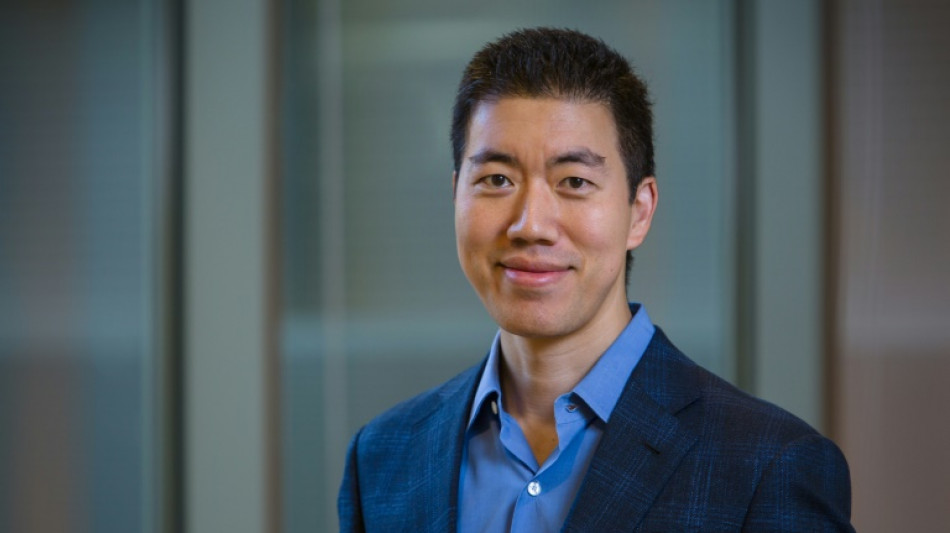
The scientist rewriting DNA, and the future of medicine / Photo: Casey ATKINS - Broad Institute of Harvard and MIT,/AFP

 NASA scan discovers new, 'once in a century' Moon crater

 Most stocks rise as Fed hikes and indicates drive to curb inflation

 UK-Sudanese author pens book to give children 'African history of Africa'

 US Congress passes sweeping Russia sanctions bill

 US stocks fall, dollar gains after Fed lifts interest rates

 US Fed raises rates to tackle 'too high' inflation in move sure to rile Trump

 US Fed raises rates to battle inflation in move likely to rile Trump

 US House faces test on sweeping Russia sanctions bill

 British PM says to make 'difficult decisions' as inflation rises

 Global fuel price demos: a round-up

 Leverate Launches MCP for Traders to Connect AI Assistants With Trading Platforms

 MEXC Launches $1M "Discover Your Wall Street DNA" Campaign to Help Traders Find Their Market Fit

 Stocks edge higher ahead of US Fed rate call

 BASIS.pro Expands On-Chain Infrastructure with XDC Network Partnership and Zypher DAO as Auto Earn Goes Live

 Pickle-flavoured tart? AI inspires Japan's convenience stores

 EU chief hosts Canada's Carney in push to 'deepen' alliance

 Meta chief pushes back on AI slowdown calls

 US Fed to deliver rate decision with markets betting on hike

 i-payout Expands U.S. Money Transmitter Licensing Footprint and Advances European EMI Strategy

 US Senate crypto bill collapses amid partisan deadlock

 OpenAI, Anthropic and Google are working to create an AI standards body

 Protesting shepherds, farmers clash with Romanian police

 Foundation Lets Ledger Users Switch to Open Source Without Starting Over

 EU to propose curbing social media, online games for under 15s

 FX Junction Reaches 40,600 Members and 26 Million Trades

A revolution is underway in gene editing -- and at its forefront is David Liu, an American molecular biologist whose pioneering work is rewriting the building blocks of life with unprecedented precision.
A professor at the Broad Institute of MIT and Harvard, Liu was awarded a Breakthrough Prize in Life Sciences on Saturday for developing two transformative technologies: one already improving the lives of patients with severe genetic diseases, the other poised to reshape medicine in the years ahead.
He spoke with AFP ahead of the Los Angeles ceremony for the prestigious Silicon Valley-founded award.
He will receive $3 million for his work on "base editing" and "prime editing," and plans to donate most of it to support his charitable foundation.
"The ability to change a DNA sequence of our choosing into a new sequence of our choosing is a fundamentally very powerful capability," the 51-year-old said, foreseeing uses not just in human medicine but areas like developing more nutritious or disease-resistant crops.
- Correcting the code -
DNA is made up of four chemical "letters" -- the nucleotide bases A, G, T and C. Mutations in this sequence cause thousands of human diseases, yet until recently, gene editing could only fix a limited number of them.
Even CRISPR-Cas9, the groundbreaking technology that earned a Nobel Prize in 2020, has major limitations.
It cuts both strands of the DNA helix, making it most useful to disrupt rather than correct genes, while the process can introduce new errors.
"Being able to use genome editing to treat genetic diseases requires, in most cases, ways to correct a DNA misspelling, not simply to disrupt a gene," Liu said.
That insight led his lab to develop base editing, which uses the Cas9 protein -- disabled so it can no longer cut both DNA strands -- to find a target DNA sequence and another enzyme to convert one letter to another -- for example, C to T or G to A.
Reversing the change -- from T to C or A to G -- was tougher. Liu's team overcame the challenge by engineering entirely new enzymes.
These base editors can now correct about 30 percent of the mutations that cause genetic diseases. The technology is already in at least 14 clinical trials.
In one of them, Beam Therapeutics -- which Liu co-founded -- announced it had treated patients of AATD, a rare genetic disorder affecting the lungs and liver, with a single drug infusion.
While traditional gene therapies often disrupt faulty genes or work around them, base editing repairs the mutation itself.
"This was the first time that humans have corrected a mutation that causes a genetic disease in a patient," Liu said.
- Cystic fibrosis hope -
Base editing, quickly dubbed "CRISPR 2.0," can't fix every mutation.
About 70 percent of the roughly 100,000 known disease-causing mutations remain out of its reach, including those caused by missing or extra letters.
To expand the toolkit, Liu's lab introduced prime editing in 2019 -- a method capable of replacing entire sections of faulty DNA with corrected sequences.
If CRISPR is like scissors that cut DNA, and base editors are like using a pencil to correct individual letters, then prime editing is the equivalent of a word processor's "find and replace" function.
Creating this tool required a series of breakthroughs Liu's team describes as "small miracles." The result is, he said, "the most versatile way we know of to edit the human genome."
Among the targets Liu and his team have already pursued with prime editing: cystic fibrosis, a common genetic disease usually caused by three missing DNA letters that causes thick mucus buildup in the lungs and digestive system.
Liu's lab has made much of its work freely accessible, sharing DNA blueprints through a nonprofit library used by tens of thousands of labs worldwide.
"The science we create -- which is ultimately funded by society, through governments and donors -- ultimately goes back to benefit society."
This year's Breakthrough Prize awards come at a fraught moment for US science, as President Donald Trump's government strips funding for institutions like the National Institutes of Health (NIH).
"The NIH is a treasure, not just for this country but for the world," said Liu. "Trying to dismantle the heart of what supports science in this country is like burning your seed corn."
Y.Uduike--CPN