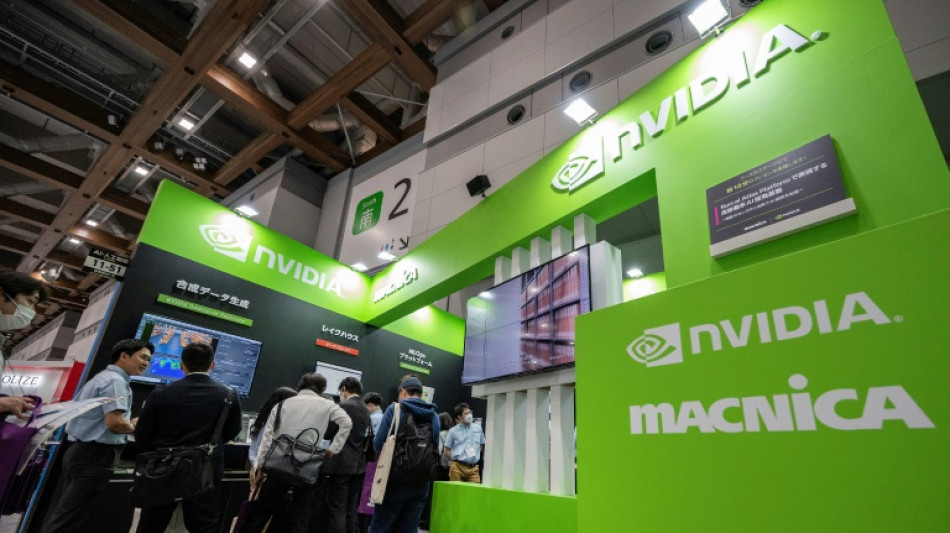
Japan ramps up tech ambitions with $65 bn for AI, chips / Photo: Richard A. Brooks - AFP

 Isolated Syrian-Druze city blames Damascus for shortages

 Kerry James Marshall: American 'blackness' painter celebrated in Europe

 Infantino 'must go', says German FA vice-president

 Japan's busiest rail station tests robot bins

 Backpackers fret over Australian visa crackdown

 Bank of Japan hikes rates to 31-year high to battle inflation

 AI doomsday warnings unlikely to slow IPOs but questions linger

 In Brazil's Amazon, the hunt for oil fuels hopes and fears

 Baby orangutans in India expose 'frightening' scale of trafficking

 Oversight Board blasts 'inadequate' Meta safeguards for AI deepfakes

 Harry makes first public appearance since return to UK

 Princess Diana's brother makes new explosive claims against Charles

 Trump admin overhauls key protection for endangered species

 Mbappe draws political fire over Ceuta t-shirt controversy

 Third malaria death in Germany from outbreak tied to Frankfurt airport

 AtlasClear Holdings Reports Preliminary Fiscal 2026 Revenue of Approximately $20.1 Million, Up 85%; Revenue Plus Interest Income of Approximately $21.9 Million

 'Another arrow to the quiver': World Bank posts record private capital mobilization

 Ireland to boycott Eurovision 2027 over Gaza

 India's Tata Sons reappoints N. Chandrasekaran as chairman

 Germany urges EU action against China to defend carmakers

 Japan eyes changing prostitution law to punish sex buyers

 Modi pitches India as global chipmaking hub

 Ukraine plans record defence spending in 2027

 NASA scan discovers new, 'once in a century' Moon crater

 Most stocks rise as Fed hikes and indicates drive to curb inflation

Japan is readying a $65-billion push in microchips and artificial intelligence aimed at reclaiming its status as a global tech leader and meeting the urgent challenges of its ageing, shrinking population.
The 10-trillion-yen package, which lawmakers could approve this week, is also seen as preparation for an uncertain world as fears grow of a potential Chinese invasion of chip powerhouse Taiwan.
But analysts warn that question marks remain over worker shortages and whether Japan can generate enough electricity for energy-hungry AI data centres.
After dominating in tech hardware during the 1980s, "Japan had a quite a long period of almost just sitting back and observing a lot of this innovation, particularly when it comes to artificial intelligence", said Kelly Forbes, president of the AI Asia Pacific Institute.
"What we have seen in the last maybe two to three years is Japan really waking up to the potential" of such developments, she told AFP.
Japanese tech investor SoftBank and US computing giant Nvidia last week unveiled ambitious proposals to build an "AI grid" across the nation.
That followed a flurry of US investments earlier this year, including from Microsoft, a partner of ChatGPT-maker OpenAI.
AI-powered automation can help Japan, which has the world's second oldest population after Monaco, said Seth Hays, author of the Asia AI Policy Monitor newsletter.
"Demographically speaking, Japan's just going to be crunched on that," he said.
So "they need to utilise AI in order to get those productivity gains that keep the country going".
- Energy problem -
The new government money will bolster Japan's home-grown Rapidus project to produce next-generation semiconductors.
Tokyo has already promised up to four trillion yen in subsidies to help triple sales of domestically produced microchips by 2030.
"Semiconductors are really at the core of AI innovation," said Forbes.
Most of the world's chips are made in Taiwan -- but fears are growing of a blockade or invasion by Beijing, which claims the self-ruled island as part of its territory.
Facing pressure from customers and governments to diversify its production, Taiwanese chip giant TSMC in February opened a $8.6-billion chip factory in southern Japan, and is planning a second facility in the country for more advanced chips.
US President Joe Biden's administration is also pouring money into building chip factories on American soil, including $6.1 billion to Micron and $6.6 billion for TSMC.
Japan's investments are an attempt "to remain competitive in that space, but also... to stay prepared around this geopolitical tension that we know is growing", Forbes said.
But the country needs to find a way to power these energy-intensive projects, from chip manufacturing to running data centres to train AI models.
Japan is heavily dependent on fossil fuel imports, with the government working to bring back online nuclear plants that were halted after the 2011 Fukushima disaster.
"In Taiwan, TSMC takes up eight percent of our electricity," said Hays, who is based in Taipei. "Where's Japan going to get the energy?"
- 'Soft' regulation -
Among Nvidia's collaborations with SoftBank is a new supercomputer using the US company's cutting-edge Blackwell AI chips.
At a speech in Tokyo, Nvidia boss Jensen Huang vowed to "transform the telecommunications network into an AI network" in Japan.
"This is completely revolutionary," he said, giving the example of a radio tower that acts as an "air traffic control, essentially, for self-driving cars".
Despite the hype, Japan has some way to go -- in this year's global classification of digital competitiveness by Swiss management school IMD, it was ranked just 31st.
To boost the sector, "Japan's copyright law is actually one of the most AI-friendly copyright laws in the world", Hays said.
"It essentially allows AI companies to train on copyrighted data, even for profit," he said, adding that while Singapore has similar rules, the approach is unusual.
At the same time, Japan has been "taking a lead" on international discussions on AI, including with an initiative launched at last year's G7 summit in Hiroshima.
Prime Minister Shigeru Ishiba has also pledged to "formulate a new support framework to attract more than 50 trillion yen in public and private investment over the next 10 years" for AI and chips.
Japan can benefit from AI advances in healthcare, Forbes said, calling the latest investments an attempt to "put Japan at the forefront of this technological revolution".
M.Mendoza--CPN