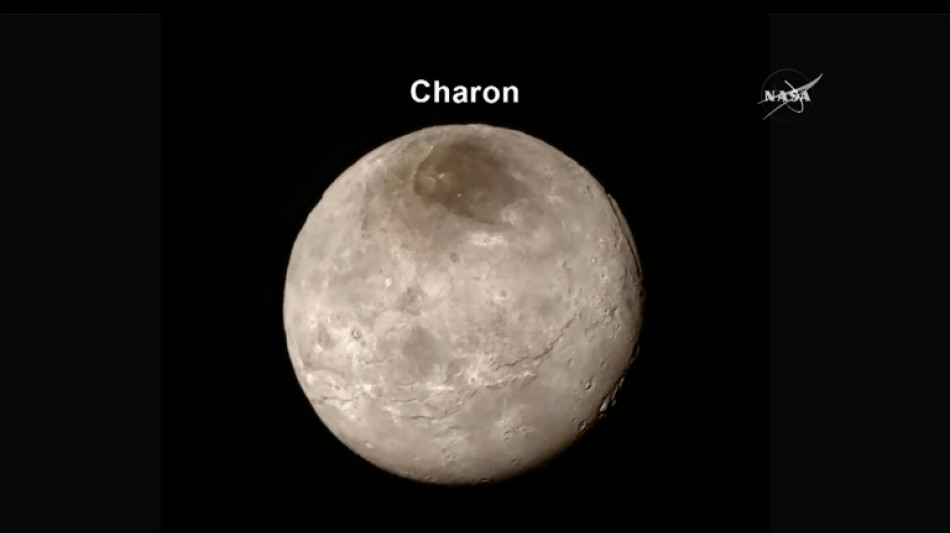
Webb telescope detects carbon dioxide on Pluto's largest moon / Photo: - - NASA TV/AFP/File

 Warren Buffett steps down as Berkshire Hathaway chairman

 Isolated Syrian-Druze city blames Damascus for shortages

 Kerry James Marshall: American 'blackness' painter celebrated in Europe

 Infantino 'must go', says German FA vice-president

 Japan's busiest rail station tests robot bins

 Backpackers fret over Australian visa crackdown

 Bank of Japan hikes rates to 31-year high to battle inflation

 AI doomsday warnings unlikely to slow IPOs but questions linger

 In Brazil's Amazon, the hunt for oil fuels hopes and fears

 Baby orangutans in India expose 'frightening' scale of trafficking

 Oversight Board blasts 'inadequate' Meta safeguards for AI deepfakes

 Harry makes first public appearance since return to UK

 Princess Diana's brother makes new explosive claims against Charles

 Trump admin overhauls key protection for endangered species

 Mbappe draws political fire over Ceuta t-shirt controversy

 Third malaria death in Germany from outbreak tied to Frankfurt airport

 AtlasClear Holdings Reports Preliminary Fiscal 2026 Revenue of Approximately $20.1 Million, Up 85%; Revenue Plus Interest Income of Approximately $21.9 Million

 'Another arrow to the quiver': World Bank posts record private capital mobilization

 Ireland to boycott Eurovision 2027 over Gaza

 India's Tata Sons reappoints N. Chandrasekaran as chairman

 Germany urges EU action against China to defend carmakers

 Japan eyes changing prostitution law to punish sex buyers

 Modi pitches India as global chipmaking hub

 Ukraine plans record defence spending in 2027

 NASA scan discovers new, 'once in a century' Moon crater

Scientists using the James Webb Space Telescope have detected carbon dioxide on the frozen surface of Pluto's biggest moon, Charon, for the first time, research revealed on Tuesday.
The discovery of CO2, along with another chemical hydrogen peroxide (H2O2), could shed light on the icy worlds in the mysterious outer reaches of our Solar System.
Pluto was long known as the ninth planet from the Sun. But after other similar objects were spotted in a region beyond Neptune called the Kuiper Belt, it was downgraded to dwarf planet in 2006.
The doughnut-shaped Kuiper Belt is thought to be home to millions of icy worlds.
These objects are "time capsules that enable us to understand the formation of the Solar System", Silvia Protopapa of the Southwest Research Institute in the US state of Colorado told AFP.
Charon offers a rare glimpse into these worlds because -- unlike other Kuiper Belt objects including Pluto -- its surface is not obscured by highly volatile ices such as methane, she explained.
Protopapa is the lead author of a new study in the journal Nature Communications describing Webb's new discoveries on the biggest of Pluto's five moons.
- 'Piece of the puzzle' -
Charon, which is around the width of France and half the size of Pluto, was first discovered in 1978.
When NASA's New Horizon spacecraft flew past Charon in 2015, it discovered the surface was mainly covered in water ice and ammonia, which are thought to give the moon its red and grey appearance.
It also showed that material from beneath the planet's surface was sometimes being exposed via craters.
This suggested to scientists that CO2, an essential gas for life on Earth, could also be on Charon's surface.
Objects in the Kuiper Belt, including Pluto and Charon, are thought to have been formed from the protoplanetary disc -- a circle of gas and dust that surrounded the infant Sun around 4.5 billion years ago.
The protoplanetary disc -- which is also thought to have contributed to the formation of Earth -- is thought to have contained CO2.
But New Horizon did not spot the gas on Charon.
The Webb telescope has now answered this "open question", because it measures longer wavelengths of light, allowing it to probe deeper, Protopapa said.
If one were to hypothetically step onto the surface of Charon, the surface would be a mixture of water ice and dry ice -- the solid form of CO2, she said.
More surprisingly, the Webb telescope also detected hydrogen peroxide, Protopapa added.
The presence of the chemical, sometimes used as disinfectant on Earth, suggests Charon's icy surface is altered by ultra-violet light and solar wind from the distant Sun, according to the study.
Discovering and disentangling these chemicals on Charon are another "piece of the puzzle" in the quest to uncover more about these distant worlds -- and in turn the birth of our Solar System, Protopapa said.
X.Cheung--CPN