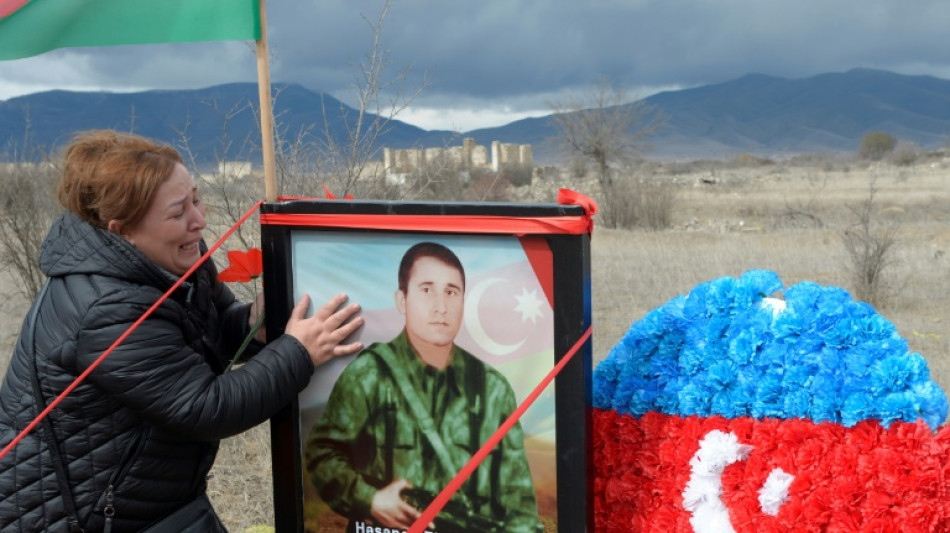
Azerbaijan refugees vow 'Great Return' to Karabakh / Photo: Tofik BABAYEV - AFP

 Wildfires push endangered Sumatran elephants to brink: Indonesian NGO

 Bank of Japan set to raise rates under pressure from inflation, US

 EU chief to unveil social media, gaming curbs for under-15s

 'Resident Evil' film brings video game's ethos to the big screen

 i-payout Expands U.S. Money Transmitter Licensing Footprint and Advances European EMI Strategy

 US Senate crypto bill collapses amid partisan deadlock

 OpenAI, Anthropic and Google are working to create an AI standards body

 Protesting shepherds, farmers clash with Romanian police

 Foundation Lets Ledger Users Switch to Open Source Without Starting Over

 EU to propose curbing social media, online games for under 15s

 FX Junction Reaches 40,600 Members and 26 Million Trades

 'We unleashed the beast': the world's fears and hopes about AI

 Hospitality leaders ask Burnham to halve VAT amid rising costs

 Worcestershire invited to nominate groups for 2027 King’s volunteer award

 Berlin's run-down public spaces at heart of election campaign

 'Widow's Bay' and 'The Pitt' win big at Emmy Awards

 Most markets drop as oil extends gains ahead of expected US rate hike

 Sri Lanka's famed beach shack battles demolition

 Vserv targets ₹1,000 crore revenue by 2030 through AI expansion

 India prohibits bank fees on UPI payments up to ₹2,000

 Brazil's Amazon defender Raoni has cancer

 Trump rejects AI slowdown concerns as UN urges coordinated controls
 Higher wages draw migrant workers to Kashmir despite attacks

 Oil supply concerns and AI warnings weigh on global markets
 'I am the hoax buster': Trump rejects AI danger warnings
Ali Hasanov looked over the overgrown ruins of his hometown in Nagorno-Karabakh and vowed to return and rebuild it.
"Whatever time it might take, we will return to Aghdam," said Hasanov. "We want to live here... we belong here."
Aghdam has been a ghost town since June 1993 when Armenian separatist forces took it from Azerbaijan, sending its entire population of 28,000 people fleeing for their lives.
The 65-year-old metalworker returned to the disputed region for the first time since on a Azerbaijan government bus tour of "liberated lands" its army retook from Armenia after six weeks of fighting in 2020.
The latest war -- in which more than 6,500 people were killed -- saw energy-rich Baku take back much of the territory it lost in the conflict in the early 1990s with its old Soviet neighbour in the aftermath of the collapse of the Communism.
Some 30,000 died in that bitter war and hundreds of thousands were forced from their homes.
Hasanov said he "couldn't sleep a wink" the night before he travelled to Aghdam, which was Karabakh's biggest town before it was razed by the Armenians.
He said his "soul was itching to get to Aghdam" ever since he and his family fled the city after it was shelled.
"To me, it was the most beautiful city in the world," he said, standing in the middle of a wasteland that stretched out to the faraway bluish mountains.
The Azeribaijan government began the regular bus trips to the "liberated lands" in January, the first time its former inhabitants have been able to set foot in the mountainous enclave in three decades.
- Dream come true -
It is the first step in what Baku calls the "Great Return", an ambitious government plan to repopulate remote Karabakh with its former Azerbaijani population.
Escorted by police armed with automatic rifles, buses to Aghdam and Karabakh's recaptured cultural capital, Shusha, depart Baku twice a week for day-long trips that only give visitors two and a half hours to see their former homes.
Hasanov said the visit was a dream come true.
"Our house stood behind that fence," he said as tears welled up in his eyes.
"There was an alley of huge plane trees over there, under which we'd play backgammon or dominoes, and over there -- a football stadium, the favourite place for our neighbourhood's lads."
Such was the destruction, that another refugee from Aghdam, Gulbeniz Jafarova, couldn't even find the ruins of her house.
"But (the) native spirit is hovering here. It feels like I spent 30 years in a prison cell and was just freed," the 55-year-old dressmaker added.
At Aghdam's cemetery she visited the grave of her brother who was killed aged 27, defending the town from Armenian separatist forces who controlled the region until the latest war.
"My mother's last words before she died were, 'My son.' I promised her that I would visit his grave."
- 'We belong here' -
Azerbaijan's government has vowed to spend billions of petrodollars on the region's reconstruction, with $1.3 billion allocated in last year's budget for infrastructure projects such as new roads, bridges and airports.
Baku has pledged to transform Aghdam into one of the country's biggest cities and plans to set up an industrial park.
Foreign Minister Jeyhun Bayramov said in January that "very shortly we will witness the first families returning to their homes" in Karabakh.
But the "Great Return" of refugees remains a distant prospect, given the scale of devastation of towns like Aghdam and the dangers from landmines, which were used extensively in the conflict, which regularly flared up over the decades.
"Whatever time it might take, we will return to Aghdam," Hasanov insisted. "We want to live here. My sons say we belong here."
X.Wong--CPN