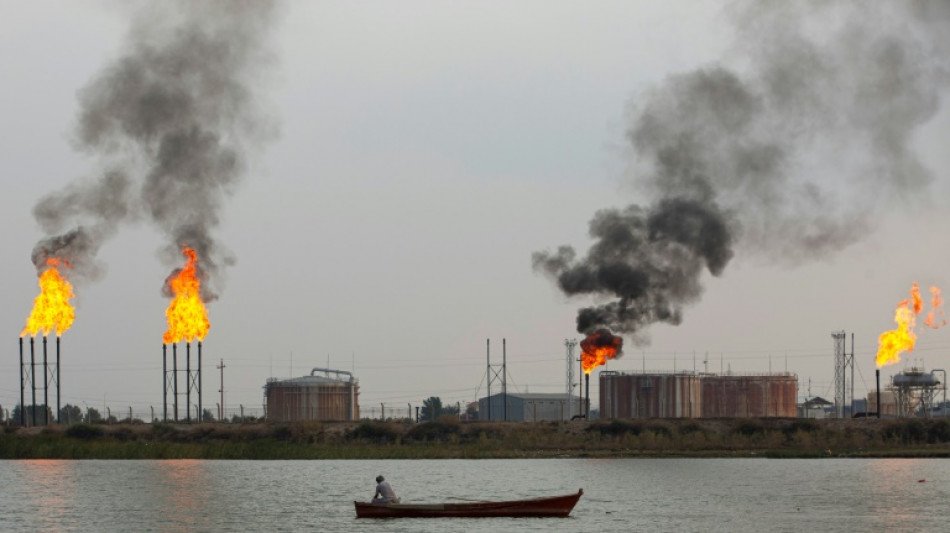
Even chance world will breach 1.5C warming within 5 years: UN / Photo: Hussein FALEH - AFP/File

 Wildfires push endangered Sumatran elephants to brink: Indonesian NGO

 Bank of Japan set to raise rates under pressure from inflation, US

 EU chief to unveil social media, gaming curbs for under-15s

 'Resident Evil' film brings video game's ethos to the big screen

 i-payout Expands U.S. Money Transmitter Licensing Footprint and Advances European EMI Strategy

 US Senate crypto bill collapses amid partisan deadlock

 OpenAI, Anthropic and Google are working to create an AI standards body

 Protesting shepherds, farmers clash with Romanian police

 Foundation Lets Ledger Users Switch to Open Source Without Starting Over

 EU to propose curbing social media, online games for under 15s

 FX Junction Reaches 40,600 Members and 26 Million Trades

 'We unleashed the beast': the world's fears and hopes about AI

 Hospitality leaders ask Burnham to halve VAT amid rising costs

 Worcestershire invited to nominate groups for 2027 King’s volunteer award

 Berlin's run-down public spaces at heart of election campaign

 'Widow's Bay' and 'The Pitt' win big at Emmy Awards

 Most markets drop as oil extends gains ahead of expected US rate hike

 Sri Lanka's famed beach shack battles demolition

 Vserv targets ₹1,000 crore revenue by 2030 through AI expansion

 India prohibits bank fees on UPI payments up to ₹2,000

 Brazil's Amazon defender Raoni has cancer

 Trump rejects AI slowdown concerns as UN urges coordinated controls

 Higher wages draw migrant workers to Kashmir despite attacks

 Oil supply concerns and AI warnings weigh on global markets

 'I am the hoax buster': Trump rejects AI danger warnings

There is an even chance that global temperatures will temporarily breach the benchmark of 1.5 degrees Celsius above pre-industrial levels in one of the next five years, the United Nations warned Tuesday.
The 2015 Paris Agreement on climate change saw countries agree to cap global warming at "well below" 2C above levels measured between 1850 and 1900 -- and 1.5C if possible.
"The chance of global near-surface temperature exceeding 1.5C above pre-industrial levels at least one year between 2022 and 2026 is about as likely as not," the UN's World Meteorological Organization said in an annual climate update.
The WMO put the likelihood at 48 percent, and said it was increasing with time.
An average temperature of 1.5 C above the pre-industrial level across a multi-year period would breach the Paris aspirational target.
There is a 93 percent chance of at least one year between 2022-2026 becoming the warmest on record and dislodging 2016 from the top ranking, said the WMO.
The chance of the five-year temperature average for 2022-2026 being higher than the last five years (2017-2021) was also put at 93 percent.
"This study shows -- with a high level of scientific skill -- that we are getting measurably closer to temporarily reaching the lower target of the Paris Agreement," said WMO chief Petteri Taalas.
"The 1.5C figure is not some random statistic. It is rather an indicator of the point at which climate impacts will become increasingly harmful for people and indeed the entire planet."
- 'Edging ever closer' -
The Paris Agreement level of 1.5C refers to long-term warming, but temporary exceedances are expected to occur with increasing frequency as global temperatures rise.
"A single year of exceedance above 1.5C does not mean we have breached the iconic threshold of the Paris Agreement, but it does reveal that we are edging ever closer to a situation where 1.5C could be exceeded for an extended period," said Leon Hermanson, of Britain's Met Office national weather service, who led the report.
The average global temperature in 2021 was around 1.11C above pre-industrial levels, according to provisional WMO figures.
The report said that back-to-back La Nina events at the start and end of 2021 had a cooling effect on global temperatures.
However, this was only temporary and did not reverse the long-term global warming trend.
La Nina refers to the large-scale cooling of surface temperatures in the central and eastern equatorial Pacific Ocean, typically occurring every two to seven years.
The effect has widespread impacts on weather around the world -- typically the opposite impacts to the El Nino warming phase in the Southern Oscillation cycle.
Any development of an El Nino event would immediately fuel temperatures, as it did in 2016, said the WMO.
- Greenhouse gas link -
The annual mean global near-surface temperature for each year between 2022 and 2026 is predicted to be between 1.1C and 1.7C higher than pre-industrial levels.
There is only a 10 percent chance of the five-year mean exceeding the 1.5C threshold.
"For as long as we continue to emit greenhouse gases, temperatures will continue to rise," said Taalas.
"And alongside that, our oceans will continue to become warmer and more acidic, sea ice and glaciers will continue to melt, sea level will continue to rise and our weather will become more extreme.
"Arctic warming is disproportionately high and what happens in the Arctic affects all of us."
Meanwhile, predicted precipitation patterns for 2022, compared to the 1991-2020 average, suggest an increased chance of drier conditions over southwestern Europe and southwestern North America, and wetter conditions in northern Europe, the Sahel, northeastern Brazil, and Australia.
Ng.A.Adebayo--CPN