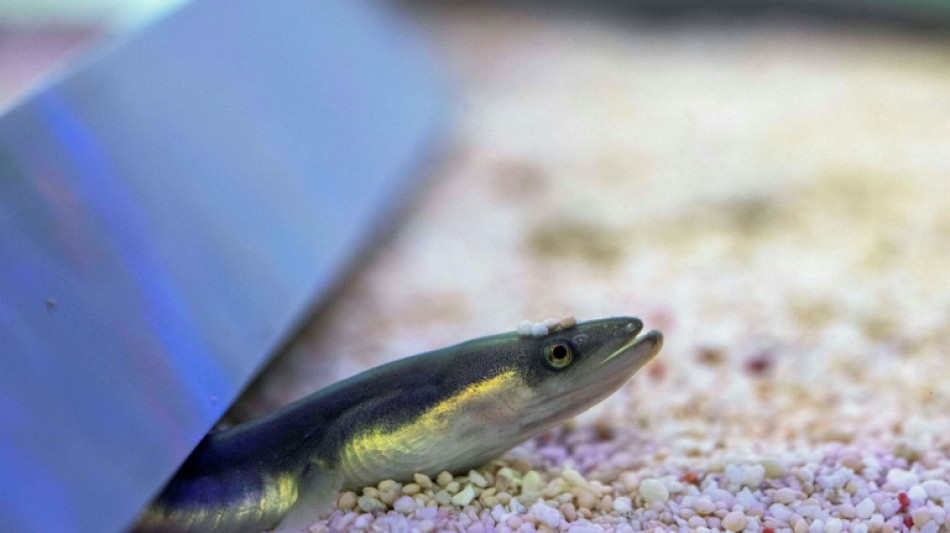
'Astonishing': Eaten eels recorded escaping from fish guts / Photo: Behrouz MEHRI - AFP/File

 Crisis-wracked Volkswagen warns of 10-bn-euro hit to profits

 Shakira to cap off world tour with Madrid 12-gig run

 Isolated Syrian-Druze city shortages

 UNESCO can be 'moderator' in AI debate: chief to AFP

 Russia seizes assets of Nestle, French firms

 Anthropic says AI systems moving towards building themselves

 Asian stocks boosted by falling oil, yen weakens after BoJ rate hike

 Afghan medical students in Pakistan hope court stops college expulsions

 Australia to detain tourists who overstay visa, minister says

 Asian stocks track Wall St rally as oil prices drop

 Prized Mexican relic returns on loan, two centuries on

 'In our lane': Fed's Warsh defies Trump but still fighting for credibility

 Trump admin makes major cut to endangered species protections

 GM delivers first components for US interceptor missiles

 Travis Scott and Keith Richards feature on GTA VI soundtrack

 King Charles warns tech bosses of 'existential dangers' of AI

 French fishermen block ports over petrol prices

 Micron's Taiwan workers say 68 months' bonus not enough

 Canada's Carney pushes 'new alliance' with EU despite Trump threats

 Beyond Investment Returns: Families Are Measuring Wealth by Freedom, Continuity, and Legacy, According to Nour Private Wealth

 King Charles disputes claims in book by Princess Diana's brother

 Nepal floods among 'most challenging' disasters: WFP

 Kids and social media: what would change under new EU law

 King Charles to call on tech giants for 'reassurances' over AI

 STARPRIME Responds to Diverging Gold Market Demand with AM/PM Fixing and XAU24/7

Eels that have been swallowed by fish have been recorded for the first time sliding tail-first back out of their would-be predators' stomach and escaping out of their gills, a study said Monday.
The remarkable last-gasp getaway also marks the first time this kind of defensive tactic has been caught on video across the animal kingdom, according to the Japanese researchers.
The team behind the new study had already observed young Japanese eels surviving being eaten by sliding out of the gills of fish -- rather than out of the mouths that had swallowed them.
Nonetheless, the researchers had assumed the eels had been somewhat near the mouths of the fish when they broke free.
But the team was "really surprised" to find that the eels were all the way in the stomach of their predators before starting their escape bid, lead study author Yuha Hasegawa of Nagasaki University told AFP.
- Stomach turning -
Some eels even circled around the stomach several times before wriggling free, according to the study in the journal Current Biology.
To see what was happening inside the bodies of the predatory dark sleeper fish, the researchers injected them with fluid to increase the contrast for recording the results on an X-ray video system.
Out of 32 eels swallowed into the stomachs of the fish, all but four tried to escape by backing out through the digestive tract, towards the esophagus and eventually out the side door of the gills, the study said.
Thirteen managed to get at least some of their tails out of the gills, while nine went all the way and escaped with their lives.
The young eels, which were around seven centimetres (three inches) long, always went tail first. Unlike most fish, eels are skilled at swimming backwards, the researchers pointed out.
The whole process took around a minute. The eels could only survive around three minutes in the stomach acid.
The fish were not harmed when the eels burst free from their gills, Yuha Hasegawa said.
It was a "difficult" experiment, he added, and it took the team a year to capture convincing footage.
Previous research has shown that some invertebrates like worms can escape from the digestive system of frogs, but the inner workings have not been recorded on X-ray video.
Study co-author Yuuki Kawabata, also from Nagasaki University, said that scientists were only beginning to understand the "mysterious, astonishing" strategies that animals use to escape from predators.
He pointed out that Japanese eels are still offering up surprises despite being quite well known.
Fish are not the only animals with a taste for these eels -- they are a popular and expensive delicacy among many humans.
Japanese eels, called Unagi when cooked, make up the vast majority of commercially sold eel in Japan.
Overfishing has led the eels to be considered an endangered species by the International Union for Conservation of Nature.
X.Cheung--CPN