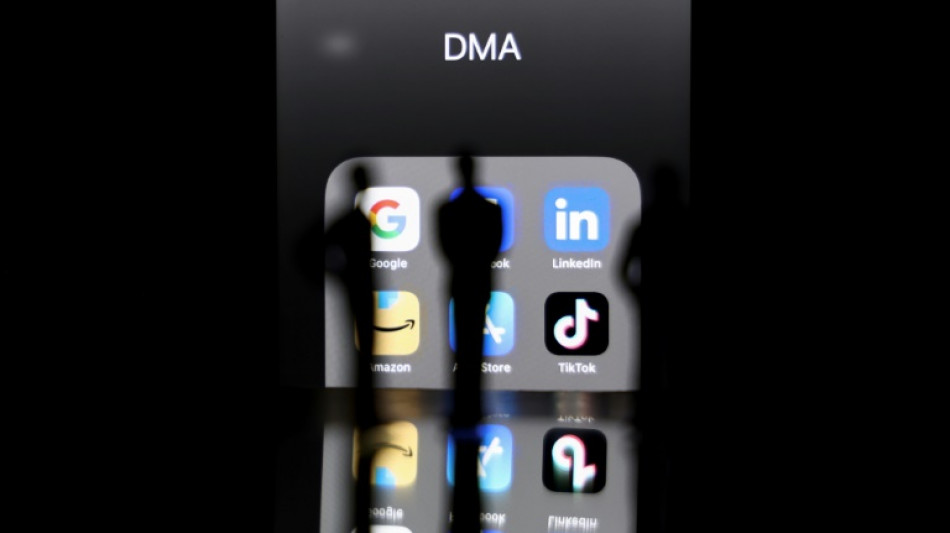
One year in, EU turning up heat in big tech fight / Photo: Kenzo TRIBOUILLARD - AFP/File

 Crisis-wracked Volkswagen warns of 10-bn-euro hit to profits

 Shakira to cap off world tour with Madrid 12-gig run

 Isolated Syrian-Druze city shortages

 UNESCO can be 'moderator' in AI debate: chief to AFP

 Russia seizes assets of Nestle, French firms

 Anthropic says AI systems moving towards building themselves

 Asian stocks boosted by falling oil, yen weakens after BoJ rate hike

 Afghan medical students in Pakistan hope court stops college expulsions

 Australia to detain tourists who overstay visa, minister says

 Asian stocks track Wall St rally as oil prices drop

 Prized Mexican relic returns on loan, two centuries on

 'In our lane': Fed's Warsh defies Trump but still fighting for credibility

 Trump admin makes major cut to endangered species protections

 GM delivers first components for US interceptor missiles

 Travis Scott and Keith Richards feature on GTA VI soundtrack

 King Charles warns tech bosses of 'existential dangers' of AI

 French fishermen block ports over petrol prices

 Micron's Taiwan workers say 68 months' bonus not enough

 Canada's Carney pushes 'new alliance' with EU despite Trump threats

 Beyond Investment Returns: Families Are Measuring Wealth by Freedom, Continuity, and Legacy, According to Nour Private Wealth

 King Charles disputes claims in book by Princess Diana's brother

 Nepal floods among 'most challenging' disasters: WFP

 Kids and social media: what would change under new EU law

 King Charles to call on tech giants for 'reassurances' over AI

 STARPRIME Responds to Diverging Gold Market Demand with AM/PM Fixing and XAU24/7

If 2024 already looks like an annus horribilis for big tech in the EU, the months ahead could prove a winter of discontent as the bloc wields a fortified new legal armoury to bring online titans to heel.
Since August 2023, the world's biggest digital platforms have faced the toughest ever tech regulations in the European Union -- which shows no sign of slowing down in enforcing them.
Brussels scored its first major victory after forcing TikTok to permanently remove an "addictive" feature from a spinoff app in Europe in August, a year after content moderation rules under the bloc's Digital Services Act (DSA) started to apply.
That followed a seven-day period earlier in the summer in which Brussels issued back-to-back decisions targeting Apple, Meta and Microsoft.
And more is to come before 2024 is over, say officials.
The EU's moves are all thanks to two laws, the DSA -- which forces companies to police online content -- and its sister competition law, the Digital Markets Act (DMA) -- which gives big tech a list of what they can and can't do in business.
Since the DMA curbs kicked in in March, the EU has notably pressured Apple to back down in a spat with Fortnite maker Epic over a gaming app store.
"The European Commission is doing the job: it is implementing the DMA with limited resources and within a short timeframe compared to lengthy competition cases," said EU lawmaker Stephanie Yon-Courtin, who focuses on digital issues.
Jan Penfrat, senior policy advisor at online rights group EDRi, says changes are already visible: the DSA giving users the "right to complain" when content is removed or accounts are suspended, or the DMA allowing them to select browsers and search engines via choice screens.
"This is just the beginning," Penfrat said.
He notes for instance that EDRi and other groups in July compiled a list of areas where Apple fails to follow the DMA. "We expect the commission to go after those as well in time," Penfrat told AFP.
- High-profile tests -
Apple is the biggest thorn in the EU's side as the DMA's chief critic, claiming it puts users' security at risk.
The iPhone maker became the first company in June to face formal accusations of breaking the DMA's rules and faces heavy fines unless it addresses the charges.
Apple announced changes to the App Store on August 8 to comply with the DMA, although smaller tech firms under the Coalition for App Fairness slammed them as "confusing". The EU is now evaluating Apple's plans.
It is too early to say whether Apple will fall into line without the EU's heavy hand but one thing is clear: Brussels is ready for a fight.
Another high-profile test of the bloc's new powers will be X, with regulators to decide as early as September whether the former Twitter should be made to comply with the DMA.
The DSA's rules on curbing disinformation and hate speech have already sparked a spectacular clash between X's billionaire owner Elon Musk and the bloc's digital chief Thierry Breton -- with the spectre of fines or an outright EU ban on the site if violations persist.
- Full speed -
EU competition chief Margrethe Vestager has said that Brussels is going at "full speed".
This was always the goal: to cut short the length of competition investigations, which lasted years, to a maximum of 12 months under the DMA.
But companies can challenge fines or decisions in the EU courts, which could mean years of subsequent legal battles, lawyers say.
And difficulties can also come from elsewhere: Apple said in June it would delay the rollout of new AI features in Europe because of "regulatory uncertainties".
EDRi's Penfrat accused Apple of fearmongering by blaming the EU for certain features not arriving in the bloc in order "to put pressure on the commission to not be too tough in the enforcement".
- Pressure building -
Apple aside, big tech isn't happy with DMA action so far.
"Instead of announcing possible punitive measures with political posturing, these probes under the DMA should focus on fostering open dialogue between the European Commission and the companies concerned," Daniel Friedlaender, head of tech lobby group CCIA Europe told AFP.
Undeterred, Brussels is turning up the heat.
In addition to potential new DMA curbs on X, the EU could soon add Telegram to its list of "very large" platforms, such as WhatsApp, that face the DSA's strictest rules.
Brussels wants no corner of the digital sphere left untouched.
That includes the critical area of artificial intelligence, with the EU currently looking into deals between giants and generative AI developers, such as Microsoft and its $13-billion tie-up with ChatGPT maker OpenAI.
C.Peyronnet--CPN