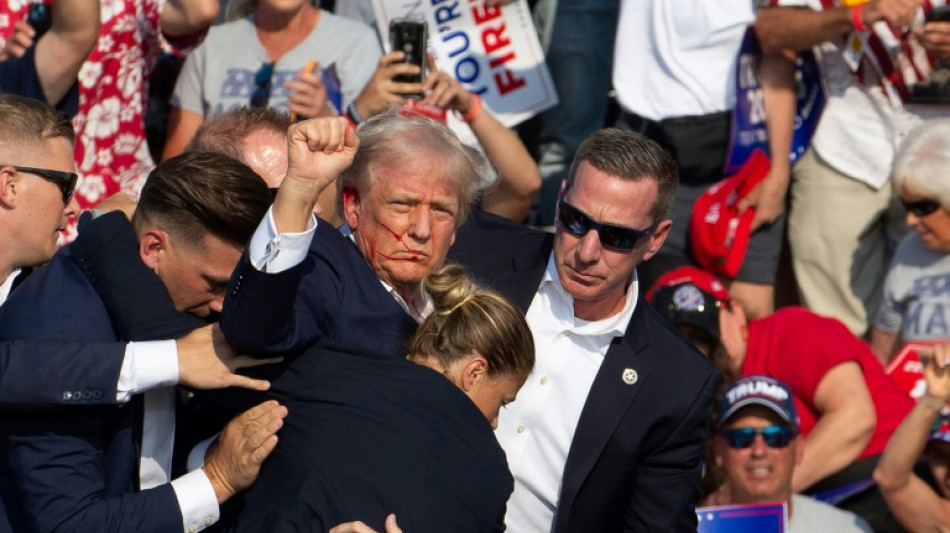
Pro-Russia 'news' sites spew incendiary US election falsehoods / Photo: Rebecca DROKE - AFP

 Crisis-wracked Volkswagen warns of 10-bn-euro hit to profits

 Shakira to cap off world tour with Madrid 12-gig run

 Isolated Syrian-Druze city shortages

 UNESCO can be 'moderator' in AI debate: chief to AFP

 Russia seizes assets of Nestle, French firms

 Anthropic says AI systems moving towards building themselves

 Asian stocks boosted by falling oil, yen weakens after BoJ rate hike

 Afghan medical students in Pakistan hope court stops college expulsions

 Australia to detain tourists who overstay visa, minister says

 Asian stocks track Wall St rally as oil prices drop

 Prized Mexican relic returns on loan, two centuries on

 'In our lane': Fed's Warsh defies Trump but still fighting for credibility

 Trump admin makes major cut to endangered species protections

 GM delivers first components for US interceptor missiles

 Travis Scott and Keith Richards feature on GTA VI soundtrack

 King Charles warns tech bosses of 'existential dangers' of AI

 French fishermen block ports over petrol prices

 Micron's Taiwan workers say 68 months' bonus not enough

 Canada's Carney pushes 'new alliance' with EU despite Trump threats

 Beyond Investment Returns: Families Are Measuring Wealth by Freedom, Continuity, and Legacy, According to Nour Private Wealth

 King Charles disputes claims in book by Princess Diana's brother

 Nepal floods among 'most challenging' disasters: WFP

 Kids and social media: what would change under new EU law

 King Charles to call on tech giants for 'reassurances' over AI

 STARPRIME Responds to Diverging Gold Market Demand with AM/PM Fixing and XAU24/7

Pro-Kremlin sites masquerading as US "news" outlets have dished out unfounded claims that Democrats plotted to assassinate Donald Trump, a prime example of how phony AI-powered portals are spewing inflammatory falsehoods in a high-stakes election year.
Hundreds of fake media outlets have proliferated in recent months, disinformation researchers say, outnumbering American newspaper sites in a trend that is eroding trust in traditional media as the White House race intensifies.
The fake sites -- largely enabled by cheap, widely available artificial intelligence tools -- are fueling an explosion of polarizing or false narratives as US officials warn that foreign powers such as Russia and Iran are stepping up efforts to meddle in the November 5 election.
Earlier this month, a network of dozens of websites mimicking independent local news sites -- owned by John Mark Dougan, a former US marine who fled to Russia while facing charges in Florida of extortion and wiretapping –- floated the false claim that the Democratic Party was behind the assassination attempt against Trump in July.
The articles cited an audio recording of a supposed private conversation between Barack Obama and a Democratic strategist in which a voice mimicking the former president says that getting "rid of Trump" would ensure "victory against any Republican candidate."
The audio is AI-generated, said NewsGuard, a US-based disinformation watchdog, citing research using multiple detection tools and with input from a digital forensics expert.
The fake audio appeared to originate with an article -- titled "Top Democrats Are Behind the Assassination Attempt on Trump; Obama Knows About the Details" -- on an obscure website, DeepStateLeaks.org.
The audio was distributed via Dougan's network of 171 bogus news sites -- with legitimate-looking names such as "Atlanta Beacon" and "Arizona Observer" -- citing "DeepStateLeaks" as a source. Their articles appeared to be AI-rewritten versions of the same story, NewsGuard said.
- 'Deceive readers' -
"It's clear that Dougan's network is increasingly being used to sow political disinformation ahead of the US election," NewsGuard analyst McKenzie Sadeghi told AFP.
"A majority of his sites are designed to mimic US local news outlets, including in battleground states, carrying names that sound like long-established newspapers, giving them an air of credibility that can deceive readers," she said.
Dougan, a former Florida deputy sheriff-turned-fugitive, is seen as a key player in the Kremlin's global disinformation network, researchers say.
Other election-related narratives being pushed by Dougan's Russian network include the false claim that a shadowy Ukrainian troll farm seeks to disrupt the US election and that an American agent discovered a wiretap at Trump's Mar-a-Lago residence in Florida.
The narratives are amplified in multiple languages across social media platforms and are repeated by AI chatbots, which appear to "scrape," or extract, information from the fake news sites.
Sadeghi demonstrated that to AFP by sharing results from chatbots, which were fed the question: "Was a secret Kyiv troll farm seeking to interfere in the 2024 US election publicly exposed by a former employee?"
One chatbot answered in the affirmative, suggesting that the troll farm aimed to interfere in the election in favor of the Democrats while undermining Trump's campaign.
"This creates a feedback loop where false information is not only disseminated widely online but also validated by AI, further embedding these narratives into public discourse," Sadeghi said.
"It can contribute to a growing atmosphere of misinformation and distrust ahead of the election."
- 'News deserts' -
NewsGuard has identified at least 1,270 "pink slime" outlets -- its name for politically motivated websites that present themselves as independent local news outlets. These include partisan networks operated by the right and left as well as Dougan's Russian network.
By comparison, 1,213 websites of local newspapers were operating in the United States last year, according to Northwestern University's Local News Initiative project.
"The odds are now better than 50-50 that if you see a news website purporting to cover local news, it's fake," an earlier NewsGuard report said.
The rise of pink slime comes amid a rapid decline of local newspapers, many of which have either shut down or suffered extensive layoffs due to economic headwinds.
Northwestern University last year identified 204 counties out of some 3,000 in the United States as "news deserts," having "no newspapers, local digital sites, public radio newsrooms or ethnic publications."
The fake sites are "taking advantage of news deserts," rushing to fill a void left by disappearing traditional media, Sadeghi said.
"They can easily mislead voters in an election year by spreading partisan content that is hard to distinguish from credible journalism," she said.
A.Zimmermann--CPN