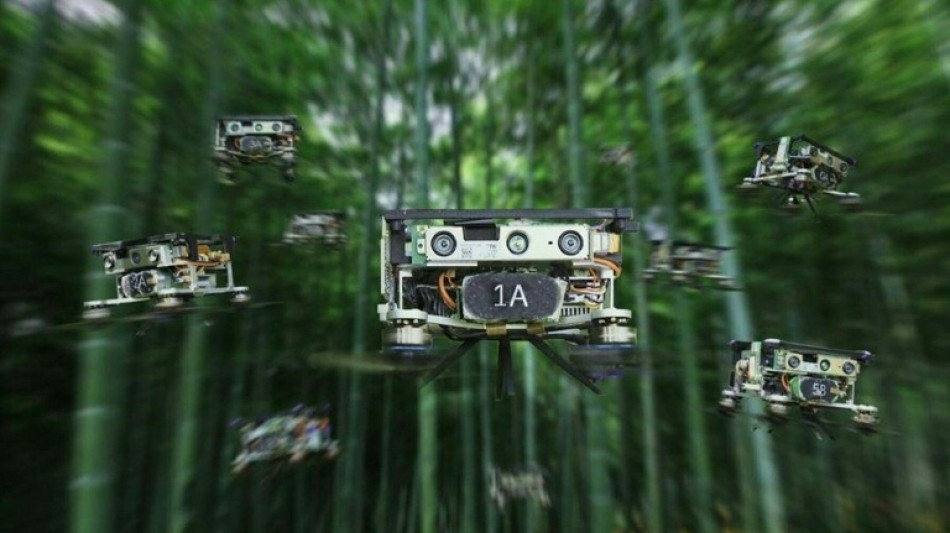
Drone swarms can now fly autonomously through thick forest / Photo: Handout - Yuman Gao and Rui Jin/AFP

 Wildfires push endangered Sumatran elephants to brink: Indonesian NGO

 Bank of Japan set to raise rates under pressure from inflation, US

 EU chief to unveil social media, gaming curbs for under-15s

 'Resident Evil' film brings video game's ethos to the big screen

 i-payout Expands U.S. Money Transmitter Licensing Footprint and Advances European EMI Strategy

 US Senate crypto bill collapses amid partisan deadlock

 OpenAI, Anthropic and Google are working to create an AI standards body

 Protesting shepherds, farmers clash with Romanian police

 Foundation Lets Ledger Users Switch to Open Source Without Starting Over

 EU to propose curbing social media, online games for under 15s

 FX Junction Reaches 40,600 Members and 26 Million Trades

 'We unleashed the beast': the world's fears and hopes about AI

 Hospitality leaders ask Burnham to halve VAT amid rising costs

 Worcestershire invited to nominate groups for 2027 King’s volunteer award

 Berlin's run-down public spaces at heart of election campaign

 'Widow's Bay' and 'The Pitt' win big at Emmy Awards

 Most markets drop as oil extends gains ahead of expected US rate hike

 Sri Lanka's famed beach shack battles demolition

 Vserv targets ₹1,000 crore revenue by 2030 through AI expansion

 India prohibits bank fees on UPI payments up to ₹2,000

 Brazil's Amazon defender Raoni has cancer

 Trump rejects AI slowdown concerns as UN urges coordinated controls

 Higher wages draw migrant workers to Kashmir despite attacks

 Oil supply concerns and AI warnings weigh on global markets

 'I am the hoax buster': Trump rejects AI danger warnings

A swarm of 10 bright blue drones lifts off in a bamboo forest in China, then swerves its way between cluttered branches, bushes and over uneven ground as it autonomously navigates the best flight path through the woods.
The experiment, led by scientists at Zhejiang University, evokes scenes from science fiction -- and the authors in fact cite films such as "Star Wars," "Prometheus" and "Blade Runner 2049" in the opening of their paper published Wednesday in the journal Science Robotics.
"Here, we take a step forward (to) such a future," wrote the team, led by Xin Zhou.
In theory, there are myriad real world applications, including aerial mapping for conservation and disaster relief work. But the technology has needed to mature so that flying robots can adapt to new environments without crashing into one another or objects, thus endangering public safety.
Drone swarms have been tested in the past, but either in open environments without obstacles, or with the location of those obstacles programmed in, Enrica Soria, a roboticist at the Swiss Federal Institute of Technology Lausanne, who was not involved in the research, told AFP.
"This is the first time there's a swarm of drones successfully flying outside in an unstructured environment, in the wild," she said, adding the experiment was "impressive."
The palm-sized robots were purpose-built, with depth cameras, altitude sensors and an on-board computer. The biggest advance was a clever algorithm that incorporates collision avoidance, flight efficiency and coordination within the swarm.
Since these drones do not rely on any outside infrastructure, such as GPS, swarms could be used during natural disasters.
For example, they could be sent into earthquake-hit areas to survey damage and identify where to send help, or into buildings where it's unsafe to send people.
It's certainly possible to use single drones in such scenarios, but a swarm approach would be far more efficient, especially given limited flight times.
Another possible use is having the swarm collectively lift and deliver heavy objects.
There's also a darker side: swarms could be weaponized by militaries, just as remote-piloted single drones are today. The Pentagon has repeatedly expressed interest and is carrying out its own tests.
"Military research is not shared with the rest of the world just openly, and so it's difficult to imagine at what stage they are with their development," said Soria.
But advances shared in scientific journals could certainly be put to military use.
- Coming soon? -
The Chinese team tested their drones in different scenarios -- swarming through the bamboo forest, avoiding other drones in a high-traffic experiment, and having the robots follow a person's lead.
"Our work was inspired by birds that fly smoothly in a free swarm through even very dense woods," wrote Zhou in a blog post.
The challenge, he said, was balancing competing demands: the need for small, lightweight machines, but with high-computational power, and plotting safe trajectories without greatly prolonging flight time.
For Soria, it's only a matter of a few years before we see such drones deployed in real-life work. First, though, they will need to be tested in ultra-dynamic environments like cities, where they'll constantly come up against people and vehicles.
Regulations will also need to catch up, which takes additional time.
L.Peeters--CPN