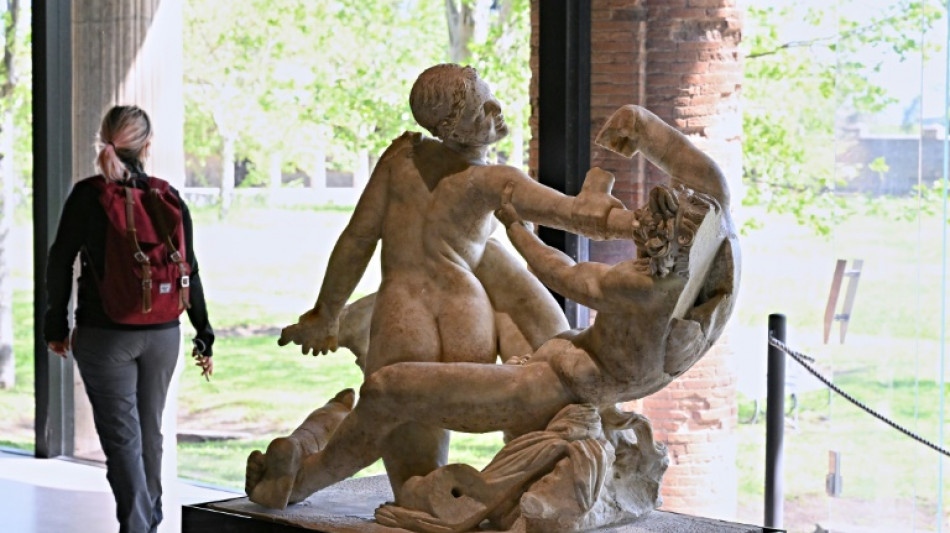
Pulses race at new erotic Pompeii exhibition / Photo: Andreas SOLARO - AFP/File

 Wildfires push endangered Sumatran elephants to brink: Indonesian NGO

 Bank of Japan set to raise rates under pressure from inflation, US

 EU chief to unveil social media, gaming curbs for under-15s

 'Resident Evil' film brings video game's ethos to the big screen

 i-payout Expands U.S. Money Transmitter Licensing Footprint and Advances European EMI Strategy

 US Senate crypto bill collapses amid partisan deadlock

 OpenAI, Anthropic and Google are working to create an AI standards body

 Protesting shepherds, farmers clash with Romanian police

 Foundation Lets Ledger Users Switch to Open Source Without Starting Over

 EU to propose curbing social media, online games for under 15s

 FX Junction Reaches 40,600 Members and 26 Million Trades

 'We unleashed the beast': the world's fears and hopes about AI

 Hospitality leaders ask Burnham to halve VAT amid rising costs

 Worcestershire invited to nominate groups for 2027 King’s volunteer award

 Berlin's run-down public spaces at heart of election campaign

 'Widow's Bay' and 'The Pitt' win big at Emmy Awards

 Most markets drop as oil extends gains ahead of expected US rate hike

 Sri Lanka's famed beach shack battles demolition

 Vserv targets ₹1,000 crore revenue by 2030 through AI expansion

 India prohibits bank fees on UPI payments up to ₹2,000

 Brazil's Amazon defender Raoni has cancer

 Trump rejects AI slowdown concerns as UN urges coordinated controls

 Higher wages draw migrant workers to Kashmir despite attacks

 Oil supply concerns and AI warnings weigh on global markets

 'I am the hoax buster': Trump rejects AI danger warnings

Raunchy scenes may redden faces at a new exhibition in Pompeii on art and sexuality in the ancient Roman city, where sculptures and paintings of breasts and buttocks abound.
Archaeologists excavating the city, which was destroyed by the eruption of nearby Vesuvius in 79 AD, were initially startled to discover erotic images everywhere, from garden statues to ceiling frescos.
Since those first digs in the 18th-century site, racy images have been found in taverns, thermal baths and private homes, from huge erect penises to a statue with both male and female physical attributes.
It became clear that "this is a city where sensuality, eroticism, are ever-present," Pompeii's site director Gabriel Zuchtriegel told AFP as he stood in front of statues of bare-chested Centaurs.
The discoveries initially caused "dismay, embarrassment, and curiosity, and were seen by some as a great opportunity to think about the relationship with their bodies and nudity in a very different way".
The Neapolitan King Charles VII, who financed the excavations, shut some of the more bawdy finds away in a secret cabinet in Naples, only showing them to those of proven moral standing, Zuchtriegel said.
That secret cabinet still exists today in the archaeological museum in the southern Italian city.
The exhibition, which runs until January 2023 and brings together some 70 works, begins with the vast erect penis on a statue of the god Priape -- a Roman symbol of fertility and prosperity.
Priape and his phallus was traditionally placed in the atrium, the large central hall of Roman houses.
- Guide for children -
Visitors are told this has nothing to do with eroticism, "though the modern imagination gives it this meaning", says Tiziana Rocco from the Pompeii exhibition office.
The smirking of embarrassed tourists is proof enough of that, despite some wishing it otherwise.
"I think modern American culture is a little bit too prudish, and uncomfortable with the human body," says Seattle tourist Daniel Berglund.
"It's nice to see ancient culture that was more open and willing to display and glorify the human body," the 40-year-old said as he lingered in front of paintings from a "cubiculum", or Roman bedroom.
Various scenes are shown, including a man and a woman having sex.
Further on, a series of oil lamps shine light on images to make pulses race -- though the curators have not forgotten that some people will be bringing their children to the exhibition.
"Families and children make up a large part of our public," says Zuchtriegel, who has put together an illustrated guide for them.
"The theme may seem difficult, but it is omnipresent in Pompeii, so it must be explained to children in one way or another," he said.
In the guide, a centaur -- a creature from Greek mythology that is half man, half horse -- searches for a mate.
On the way he meets Narcissus, who fell in love with his own image, Dionysus, the god of wine, and Hermaphrodite, the child of Aphrodite and Hermes, who had both male and female sexual organs.
"It's a playful way to meet the different figures of Greek myths present in Pompeii," Zuchtriegel said
O.Ignatyev--CPN