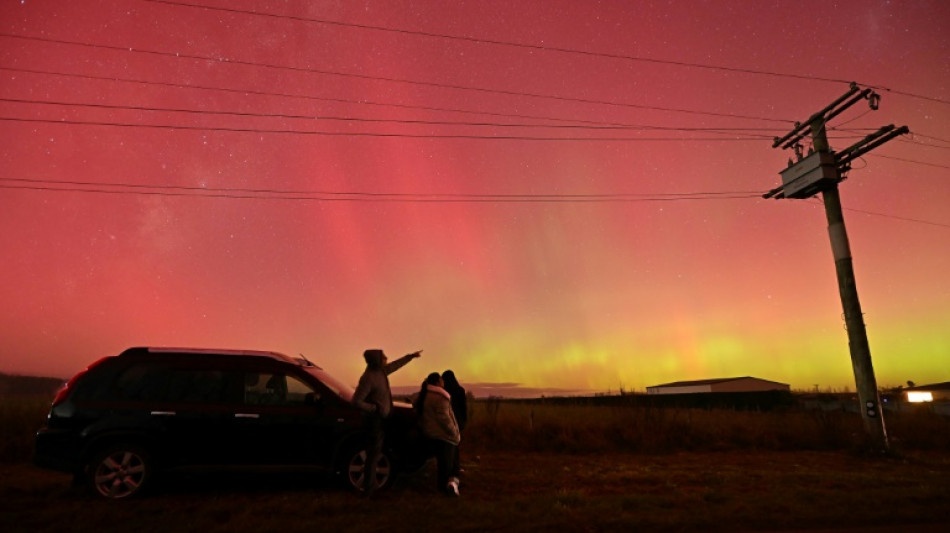
Solar storms could cause more auroras on Tuesday night / Photo: Sanka Vidanagama - AFP/File

 Nigeria miners struggled to breathe in cell before 37 died: survivors

 Warren Buffett steps down as Berkshire Hathaway chairman

 Isolated Syrian-Druze city blames Damascus for shortages

 Kerry James Marshall: American 'blackness' painter celebrated in Europe

 Infantino 'must go', says German FA vice-president

 Japan's busiest rail station tests robot bins

 Backpackers fret over Australian visa crackdown

 Bank of Japan hikes rates to 31-year high to battle inflation

 AI doomsday warnings unlikely to slow IPOs but questions linger

 In Brazil's Amazon, the hunt for oil fuels hopes and fears

 Baby orangutans in India expose 'frightening' scale of trafficking

 Oversight Board blasts 'inadequate' Meta safeguards for AI deepfakes

 Harry makes first public appearance since return to UK

 Princess Diana's brother makes new explosive claims against Charles

 Trump admin overhauls key protection for endangered species

 Mbappe draws political fire over Ceuta t-shirt controversy

 Third malaria death in Germany from outbreak tied to Frankfurt airport

 AtlasClear Holdings Reports Preliminary Fiscal 2026 Revenue of Approximately $20.1 Million, Up 85%; Revenue Plus Interest Income of Approximately $21.9 Million

 'Another arrow to the quiver': World Bank posts record private capital mobilization

 Ireland to boycott Eurovision 2027 over Gaza

 India's Tata Sons reappoints N. Chandrasekaran as chairman

 Germany urges EU action against China to defend carmakers

 Japan eyes changing prostitution law to punish sex buyers

 Modi pitches India as global chipmaking hub

 Ukraine plans record defence spending in 2027

Massive explosions on the Sun have triggered warnings of geomagnetic storms that could create dazzling auroras in the northern United States, Europe and southern Australia on Tuesday night.
In May, the most powerful geomagnetic storm to strike Earth in more than two decades lit up night skies with colourful light displays in Hawaii, Spain, South Africa and other places far from the extreme latitudes where they are normally seen.
These storms are caused by coronal mass ejections (CMEs) -- expulsions of plasma and magnetic fields from the Sun which take days to reach Earth.
At least four CMEs that erupted in recent days are headed towards Earth, the US-based National Oceanic and Atmospheric Administration (NOAA) said late Monday.
They will arrive from Tuesday to Thursday, with "geomagnetic storm watches" declared by the NOAA on those days.
But "the brunt of the activity is most likely" to come on Tuesday, when there is a "strong" geomagnetic storm warning of G3, the NOAA said.
May's record storms were classified as the most extreme level of G5. This means any potential auroras this week are unlikely to stray as far, or as be as powerful, as those seen earlier this year.
But if the current forecast is correct, during the late evening hours in the US on Tuesday, an "aurora could become visible as far south as the northeast US through the upper Midwest and across the rest of the northern states to include northern Oregon", the NOAA said.
"With a bit of luck," aurora borealis -- also known as the northern lights -- could also be seen in areas such as England, northern Germany, the Netherlands and Belgium, according to the website SpaceWeatherLive.
Australia's Bureau of Meteorology said that a sequence of CMEs arriving in the next few days mean that aurora australis might be visible in some areas.
- 'Cannibal CME' -
When CMEs erupt, they shoot around a billion tons of plasma -- with an accompanying magnetic field -- from the Sun towards our home planet.
One of the CMEs coming towards Earth this week merged with another, forming what is called a "Cannibal CME", according to spaceweather.com.
The NOAA warned that more CMEs are continuing to erupt, so more could be coming our way.
When the CMEs slam into Earth's magnetosphere, they can create geomagnetic storms.
These storms can mess with satellites orbiting Earth and affect things like radio signals and GPS positioning systems.
They can also knock out electricity grids -- the "Halloween Storms" of October 2003 sparked blackouts in Sweden and damaged power infrastructure in South Africa.
Astronauts on the International Space Station often shelter during extreme solar activity to avoid being exposed to radiation.
Numerous strong solar flares -- huge explosions on the Sun's surface which can cause CMEs -- have also been emitted in recent days.
Most CMEs and flares come from sunspots, which are massive, darker areas of intense activity on the solar surface. The sunspot cluster that caused May's storms was 17 times the size of Earth.
More geomagnetic storms could be yet to come, because solar activity is only just approaching the peak of its roughly 11-year cycle.
The peak -- called "solar maximum" -- is expected between late 2024 and early 2026.
M.García--CPN