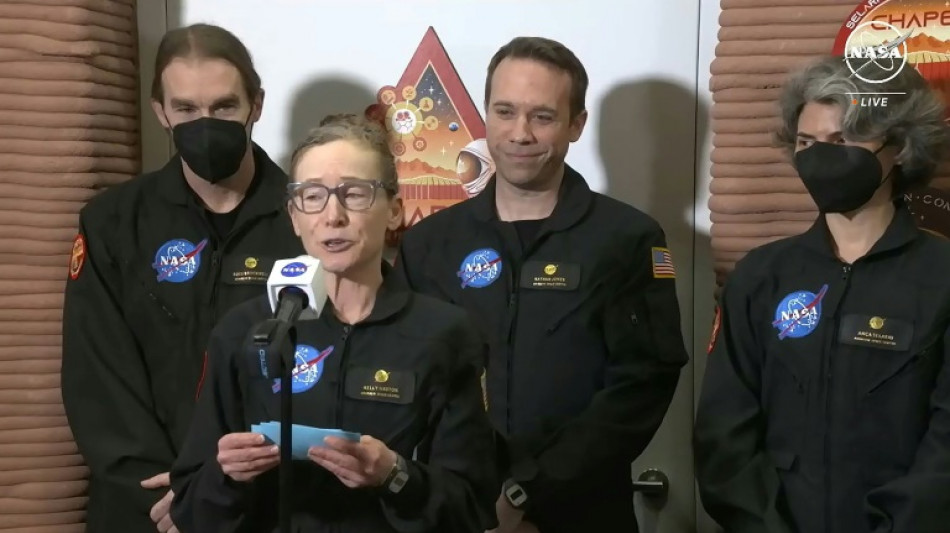
'Ready to come out?' Scientists reemerge after year 'on Mars' / Photo: Jose ROMERO - NASA TV/AFP

 Nigeria miners struggled to breathe in cell before 37 died: survivors

 Warren Buffett steps down as Berkshire Hathaway chairman

 Isolated Syrian-Druze city blames Damascus for shortages

 Kerry James Marshall: American 'blackness' painter celebrated in Europe

 Infantino 'must go', says German FA vice-president

 Japan's busiest rail station tests robot bins

 Backpackers fret over Australian visa crackdown

 Bank of Japan hikes rates to 31-year high to battle inflation

 AI doomsday warnings unlikely to slow IPOs but questions linger

 In Brazil's Amazon, the hunt for oil fuels hopes and fears

 Baby orangutans in India expose 'frightening' scale of trafficking

 Oversight Board blasts 'inadequate' Meta safeguards for AI deepfakes

 Harry makes first public appearance since return to UK

 Princess Diana's brother makes new explosive claims against Charles

 Trump admin overhauls key protection for endangered species

 Mbappe draws political fire over Ceuta t-shirt controversy

 Third malaria death in Germany from outbreak tied to Frankfurt airport

 AtlasClear Holdings Reports Preliminary Fiscal 2026 Revenue of Approximately $20.1 Million, Up 85%; Revenue Plus Interest Income of Approximately $21.9 Million

 'Another arrow to the quiver': World Bank posts record private capital mobilization

 Ireland to boycott Eurovision 2027 over Gaza

 India's Tata Sons reappoints N. Chandrasekaran as chairman

 Germany urges EU action against China to defend carmakers

 Japan eyes changing prostitution law to punish sex buyers

 Modi pitches India as global chipmaking hub

 Ukraine plans record defence spending in 2027

The NASA astronaut knocks loudly three times on a what appears to be a nondescript door, and calls cheerfully: "You ready to come out?"
The reply is inaudible, but beneath his mask he appears to be grinning as he yanks the door open -- and four scientists who have spent a year away from all other human contact, simulating a mission to Mars, spill out to cheers and applause.
Anca Selariu, Ross Brockwell, Nathan Jones and team leader Kelly Haston have spent the past 378 days sealed inside the "Martian" habitat in Houston, Texas, part of NASA's research into what it will take to put humans on the Red Planet.
They have been growing vegetables, conducting "Marswalks," and operating under what NASA terms "additional stressors" -- such as communication delays with "Earth", including their families; isolation and confinement.
It's the kind of experience that would make anyone who lived through pandemic lockdowns shudder -- but all four were beaming as they reemerged Saturday, their hair slightly more unruly and their emotion apparent.
"Hello. It's actually so wonderful just to be able to say hello to you," Haston, a biologist, said with a laugh.
"I really hope I don't cry standing up here in front of all of you," Jones, an emergency room doctor, said as he took to the microphone -- and nearly doing just that several moments later as he spotted his wife in the crowd.
The habitat, dubbed Mars Dune Alpha, is a 3D printed 1,700 square-foot (160 square-meter) facility, complete with bedrooms, a gym, common areas, and a vertical farm to grow food.
An outdoor area, separated by an airlock, is filled with red sand and is where the team donned suits to conduct their "Marswalks", though it is still covered rather than being open air.
"They have spent more than a year in this habitat conducting crucial science, most of it nutrition-based and how that impacts their performace ... as we prepare to send people on to the Red Planet," Steve Koerner, deputy director at NASA's Johnson Space Center, told the crowd.
"I'm very appreciative."
This mission is the first of a series of three planned by NASA, grouped under the title CHAPEA -- Crew Health and Performance Exploration Analog.
A year-long mission simulating life on Mars took place in 2015-2016 in a habitat in Hawaii, and although NASA participated in it, it was not at the helm.
Under its Artemis program, America plans to send humans back to the Moon in order to learn how to live there long-term to help prepare a trip to Mars, sometime towards the end of the 2030s.
Ng.A.Adebayo--CPN