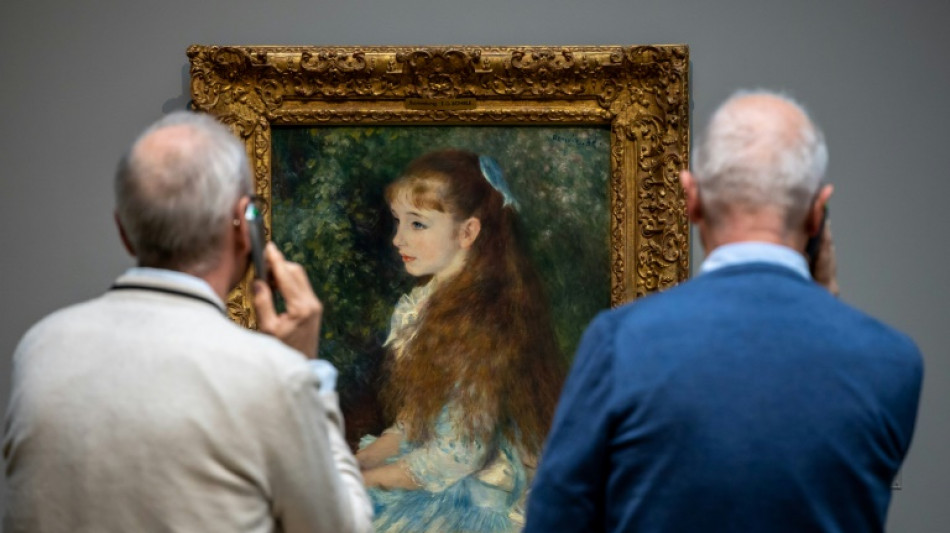
Experts press Swiss foundation over Nazi-era art collection / Photo: ARND WIEGMANN - AFP

 Nigeria miners struggled to breathe in cell before 37 died: survivors

 Warren Buffett steps down as Berkshire Hathaway chairman

 Isolated Syrian-Druze city blames Damascus for shortages

 Kerry James Marshall: American 'blackness' painter celebrated in Europe

 Infantino 'must go', says German FA vice-president

 Japan's busiest rail station tests robot bins

 Backpackers fret over Australian visa crackdown

 Bank of Japan hikes rates to 31-year high to battle inflation

 AI doomsday warnings unlikely to slow IPOs but questions linger

 In Brazil's Amazon, the hunt for oil fuels hopes and fears

 Baby orangutans in India expose 'frightening' scale of trafficking

 Oversight Board blasts 'inadequate' Meta safeguards for AI deepfakes

 Harry makes first public appearance since return to UK

 Princess Diana's brother makes new explosive claims against Charles

 Trump admin overhauls key protection for endangered species

 Mbappe draws political fire over Ceuta t-shirt controversy

 Third malaria death in Germany from outbreak tied to Frankfurt airport

 AtlasClear Holdings Reports Preliminary Fiscal 2026 Revenue of Approximately $20.1 Million, Up 85%; Revenue Plus Interest Income of Approximately $21.9 Million

 'Another arrow to the quiver': World Bank posts record private capital mobilization

 Ireland to boycott Eurovision 2027 over Gaza

 India's Tata Sons reappoints N. Chandrasekaran as chairman

 Germany urges EU action against China to defend carmakers

 Japan eyes changing prostitution law to punish sex buyers

 Modi pitches India as global chipmaking hub

 Ukraine plans record defence spending in 2027

A Swiss foundation must do more to trace the provenance of works in a vast art collection acquired in questionable circumstances during World War II, a team of experts said Friday.
There has long been suspicion around the Nazi-era origins of one of Europe's most prestigious private art collections, acquired by arms dealer Emil Buhrle, who made his fortune during the war.
The German-born industrialist became a naturalised Swiss citizen in 1937. By the time he died in 1956, he had amassed around 600 artworks, including masterpieces by Cezanne, Degas, Manet, Monet, Renoir, Rembrandt, Picasso and Van Gogh.
Some had previously been looted from their Jewish owners, or sold cheaply and in haste as their owners fled the Nazis.
The Buhrle Foundation, which owns the collection, has been working to clarify the provenance of the works for years.
Its efforts came into particular focus when Kunsthaus Zurich, one of Switzerland's most prestigious art museums, agreed to permanently house the collection. Until then, it had been displayed at a private museum on the outskirts of Zurich.
The Kunsthaus has faced especially keen scrutiny since it opened a new building to house a large part of the collection in 2021.
- 'Insufficient' -
A team of experts mandated by the Zurich authorities and the museum to evaluate the foundation's research on provenance on Friday concluded that it had been "insufficient".
"Provenance research must be continued," said the team, led by renowned Swiss historian Raphael Gross, president of the German Historical Museum Foundation.
The Buhrle Foundation has confirmed that 13 paintings bought by the German-born industrialist had been stolen by the Nazis from Jewish owners in France.
Following a series of court cases after World War II ended, in the late 1940s Buhrle returned all 13 pieces to their rightful owners then repurchased nine of them, the foundation said.
But the foundation says its research over two decades concluded there were no signs of "problematic provenance" for any of the 203 works in the current collection.
Friday's expert review examined the foundation's sources, methodology, accuracy, standards and historical contextualisation.
Voicing particular concern that the foundation had categorised 90 works as unproblematic despite lacking full provenance research, the experts insisted they should all be re-examined.
The research should "concentrate on clarifying the previous Jewish ownership and persecution-related confiscation of the works", they added.
"Without the Nazi's persecution of Jews, the Buhrle Collection would never have reached the level it did," Gross reporters at a new conference, the Swiss news agency Keystone-ATS reported.
- 'Superficial' -
The experts conducted an in-depth examination of the provenance investigation conducted on five emblematic works. They research there, they said, was so "superficial that decisive indicators (were) overlooked".
One of the works, "Madame Cezanne with a Fan" by Paul Cezanne, had belonged to the US writer, poet and art collector Gertrude Stein, who was living in Nazi-occupied France.
"Gertrude Stein sold it to an art dealer who demonstrably exploited the plight of Jewish refugees," it said. "The provenance of this work has not yet been sufficiently researched".
The experts urged the Kunsthaus to set up an interdisciplinary panel to create a scheme for examining all art in its own collection and on long-term loan that could potentially be linked to Nazi-related confiscations.
The report also suggested the museum conduct a further debate, if possible a public one, about the Buhrle collection and the museum's association with his name.
O.Hansen--CPN