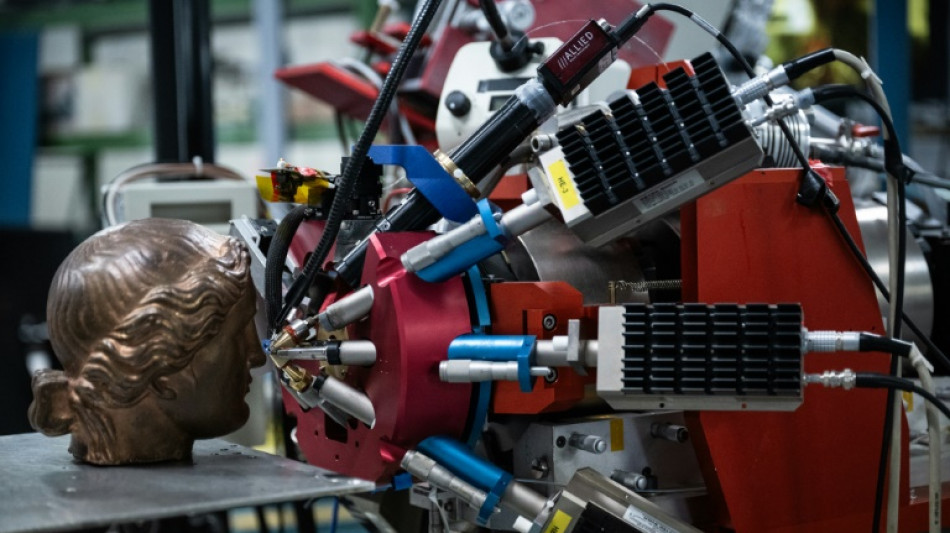
The high-tech art lab hidden underneath Paris / Photo: JULIEN DE ROSA - AFP

 Nigeria miners struggled to breathe in cell before 37 died: survivors

 Warren Buffett steps down as Berkshire Hathaway chairman

 Isolated Syrian-Druze city blames Damascus for shortages

 Kerry James Marshall: American 'blackness' painter celebrated in Europe

 Infantino 'must go', says German FA vice-president

 Japan's busiest rail station tests robot bins

 Backpackers fret over Australian visa crackdown

 Bank of Japan hikes rates to 31-year high to battle inflation

 AI doomsday warnings unlikely to slow IPOs but questions linger

 In Brazil's Amazon, the hunt for oil fuels hopes and fears

 Baby orangutans in India expose 'frightening' scale of trafficking

 Oversight Board blasts 'inadequate' Meta safeguards for AI deepfakes

 Harry makes first public appearance since return to UK

 Princess Diana's brother makes new explosive claims against Charles

 Trump admin overhauls key protection for endangered species

 Mbappe draws political fire over Ceuta t-shirt controversy

 Third malaria death in Germany from outbreak tied to Frankfurt airport

 AtlasClear Holdings Reports Preliminary Fiscal 2026 Revenue of Approximately $20.1 Million, Up 85%; Revenue Plus Interest Income of Approximately $21.9 Million

 'Another arrow to the quiver': World Bank posts record private capital mobilization

 Ireland to boycott Eurovision 2027 over Gaza

 India's Tata Sons reappoints N. Chandrasekaran as chairman

 Germany urges EU action against China to defend carmakers

 Japan eyes changing prostitution law to punish sex buyers

 Modi pitches India as global chipmaking hub

 Ukraine plans record defence spending in 2027

It looks like the lair of a Bond villain: behind armoured doors, buried underground below the Louvre in Paris, lies one of the most high-tech art labs in the world.
Across three floors and nearly 6,000 square metres, the Centre for Research and Restoration of Museums of France (C2RMF) includes its own particle accelerator called AGLAE, and is bustling with radiologists, chemists, geologists, metallurgists, archaeologists and engineers.
The 150-strong team examines around 1,000 artworks per year, discovering precisely which materials and methods went into making them, their origin and age, and how the years have altered them.
Their analyses inform restoration teams within the centre, at the Louvre, Versailles and beyond.
Many great artworks have passed through the lab since its creation in 1999, including the Mona Lisa, the stained-glass windows of Notre-Dame Cathedral or Napoleon's sabre.
- Like 'CSI' -
When AFP was granted a rare visit recently, an 11th century bronze sculpture of the Hindu god Vishnu had recently arrived from Cambodia ahead of exhibitions in France and the United States next year.
A masterpiece of Khmer art, the "Vishnu of Western Mebon" was found at Angkor Wat in 1936, a rare reclining depiction of the Hindu god that would have measured some six metres when it was complete.
Behind thick, lead doors, a team of 10 specialists was carrying out X-rays and 3D scanning on the statue.
Certain parts would then be tested with techniques such as X-ray fluorescence and spectrometry that bombard it with gamma rays and electrons to discover its detailed chemical and molecular composition.
"We're a bit like NASA, each with our own skills, or 'CSI: Miami', the scientific police," said team leader David Bourgarit, an archaeo-metallurgical research engineer.
"Our crime scenes are archaeological discoveries. We try to understand who made them, how and why, like a police investigation," he added.
He pointed to little white dots around the eyebrows of the statue that he said were said were another metal, "denser than copper", which will require further analysis to identify.
The team also wants to identity the clay used to make the initial mould for the statue, traces of which are still inside.
That should allow them to pinpoint exactly where it was made by comparing to earth samples.
Some fragments may also pass through AGLAE (the French acronym for the Grand Louvre Accelerator of Elemental Analysis), installed in the 1990s and the only one in the world to work exclusively on artworks.
In a room packed with machinery, the straight-line accelerator gives off a powerful roar as it creates and blasts particles at artworks and artefacts.
It allows the scientists to ascertain the amounts and combinations of elements in the objects, adding another layer of analysis for dating and verifying their authenticity.
Y.Ibrahim--CPN