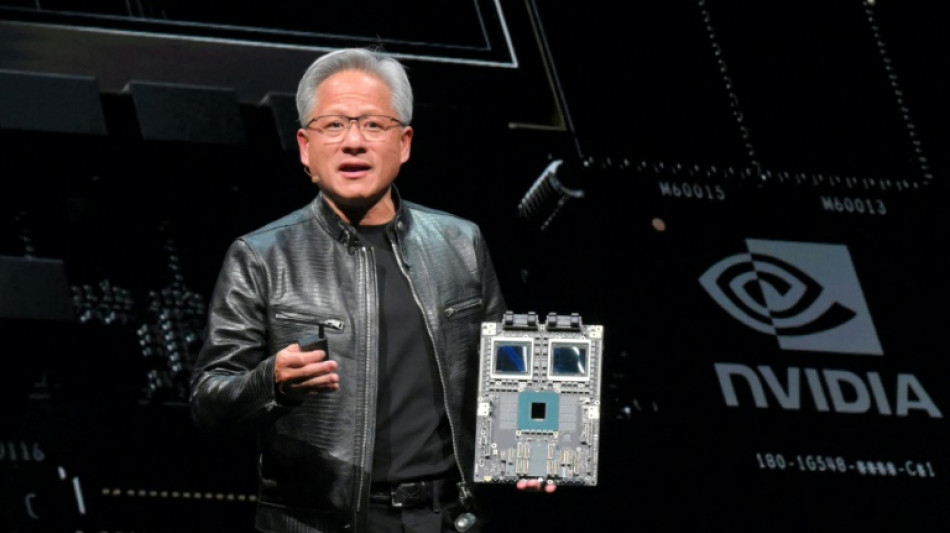
Nvidia boss unveils AI products ahead of Taiwan expo / Photo: Sam YEH - AFP

 Cuba hit with seventh major blackout of the year
 Nigeria miners struggled to breathe in cell before 37 died: survivors

 Warren Buffett steps down as Berkshire Hathaway chairman

 Isolated Syrian-Druze city blames Damascus for shortages

 Kerry James Marshall: American 'blackness' painter celebrated in Europe

 Infantino 'must go', says German FA vice-president

 Japan's busiest rail station tests robot bins

 Backpackers fret over Australian visa crackdown

 Bank of Japan hikes rates to 31-year high to battle inflation

 AI doomsday warnings unlikely to slow IPOs but questions linger

 In Brazil's Amazon, the hunt for oil fuels hopes and fears

 Baby orangutans in India expose 'frightening' scale of trafficking

 Oversight Board blasts 'inadequate' Meta safeguards for AI deepfakes

 Harry makes first public appearance since return to UK

 Princess Diana's brother makes new explosive claims against Charles

 Trump admin overhauls key protection for endangered species

 Mbappe draws political fire over Ceuta t-shirt controversy

 Third malaria death in Germany from outbreak tied to Frankfurt airport

 AtlasClear Holdings Reports Preliminary Fiscal 2026 Revenue of Approximately $20.1 Million, Up 85%; Revenue Plus Interest Income of Approximately $21.9 Million

 'Another arrow to the quiver': World Bank posts record private capital mobilization

 Ireland to boycott Eurovision 2027 over Gaza

 India's Tata Sons reappoints N. Chandrasekaran as chairman

 Germany urges EU action against China to defend carmakers

 Japan eyes changing prostitution law to punish sex buyers

 Modi pitches India as global chipmaking hub

Nvidia on Sunday unveiled new products and plans to accelerate the advance of artificial intelligence, with the AI hardware titan's CEO telling a packed stadium in Taipei that "the next industrial revolution has begun".
Jensen Huang is in Taiwan for the island's premier tech expo, Computex, along with the CEOs of some of the world's biggest semiconductor heavyweights –- including AMD, Intel and Qualcomm –- and their plans for a tech industry dominated by AI are top of the agenda.
Taiwan-born Huang has celebrity status on the island, and there was huge media and public interest in his visit thanks in large part to Nvidia's status as the undisputed leader in the specialised chips and hardware needed to build and run cutting-edge AI.
"Companies and countries are partnering with Nvidia to shift the trillion-dollar traditional data centers to accelerated computing and build a new type of data center -- AI factories -- to produce a new commodity: artificial intelligence," Huang told the crowd at National Taiwan University's sports center.
He announced the general availability of Nvidia ACE generative AI, which can create lifelike human avatars for industries such as customer support.
He also outlined how some top tech companies such as Taiwan's Foxconn -- the world's largest contract electronics manufacturer -- and German industrial giant Siemens are using Nvidia's platforms to develop AI-powered autonomous robots.
While Nvidia had just released its Blackwell platform, Huang announced plans for an "ultra" version in 2025, and briefly teased a next-generation GPU architecture codenamed Rubin.
"Our company is on a one-year rhythm," he said, pointing to an accelerated roadmap for new GPU products each year.
In the future laid out by Huang during his nearly two-hour speech, "almost every interaction you have with the internet or with a computer will likely have a generative AI running in the cloud somewhere."
His keynote was also bookended with praise for Taiwan, whose advanced semiconductor industry is crucial to the production of everything from iPhones to the servers that run ChatGPT
"Taiwan is the home of our treasured partners," he said. "This is... where everything Nvidia does begins, our partners and ourselves take it to the world. Taiwan and our partnership has created the world's AI infrastructure."
A day before his speech, Huang threw the opening pitch before a baseball game in Taipei.
And on Thursday, he dined with some of Taiwan's tech industry leaders, including the head of Apple supplier Foxconn.
- Showcasing the future -
Lisa Su of AMD and Qualcomm boss Cristiano Amon are also scheduled to deliver keynote speeches at Computex.
Su is expected to outline AMD's plans to compete in cutting-edge AI, while Amon will "showcase the AI-accelerated experiences users can expect from their next-generation PCs", according to the organisers.
Intel CEO Pat Gelsinger and Rene Haas, head of the British chip design giant Arm, will also speak at the event.
Tech firms are betting big on AI, and Taiwanese manufacturers are central to their plans -- the island produces the bulk of the world's most advanced semiconductors, including those needed for the most powerful AI applications and research.
Suppliers such as Foxconn, traditionally focused on contract electronics for the likes of Apple, have also pivoted in recent years into producing AI hardware.
Foxconn CEO Young Liu told shareholders on Friday that the firm's global market share for AI servers will increase to 40 percent this year.
However, Taiwan's central position in the supply chain for semiconductors -- the lifeblood of the modern economy -- has become a source of concern in capitals and boardrooms around the world.
Taiwan is self-ruled, but China claims the island as its territory and has never ruled out the use of force to bring it under its control.
In recent years, the relationship between Beijing and Taipei has deteriorated and the Chinese military has staged multiple large-scale exercises around the island -- including the simulation of a blockade.
Ng.A.Adebayo--CPN