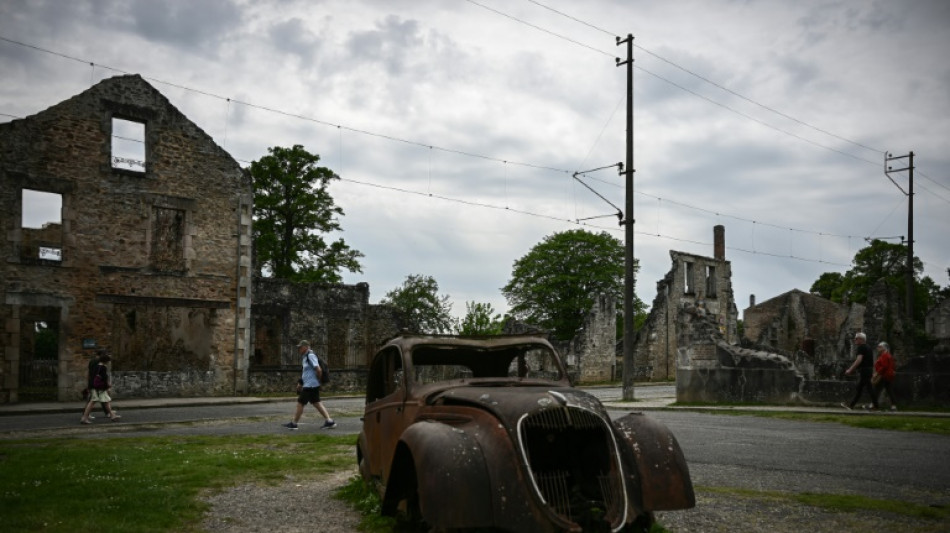
France seeks to save Nazi massacre village from decay / Photo: Philippe LOPEZ - AFP

 Cuba hit with seventh major blackout of the year

 Nigeria miners struggled to breathe in cell before 37 died: survivors

 Warren Buffett steps down as Berkshire Hathaway chairman

 Isolated Syrian-Druze city blames Damascus for shortages

 Kerry James Marshall: American 'blackness' painter celebrated in Europe

 Infantino 'must go', says German FA vice-president

 Japan's busiest rail station tests robot bins

 Backpackers fret over Australian visa crackdown

 Bank of Japan hikes rates to 31-year high to battle inflation

 AI doomsday warnings unlikely to slow IPOs but questions linger

 In Brazil's Amazon, the hunt for oil fuels hopes and fears

 Baby orangutans in India expose 'frightening' scale of trafficking

 Oversight Board blasts 'inadequate' Meta safeguards for AI deepfakes

 Harry makes first public appearance since return to UK

 Princess Diana's brother makes new explosive claims against Charles

 Trump admin overhauls key protection for endangered species

 Mbappe draws political fire over Ceuta t-shirt controversy

 Third malaria death in Germany from outbreak tied to Frankfurt airport

 AtlasClear Holdings Reports Preliminary Fiscal 2026 Revenue of Approximately $20.1 Million, Up 85%; Revenue Plus Interest Income of Approximately $21.9 Million

 'Another arrow to the quiver': World Bank posts record private capital mobilization

 Ireland to boycott Eurovision 2027 over Gaza

 India's Tata Sons reappoints N. Chandrasekaran as chairman

 Germany urges EU action against China to defend carmakers

 Japan eyes changing prostitution law to punish sex buyers

 Modi pitches India as global chipmaking hub

A French village preserved as a reminder of Nazi cruelty since Waffen-SS troops murdered 643 people there in 1944 is in danger of decay, sparking efforts to preserve the site.
On June 10, 1944, Oradour-sur-Glane in German-occupied southern France became the scene of a massacre of civilians that still shocks the nation to this day.
Possibly as punishment for the killing by the French Resistance of a high-ranking SS member, German troops rounded up everyone they could find in the village and machine-gunned or burned alive men, women and children, torched or razed buildings and destroyed a church.
Postwar president Charles de Gaulle said the "martyr village" should never be rebuilt, but instead kept as a permanent reminder of the horrors of the Nazi occupation for postwar generations.
- 'Survivors are gone' -
But 80 years later, village buildings are crumbling, roofs have disappeared and walls are covered in moss, prompting local politicians and descendants of villagers to call for a major conservation effort to keep the memory alive.
"All the survivors are gone, the only witnesses of the massacre are these stones," said Agathe Hebras, whose grandfather Robert was the last survivor of only six people to escape the SS murder spree. He died last year.
"I am deeply attached to these ruins, like many people here, we can't let them wither away," the 31-year-old told AFP. "We need to take care of them as best we can for as long as possible."
A new, eponymous town built nearby after the war is bustling, but the old ruins -- which are owned by the French state and a listed heritage site -- are eerily silent.
- 'Urgent action' -
Some of the crumbling, blackened buildings carry signs like "Hairdresser", "Cafe", or "Ironmongery", reminding visitors that people went about their daily lives here until the murderous assault.
Scattered over 10 hectares are the odd rusty bicycle, sewing machine or shell of a period car.
"We need very, very urgent action," said Oradour-sur-Glane's mayor Philippe Lacroix. "As this setting disappears so will remembrance, little by little."
Carine Villedieu Renaud, 47, the granddaughter of the only couple that survived the massacre, often walks across the ruins on her way to the new town, remembering her grandmother who lost her mother, her sisters and her four-year old daughter in the massacre.
"She would take me for walks among the ruins," she said. "We would pick flowers and she would tell me about her old life."
While the grandmother told her stories "without taboo", other survivors only felt able to speak about the massacre decades later, if at all.
Hebras said her grandfather, who lost two sisters and his mother in the killings, only began to talk about the events in the late 1980s.
"The first generation of children born in Oradour after the massacre, which includes my father, lived through a very hard time because their parents kept silent, believing that they needed to forget to keep on living," she said.
- 'Universal significance' -
Since 1946, the government has allocated the equivalent of 200,000 euros ($216,000 at current rates) annually for maintenance, in addition to ad hoc spending, like the 480,000 euros allocated to the village church's restoration last year.
But much more is needed, said Laetitia Morellet, the regional deputy director for heritage and architecture.
"We don't want to bring back what was destroyed," she told AFP. "We want to preserve the state of destruction, because that is what helps people understand this war crime."
Some 19 million euros are needed, and an effort to source the money through donations and state financing is underway.
Oradour-sur-Glane could eventually gain "a certain universal significance" beyond the 1944 massacre and World War II, said Benoit Sadry, president of an association grouping the victims' families.
"What counts is to keep proof that in mass crimes committed during wars it is always the civilian population that pays the highest price," he said.
A.Levy--CPN