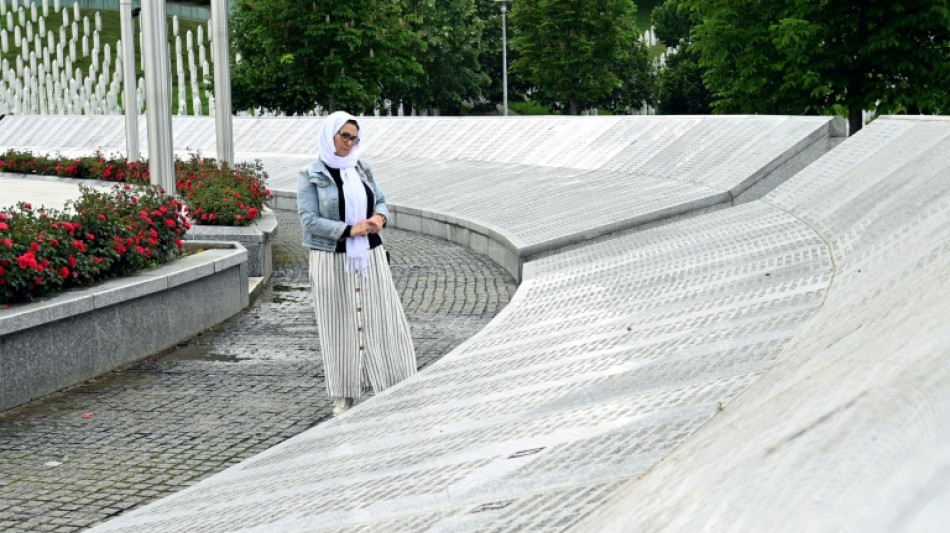
UN creates Srebrenica genocide memorial day / Photo: ELVIS BARUKCIC - AFP

 Cuba hit with seventh major blackout of the year

 Nigeria miners struggled to breathe in cell before 37 died: survivors

 Warren Buffett steps down as Berkshire Hathaway chairman

 Isolated Syrian-Druze city blames Damascus for shortages

 Kerry James Marshall: American 'blackness' painter celebrated in Europe

 Infantino 'must go', says German FA vice-president

 Japan's busiest rail station tests robot bins

 Backpackers fret over Australian visa crackdown

 Bank of Japan hikes rates to 31-year high to battle inflation

 AI doomsday warnings unlikely to slow IPOs but questions linger

 In Brazil's Amazon, the hunt for oil fuels hopes and fears

 Baby orangutans in India expose 'frightening' scale of trafficking

 Oversight Board blasts 'inadequate' Meta safeguards for AI deepfakes

 Harry makes first public appearance since return to UK

 Princess Diana's brother makes new explosive claims against Charles

 Trump admin overhauls key protection for endangered species

 Mbappe draws political fire over Ceuta t-shirt controversy

 Third malaria death in Germany from outbreak tied to Frankfurt airport

 AtlasClear Holdings Reports Preliminary Fiscal 2026 Revenue of Approximately $20.1 Million, Up 85%; Revenue Plus Interest Income of Approximately $21.9 Million

 'Another arrow to the quiver': World Bank posts record private capital mobilization

 Ireland to boycott Eurovision 2027 over Gaza

 India's Tata Sons reappoints N. Chandrasekaran as chairman

 Germany urges EU action against China to defend carmakers

 Japan eyes changing prostitution law to punish sex buyers

 Modi pitches India as global chipmaking hub

The UN General Assembly voted Thursday to establish an annual day of remembrance for the 1995 Srebrenica genocide, despite furious opposition from Bosnian Serbs and Serbia.
The resolution written by Germany and Rwanda -- countries synonymous with genocide in the 20th century -- received 84 votes in favor, 19 against with 68 abstentions and makes July 11 "International Day of Remembrance of the Srebrenica Genocide."
Ahead of the vote, Serbian President Aleksandar Vucic warned the General Assembly that the move "will just open old wounds and that will create a complete political havoc."
But he said he did not deny the killings at Srebrenica, adding that he bowed his "head to all the victims of the conflict in Bosnia."
"This resolution seeks to foster reconciliation, in the present and for the future," said Germany's ambassador to the UN Antje Leendertse.
Church bells rang out across Serbia on Thursday in protest. The Serbian Orthodox Church said it hoped the gesture would unite Serbs in "prayers, serenity, mutual solidarity and firmness in doing good, despite untrue and unjust accusations it faces at the UN."
Bosnian Serb leader Milorad Dodik, meanwhile, denied a genocide had even taken place in the Bosnian city and said that his administration would not recognize the UN resolution.
"There was no genocide in Srebrenica," Dodik told a press conference in Srebrenica.
Bosnian Serb forces captured Srebrenica -- a UN-protected enclave at the time -- on July 11, 1995, a few months before the end of Bosnia's civil war, which saw approximately 100,000 people killed.
In the following days, Bosnian Serb forces killed around 8,000 Muslim men and teenagers -- a crime described as a genocide by the International Criminal Tribunal for the former Yugoslavia (ICTY) and the International Court of Justice.
The incident is considered the worst single atrocity in Europe since World War II.
In addition to establishing the memorial day, the resolution condemns "any denial" of the genocide and urges UN member countries to "preserve the established facts."
In a letter to other UN members, Germany and Rwanda described the vote as a "crucial opportunity to unite in honoring the victims and acknowledging the pivotal role played by international courts."
- Threat to peace, security -
However, there has been a furious response from Serbia and the Bosnian Serb leadership.
In an attempt to defuse tensions, the authors of the resolution added -- at Montenegro's request -- that culpability for the genocide is "individualized and cannot be attributed to any ethnic, religious or other group or community as a whole."
That has not been enough for Belgrade.
In a letter sent Sunday to all UN delegations, Serbian charge d'affaires Sasa Mart warned that raising "historically sensitive topics serves only to deepen division and may bring additional instability to the Balkans."
Russia's UN ambassador, Vasily Nebenzia, called the resolution "provocative" and a "threat to peace and security."
Moscow previously vetoed a UN Security Council resolution condemning the "crime of genocide at Srebrenica."
Milorad Dodik, political leader in the Bosnian Serb entity -- where thousands of people demonstrated this April against the resolution -- said the Srebrenica genocide had been a "sham."
The European Union has responded strongly, with foreign affairs spokesman Peter Stano saying "there cannot be any denial" and "anyone trying to put it in doubt has no place in Europe."
For relatives of the victims of the massacre, the UN debate is an important moment in their quest for peace.
"Those who led their people into this position (of genocide denial) must accept the truth, so that we can all find peace and move on with our lives," said Kada Hotic, 79-year-old co-director of an association of Srebrenica mothers, who lost her son, husband and two brothers.
The resolution is "of the highest importance for spreading the truth," said Denis Becirovic, the Bosnian member of Bosnia and Herzegovina's tripartite presidency.
U.Ndiaye--CPN
