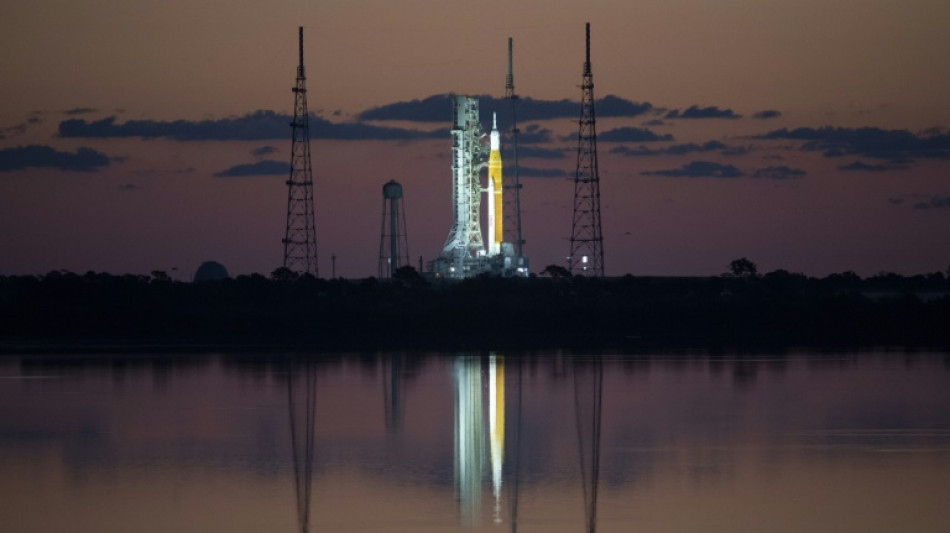
After failed tests, NASA's Moon rocket heads back to workshop / Photo: Joel KOWSKY - NASA/AFP/File

 Wildfires push endangered Sumatran elephants to brink: Indonesian NGO

 Bank of Japan set to raise rates under pressure from inflation, US

 EU chief to unveil social media, gaming curbs for under-15s

 'Resident Evil' film brings video game's ethos to the big screen

 i-payout Expands U.S. Money Transmitter Licensing Footprint and Advances European EMI Strategy

 US Senate crypto bill collapses amid partisan deadlock

 OpenAI, Anthropic and Google are working to create an AI standards body

 Protesting shepherds, farmers clash with Romanian police

 Foundation Lets Ledger Users Switch to Open Source Without Starting Over

 EU to propose curbing social media, online games for under 15s

 FX Junction Reaches 40,600 Members and 26 Million Trades

 'We unleashed the beast': the world's fears and hopes about AI

 Hospitality leaders ask Burnham to halve VAT amid rising costs

 Worcestershire invited to nominate groups for 2027 King’s volunteer award

 Berlin's run-down public spaces at heart of election campaign

 'Widow's Bay' and 'The Pitt' win big at Emmy Awards

 Most markets drop as oil extends gains ahead of expected US rate hike

 Sri Lanka's famed beach shack battles demolition

 Vserv targets ₹1,000 crore revenue by 2030 through AI expansion

 India prohibits bank fees on UPI payments up to ₹2,000

 Brazil's Amazon defender Raoni has cancer

 Trump rejects AI slowdown concerns as UN urges coordinated controls

 Higher wages draw migrant workers to Kashmir despite attacks

 Oil supply concerns and AI warnings weigh on global markets

 'I am the hoax buster': Trump rejects AI danger warnings

NASA's Space Launch System rocket is heading back to its assembly building for repairs next week, pushing the earliest possible launch date for its uncrewed test flight to the Moon to later this summer, officials said Monday.
Since April 1 the space agency has been unsuccessfully attempting a key "wet dress rehearsal" test, so dubbed because it involves loading liquid propellant.
The procedure is meant as a run-through of launch operations, including a final countdown to within ten seconds before blast off, but without actually firing the engines.
But NASA teams have encountered several technical hitches.
These included a leak involving flammable liquid hydrogen, a faulty valve that prevented fueling of the upper stage and running low on supply of nitrogen that is used to purge oxygen from the rocket prior to tanking operations, for safety reasons.
The rocket, which is 322 feet (98 meters) tall with the Orion crew capsule fixed on top, will begin its slow journey back from Kennedy Space Center's Launch Complex 39B to the vehicle assembly building on April 26, where it will be repaired.
Asked what this might mean for the earliest opportunity to launch the Artemis-1 test flight to the Moon and back, senior official Tom Whitmeyer said: "I think the early June window would be challenging."
NASA had previously envisaged a test flight as early as May.
There are subsequent launch windows in July and in August. These depend on factors like the relative positions of the Earth and Moon, as well as how long the rocket will have to fly in an eclipse, since it requires the Sun to keep it powered and thermally regulated.
A delay in Artemis-1 will have a cascading effect on subsequent missions -- Artemis-2, the first uncrewed test flight around the Moon, and Artemis-3, which will see the first woman and first person of color touch down on the lunar south pole.
NASA wants to build a permanent presence on the Moon and use it as a proving ground for technologies necessary for a Mars mission envisioned for sometime in the 2030s.
H.Meyer--CPN