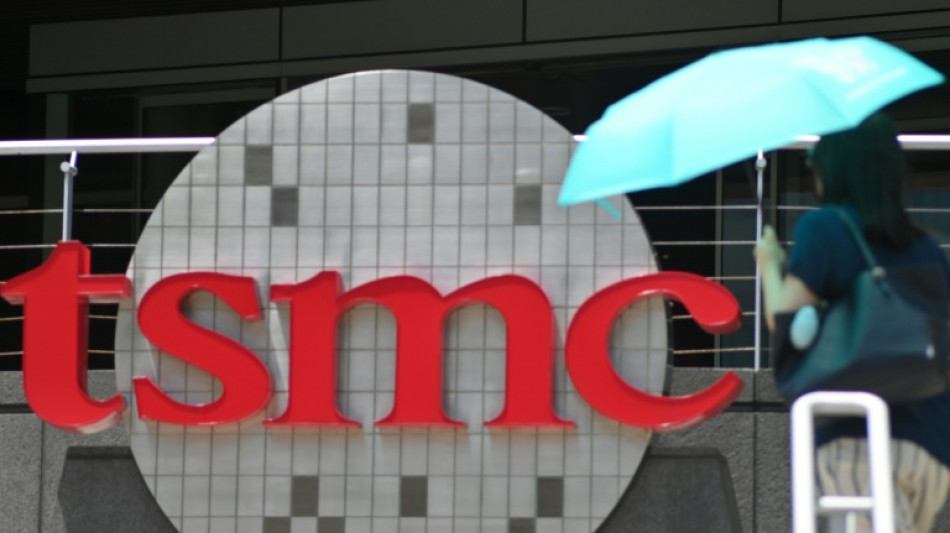
Chip giant TSMC's April revenue jumps 60% on-year / Photo: Sam Yeh - AFP/File

 Cuba hit with seventh major blackout of the year

 Nigeria miners struggled to breathe in cell before 37 died: survivors

 Warren Buffett steps down as Berkshire Hathaway chairman

 Isolated Syrian-Druze city blames Damascus for shortages

 Kerry James Marshall: American 'blackness' painter celebrated in Europe

 Infantino 'must go', says German FA vice-president

 Japan's busiest rail station tests robot bins

 Backpackers fret over Australian visa crackdown

 Bank of Japan hikes rates to 31-year high to battle inflation

 AI doomsday warnings unlikely to slow IPOs but questions linger

 In Brazil's Amazon, the hunt for oil fuels hopes and fears

 Baby orangutans in India expose 'frightening' scale of trafficking

 Oversight Board blasts 'inadequate' Meta safeguards for AI deepfakes

 Harry makes first public appearance since return to UK

 Princess Diana's brother makes new explosive claims against Charles

 Trump admin overhauls key protection for endangered species

 Mbappe draws political fire over Ceuta t-shirt controversy

 Third malaria death in Germany from outbreak tied to Frankfurt airport

 AtlasClear Holdings Reports Preliminary Fiscal 2026 Revenue of Approximately $20.1 Million, Up 85%; Revenue Plus Interest Income of Approximately $21.9 Million

 'Another arrow to the quiver': World Bank posts record private capital mobilization

 Ireland to boycott Eurovision 2027 over Gaza

 India's Tata Sons reappoints N. Chandrasekaran as chairman

 Germany urges EU action against China to defend carmakers

 Japan eyes changing prostitution law to punish sex buyers

 Modi pitches India as global chipmaking hub

Taiwanese chip giant TSMC's April revenue jumped nearly 60 percent on-year, the firm said Friday, riding a huge wave of demand for the advanced semiconductors used in AI hardware.
The Taiwan Semiconductor Manufacturing Company controls more than half the world's output of chips, and supplies them for everything from Apple's iPhones to Nvidia's cutting-edge artificial intelligence hardware.
Consolidated revenues for April were "approximately NT$236.02 billion ($7.2 billion)... an increase of 59.6 percent from April 2023", TSMC said in a statement.
This compares with a 34.3 percent on-year jump in March 2024.
The company said last month that first-quarter revenues had increased by 13 percent on-year to $18.87 billion, and expects a 27.6 percent rise in the second.
The wild success of OpenAI's ChatGPT has sparked an AI gold rush, with demand surging around the world for the cutting-edge chips needed to train and run AI services.
TSMC dominates the global chip industry, and the bulk of its fabrication plants are based in Taiwan, a self-ruled island that is claimed by neighbouring China.
The semiconductor supply chain is highly vulnerable to shocks, and concerned governments have lobbied TSMC to move more production away from Taiwan.
TSMC announced plans in April for a third factory in the United States.
Its US projects have faced obstacles in the past year, which the company had attributed to a lack of human resources, as making chips requires highly specialised skills.
But if successful, the TSMC fabs in Arizona would be the "first time" that super-advanced chips will be made on American soil, according to US Commerce Secretary Gina Raimondo.
This year, TSMC also launched a new $8.6 billion plant in the southern Japanese island of Kyushu -- a coup for Japan as it vies with the United States and Europe to woo semiconductor firms with huge subsidies.
It is also planning another Japan facility in Kumamoto for more advanced chips.
On top of geopolitical worries, natural disasters are a threat too.
A major earthquake last month in Taiwan also saw a flurry of emails sent out by TSMC to assure customers that there was minimal impact on its production lines.
D.Philippon--CPN