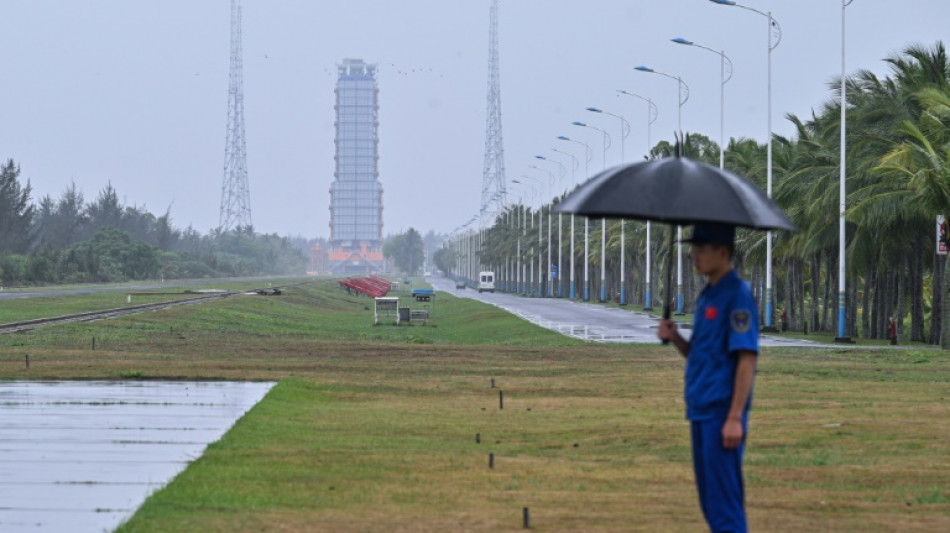
China to launch first probe to return samples from Moon's far side / Photo: Hector RETAMAL - AFP

 Cuba hit with seventh major blackout of the year

 Nigeria miners struggled to breathe in cell before 37 died: survivors

 Warren Buffett steps down as Berkshire Hathaway chairman

 Isolated Syrian-Druze city blames Damascus for shortages

 Kerry James Marshall: American 'blackness' painter celebrated in Europe

 Infantino 'must go', says German FA vice-president

 Japan's busiest rail station tests robot bins

 Backpackers fret over Australian visa crackdown

 Bank of Japan hikes rates to 31-year high to battle inflation

 AI doomsday warnings unlikely to slow IPOs but questions linger

 In Brazil's Amazon, the hunt for oil fuels hopes and fears

 Baby orangutans in India expose 'frightening' scale of trafficking

 Oversight Board blasts 'inadequate' Meta safeguards for AI deepfakes

 Harry makes first public appearance since return to UK

 Princess Diana's brother makes new explosive claims against Charles

 Trump admin overhauls key protection for endangered species

 Mbappe draws political fire over Ceuta t-shirt controversy

 Third malaria death in Germany from outbreak tied to Frankfurt airport

 AtlasClear Holdings Reports Preliminary Fiscal 2026 Revenue of Approximately $20.1 Million, Up 85%; Revenue Plus Interest Income of Approximately $21.9 Million

 'Another arrow to the quiver': World Bank posts record private capital mobilization

 Ireland to boycott Eurovision 2027 over Gaza

 India's Tata Sons reappoints N. Chandrasekaran as chairman

 Germany urges EU action against China to defend carmakers

 Japan eyes changing prostitution law to punish sex buyers

 Modi pitches India as global chipmaking hub

China is set Friday to launch a probe to collect samples from the far side of the Moon, a world first as Beijing pushes ahead with an ambitious programme that aims to send a crewed lunar mission by 2030.
A rocket carrying the Chang'e-6 lunar probe is scheduled to blast off from the Wenchang Space Launch Center in southern China's Hainan province just before 5:30 pm (0930 GMT), officials have said.
It is the latest leap for China's ambitious space programme, which Washington has warned is being used to mask military objectives and an effort to establish extraterrestrial dominance.
The Chang'e-6 aims to collect around two kilograms of lunar samples from the far side of the Moon and bring them back to Earth for analysis.
It is a technically complex 53-day mission that will also see it attempt an unprecedented launch from the side of the Moon that always faces away from Earth.
"Chang'e-6 will collect samples from the far side of the Moon for the first time," Ge Ping, vice director of China's Lunar Exploration and Space Engineering Center, told journalists.
The probe is set to land in the immense South Pole-Aitken Basin, one of the largest known impact craters in the solar system.
Once there, it will scoop up lunar soil and rocks, and carry out other experiments in the landing zone.
It must then lift off from the Moon's surface and retrace its steps back home.
- Space dream -
Plans for China's "space dream" have been put into overdrive under President Xi Jinping.
Beijing has ploughed huge resources into its space programme over the last decade, targeting a string of ambitious undertakings in an effort to close the gap with the two traditional space powers -- the United States and Russia.
The country has notched several notable achievements, including building a space station called Tiangong, or "heavenly palace", to which it sent a fresh crew of three astronauts last month.
Beijing has landed robotic rovers on Mars and the Moon, and made China only the third country to independently put humans in orbit.
China aims to send a crewed mission to the Moon by 2030, and plans to build a base on the lunar surface.
The United States is also planning to put astronauts back on the Moon by 2026 with its Artemis 3 mission.
The rapid advance of China's space programme has raised alarm bells in Washington, with the head of NASA warning last month that the US was now in a "race" against Beijing.
"We believe that a lot of their so-called civilian space program is a military program," NASA administrator Bill Nelson told lawmakers on Capitol Hill.
- Dark side of the Moon -
Chang'e-6 is the first of three high-wire uncrewed missions to the Moon planned by China this decade.
Its successor, Chang'e-7, will scour the lunar south pole for water, while Chang'e-8 will attempt to establish the technical feasibility of building a planned base, known as the International Lunar Research Station, with Beijing saying a "basic model" will be completed by 2030.
Scientists say the Moon's dark side -- so-called because it is invisible from Earth, not because it never catches the sun's rays -- holds great promise for research as its craters are less covered by ancient lava flows than the near side.
That might mean it is more possible to collect material that sheds light on how the Moon formed in the first place.
"The samples collected by Chang'e-6 will have a geological age of approximately 4 billion years," Ge said.
"Collecting lunar samples from different regions and geological ages, and conducting experiments is of great value and significance for humanity."
Y.Jeong--CPN