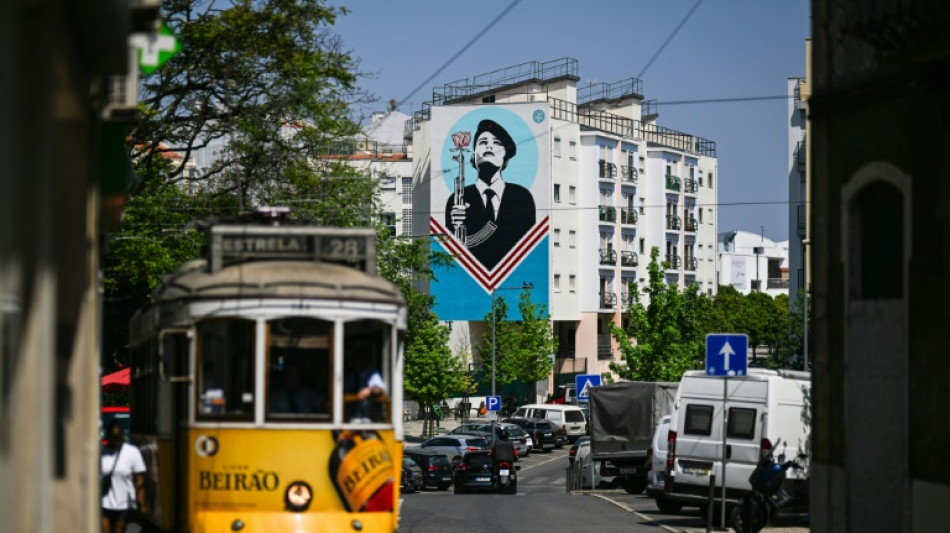
Portugal marks 50 years of democracy with far right on rise / Photo: PATRICIA DE MELO MOREIRA - AFP

 Cuba hit with seventh major blackout of the year

 Nigeria miners struggled to breathe in cell before 37 died: survivors

 Warren Buffett steps down as Berkshire Hathaway chairman

 Isolated Syrian-Druze city blames Damascus for shortages

 Kerry James Marshall: American 'blackness' painter celebrated in Europe

 Infantino 'must go', says German FA vice-president

 Japan's busiest rail station tests robot bins

 Backpackers fret over Australian visa crackdown

 Bank of Japan hikes rates to 31-year high to battle inflation

 AI doomsday warnings unlikely to slow IPOs but questions linger

 In Brazil's Amazon, the hunt for oil fuels hopes and fears

 Baby orangutans in India expose 'frightening' scale of trafficking

 Oversight Board blasts 'inadequate' Meta safeguards for AI deepfakes

 Harry makes first public appearance since return to UK

 Princess Diana's brother makes new explosive claims against Charles

 Trump admin overhauls key protection for endangered species

 Mbappe draws political fire over Ceuta t-shirt controversy

 Third malaria death in Germany from outbreak tied to Frankfurt airport

 AtlasClear Holdings Reports Preliminary Fiscal 2026 Revenue of Approximately $20.1 Million, Up 85%; Revenue Plus Interest Income of Approximately $21.9 Million

 'Another arrow to the quiver': World Bank posts record private capital mobilization

 Ireland to boycott Eurovision 2027 over Gaza

 India's Tata Sons reappoints N. Chandrasekaran as chairman

 Germany urges EU action against China to defend carmakers

 Japan eyes changing prostitution law to punish sex buyers

 Modi pitches India as global chipmaking hub

Portugal marks Thursday 50 years since a military coup ended a decades-long dictatorship and 13 years of colonial wars in Africa, an anniversary that comes as a far-right party gains prominence.
The anniversary of the Carnation Revolution -- named after the flowers protesters placed in soldiers' guns during the peaceful uprising -- comes a month after the far-right party Chega more than quadrupled its seats in parliament, cementing its position as Portugal's third-largest party.
The highlight of the celebrations will be a military parade through central Lisbon featuring some of the roughly 5,000 soldiers who were part of the putsch, as well as around 15 restored military vehicles used on the day.
On April 25, 1974, the oldest authoritarian regime in Western Europe at the time fell within a matter of hours, virtually without bloodshed, thanks to an uprising by non-commissioned officers that was immediately backed by the public.
The coup paved the way for the country's first free elections based on universal suffrage on April 25, 1975, as well as the independence of Portugal's remaining African colonies: Angola, Mozambique, Guinea-Bissau and Cape Verde.
"The main motivation was to resolve the problem of the colonial wars" that had been going on for 13 years in Angola, and almost as long in Mozambique and Guinea-Bissau, said retired colonel Vasco Lourenco.
Lourenco, one of the officers who took part in the coup, now heads the April 25 Association that represents putschist soldiers.
As a young officer, he said it took almost a year to put together the "conspiracy" to carry out "a coup d'etat aimed at opening the way to freedom, putting an end to the wars and building democracy in Portugal", he told AFP.
As it does every year, parliament will hold a special commemorative session and there will be a parade. And this year the heads of African states that were once Portuguese colonies will join the celebrations.
- 'Poor, backward, illiterate' -
Portugal's dictatorship years began in 1926, consolidated under prime minister Antonio de Oliveira Salazar and continued from 1968 by his successor Marcelo Caetano.
Many Portuguese believed the country's authoritarian past would offer it some protection from the rise of the far right, which has been seen elsewhere in Europe, but the breakthrough by Chega in a general election last month has dampened this view.
While its founder and leader Andre Ventura has criticised the dictatorship years, Chega ("Enough") has used the slogan "God, Homeland, Family, Work" -- an echo of the Salazar dictatorship's "God, Homeland, Family".
Set up in 2019, Chega promises greater law and order, tougher immigration measures and chemical castration for paedophiles.
It is the first hard-right party to gain ground on Portugal's political scene since the end of the dictatorship.
"I thought that 48 years of dictatorship would have made the country immune to this wave of populism and radical far-right movements, but the reality turned out to be different," said Maria Inacia Rezola, a historian who is overseeing the anniversary celebrations.
During the dictatorship Portugal remained "a poor, backward, illiterate country isolated from the rest of the world", Rezola said.
Despite the fact that the Carnation Revolution still appears widely appreciated, a sizable part of the population express a certain nostalgia for the previous regime.
A survey published last week found that half of respondents said the former regime had more negative aspects than positive -- but a fifth said the opposite.
U.Ndiaye--CPN